Lesson 2: Classifying Chemical Reactions
Part c: Single Replacement Reactions
Part a:
Decomposition and Synthesis Reactions
Part b:
Combustion Reactions
Part c: Single Replacement Reactions
Part d:
Double Replacement Reactions
Part e:
Predicting Products
The Big Idea
In this lesson, you’ll uncover how a single element can another in a compound—known as a single replacement(or displacement) reaction. The general pattern is A + BC → AC + B. You’ll delve into metal and halogen reactivity series to predict outcomes and explore vivid examples like copper displacing silver (Cu + AgNO₃ → Ag + Cu(NO₃)₂) and sodium reacting with water (Na + H₂O → NaOH + H₂).
Reaction Types and Predicting Products
Lesson 2 began with a discussion of reaction types. The emphasis was on using a knowledge of reaction types to predict the products of a reaction. Five reaction types were identified. Synthesis (a.k.a., combination) and decomposition reactions were discussed in Lesson 2a and combustion reactions were discussed in Lesson 2b. Several examples were used to demonstrate how a knowledge of these types of reactions could be used to predict products and construct balanced chemical equations. In Lesson 2c, we will discuss a fourth reaction type category - single replacement reactions.
What is a Single Replacement Reaction?
A single replacement reaction is a reaction in which one element replaces another element in a compound. This type of reaction is also referred to as a single displacement reaction. The generic form of a single replacement reaction is
A + BC → B + AC
In this reaction the element A replaces the element B in the compound BC. The element A starts as a free element and finishes as the positive ion of an ionic compound. The element B starts as the positive ion in an ionic compound and finishes as a free element. Element A has replaced element B.
 Cation Replacement
Single replacement reactions commonly occur when the solid metal (A) is placed in an aqueous solution of the ionic compound (BC). You can expect that a metal will replace another metallic ion in the solution. The metallic element A becomes an ion, and the metallic ion B becomes a solid.
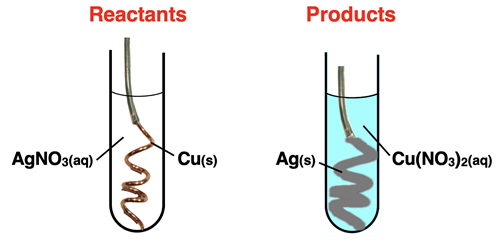
Suppose that a copper wire is immersed in an aqueous solution of silver(I) nitrate. The copper replaces the silver ions. Put another way, the copper and the silver trade places. The balanced chemical equation for the reaction is …
Cu(s) + 2 AgNO3(aq) → 2 Ag(s) + Cu(NO3)2(aq)
A + BC → B + AC
When this reaction is performed in the lab, a solid copper wire is typically shaped into a coil. It is then placed in a colorless solution of AgNO3. Over the course of time, grey flakes of silver metal can be observed forming on the surface of the copper wire. The solution gradually turns a blue color, indicated the presence of Cu(NO3)2. The formation of a solid and a color change are observed as evidence of a chemical reaction.
As a second example of a single replacement reaction, consider the reaction of sodium metal in water. The balanced chemical equation is …
2 Na(s) + 2 H2O(l) → H2(g) + 2 NaOH(aq)
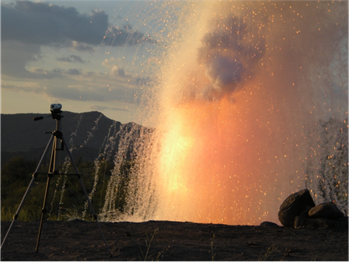 The water reactant can be thought of as H•OH. The element Na replaces the element H of H•OH. Put another way, Na and H trade places. When this reaction is observed in a lab (with CAUTION … and with a small amount of Na), bubbles are formed and a large amount of heat (and even flames) can be observed. This is evidence of a chemical reaction.
The reaction of sodium with water is very dangerous. Reaction of large quantities of sodium can generate explosive amounts of heat, ultimately expelling reactive sodium into the air and onto innocent bystanders. The safest means of observing the reaction is by watching a YouTube video, thus placing time, distance, and a screen between you and the reaction.
Image Source
Reactivity Series
Not every metallic element will replace a metal ion in a dissolved compound. Metals are ordered according to their degree of reactivity. Only a more reactive metal will replace a metal ion in a compound. The chart below is known as a Metal Reactivity Series.
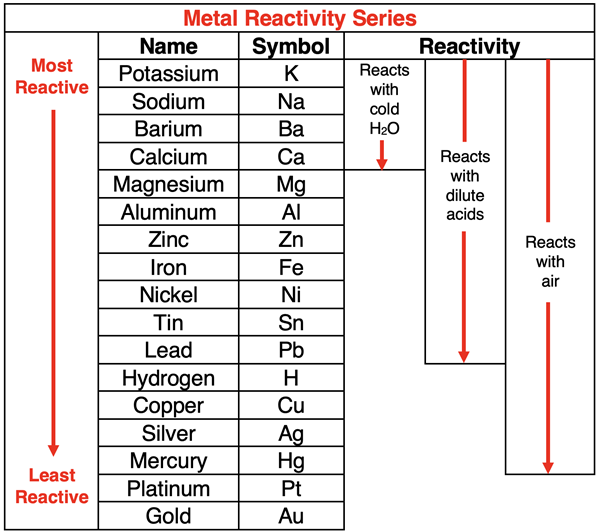
Metal elements higher on the chart will react with ionic compounds containing metal ions located lower on the chart. So, zinc (Zn) would replace silver ions (Ag+) in AgNO3(aq). However, silver would not replace zinc ions in Zn(NO3)2(aq).

An understanding of the metal reactivity series will assist in predicting whether a single replacement reaction will take place.
Anion Replacement
Metals are not the only elements that can participate in single replacement reactions Nonmetal halogens are also observed to react with ionic compounds containing a less reactive halogen. Just as metals replace metals, you can expect a halogen to replace another halogen. As an example, bromine will react with an aqueous solution of sodium iodide. The balanced chemical equation is …
Br2(aq) + 2 NaI(aq) → I2(aq) + 2 NaBr(aq)
 NOTE: in their elemental state, both bromine and iodine are diatomic elements (HONClBrIF).
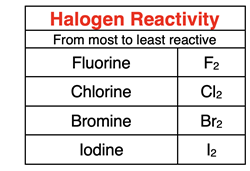
Predicting whether a reaction occurs requires that attention be given to the relative reactivity of the two halogens. The chart at the right is the reactivity series for halogens. Elements highest on the chart are the most reactive. So, while bromine can replace iodine as shown by the above equation, iodine is not reactive enough to replace bromine.
I2(aq) + NaBr(aq) → No Reaction
How to Predict Products and Write Balanced Equations
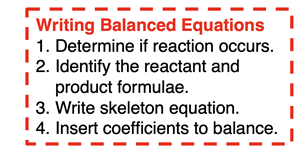 A common task required in introductory Chemistry courses is to write balanced chemical equations for single replacement reactions. The first step is to use a reactivity series to decide if a reaction actually takes place. An element higher on the chart will react with an ion located lower on the chart. The second step is to identify the reactant and product formulae. If the reactant element is a metal, then it replaces the cation in the ionic compound. (Cations are listed first in the formulae of ionic compounds.) If the reactant element is a nonmetal, then it will replace the anion of the ionic compound. The third step involves writing a skeleton equation for the single replacement reaction. The fourth step involves adding coefficients to balance the chemical equation.
We have provided four examples below to demonstrate the use of the above method and logic. Take time to try them yourself. Tap the Check Answer button to view the answer and complete solution.
Example 1 - Writing a Balanced Equation for a Single Replacement Reaction
Aluminum metal is added to a solution of tin(IV) chloride. Write the balanced chemical equation for the reaction.
Check Answer
Aluminum is higher on the metal activity chart than tin. So, the aluminum will replace the tin. The reactant formulae are Al(s) and SnCl
4(aq). Al and Sn trade places. So, the product formulae are Sn(s) and AlCl
3(aq). The formulae for these ionic compounds were determined using
formula writing rules from
Chapter 4 of this
Chemistry Tutorial. The skeleton equation can be written:
Skeleton Equation: Al(s) + SnCl
4(aq)
→ Sn(s) + AlCl
3(aq)
The method of writing balanced chemical equations can now be used to balance the skeleton equation. Refer to our
thoroughly written Tutorial page for help with balancing equations.
Balanced Equation:
4 Al(s) + 3 SnCl4(aq) → 3 Sn(s) + 4 AlCl3(aq)
Example 2 - Writing a Balanced Equation for a Single Replacement Reaction
Chlorine gas is bubbled into an aqueous solution of sodium iodide. Write the balanced chemical equation for the reaction.
Check Answer
Chlorine is higher on the halogen activity chart than iodine. So, the chlorine will replace the iodide. The reactant formulae are Cl
2(aq) and NaI(aq). The Cl
2 could be written as either gas or aqueous state. We wrote aqueous state since the gas will dissolve before it reacts. Cl and I trade places. So, the product formulae are I
2(aq) and NaCl(aq). In both cases, halogens are diatomic molecules (HON
ClBr
IF). The skeleton equation can be written:
Skeleton Equation: Cl
2(aq) + NaI(aq)
→ I
2(aq) + NaCl(aq)
The method of writing balanced chemical equations can now be used to balance the skeleton equation. Refer to our
thoroughly written Tutorial page for help with balancing equations.
Balanced Equation:
Cl2(aq) + 2 NaI(aq) → I2(aq) + 2 NaCl(aq)
Example 3 - Writing a Balanced Equation for a Single Replacement Reaction
Calcium metal is added to a beaker of water. Write the balanced chemical equation for the reaction of calcium and water.
Check Answer
This reaction is similar to the example given above of Na reacting with water. The Ca will react with water and replace the H atom on H•OH. The reactant formulae are Ca(s) and H
2O(l). The product formulae are H
2(g) and Ca(OH)
2(aq). Hydrogen is a diatomic molecule (
HONClBrIF). The formula for Ca(OH)
2 was determined using
formula writing rules from
Chapter 4 of this
Chemistry Tutorial. The skeleton equation can be written:
Skeleton Equation: Ca(s) + H
2O(l)
→ H
2(aq) + Ca(OH)
2(aq)
The method of writing balanced chemical equations can now be used to balance the skeleton equation. Refer to our
thoroughly written Tutorial page for help with balancing equations.
Balanced Equation:
Ca(s) + 2 H2O(l) → H2(aq) + Ca(OH)2(aq)
Example 4 - Writing a Balanced Equation for a Single Replacement Reaction
Copper metal is added to an aqueous solution of iron(II) nitrate. Write the balanced chemical equation for the reaction.
Check Answer
Copper metal is lower on the metal reactivity chart than iron. Thus, the copper is unable to replace the iron. There is no reaction (NR).
Cu(s) + Fe(NO3)2(aq) → NR
Before You Leave - Practice and Reinforcement
Now that you've done the reading, take some time to strengthen your understanding and to put the ideas into practice. Here's some suggestions.
- Once you have some comfort with Lessons 2a through 2d, try our Chemical Reaction Type Concept Builder. It will provide awesome practice on all five reaction types.
- Download our Study Card on Types of Reactions. (It covers Lessons 2a, 2b, 2c, and some of Lesson 2d.) Save it to a safe location and use it as a review tool.
- The Check Your Understanding section below includes questions with answers and explanations. It provides a great chance to self-assess your understanding.
Check Your Understanding of Single Replacement Reactions
Use the following questions to pratice the skill of recognizing products and writing balanced chemical equations for single replacement reactions. Tap the Check Answer buttons when ready.
1. REVIEW: How can you distinguish between the cation and the anion in an ionic formula?
View Answer
Ionic compounds consist of two ions - a positive ion (cation) and a negative ion (anion). The positive ion is always listed first. The negative ion is always listed second. If there are only two elements in the formula (i.e., a binary ionic compound), then the first element would be the catiion and the second one would be the anion. If there are three or more elements in the formula, then there is at least one polyatomic ion. Use a
polyatomic ion list to recognize it. The other ion is the remaining element that was not part of the polyatomic ion.
2. When writing a chemical equation for a single replacement reaction, you must be able to write the formula for an ionic compound. Explain the rules or procedure for doing this.
View Answer
First identify the ion formulae. You probably have a name of the ionic compound. The first word of the name is the positive ion. Look it up on the PT to determine its charge. If it is a transition metal, then the Roman numeral in the name is its charge. The second word is the negative ion. If it ends -ide, then it is a monatomic anion and you can look up the element on the PT to determine its charge. If the second name does not end in -ide, then the anion is a polyatomic ion. Look up the formula (with the charge) on a
polyatomic ion list.
Once you know the formula for the two ions, determine the ion ratios. These ratios are the subscripts in the formula of the ionic compound formula. Write the element symbol folllowed by the subscript, with cation first and then the anion. If either ion is a polyatomic ion and there is a subscript (other then one), then enclose the polyatomic formula in parenthesis with the subscript listed behind the close parenthesis.
Writing formulas is a pretty big deal in Chemistry. It just isn't
going away. If you're still having troubles, then do yourself a favor. We have lots of detailed directions, examples to learn by, and practice questions to improve your skill. Visit our
Chapter 4 and get the help you need.
3. Can a metal ever replace a nonmetal in a single replacement reaction?
View Answer
Answer: Nope. It's news to us if it can.
Metals replace metals. Nonmetals replace nonmetals. Count on it.
4. The following equations list the reactants only. In which cases could the reaction be a single replacement reaction? Select all that apply.
Reaction A: N
2(g) + H
2(g)
→
Reaction B: Al(s) + CuCl
2(aq)
→
Reaction C: NH
4NO
3(s)
→
Reaction D: CH
4(g) + O
2(g)
→
Reaction E: F
2(aq) + CuI
2(aq)
→
View Answer
Answer: B and E
You're looking for a free element (by itself) and an ionic compound. You get that with reaction B and E.
Reaction A looks like synthesis, C looks like decomposition, and D looks like combustion.
5. For each of the following, identify if a reaction occurs. For each that does occur, identify product formulae, write the skeleton equation, and insert coefficients to balance the chemical equation.
- Al(s) + CuI2(aq) →
View Answer
Answer: An SR reaction occurs
Product formulae are Cu(s) and AlI3(aq)
Skeleton Equation: Al(s) + CuI2(aq) → Cu(s) + AlI3(aq)
Balanced Chemical Equation: 2 Al(s) + 3 CuI2(aq) → 3 Cu(s) + 2 AlI3(aq)
- F2(aq) + CuBr2(aq) →
View Answer
Answer: Yes. An SR reaction occurs
Product Formulae: Br2(aq) and CuF2(aq)
Skeleton Equation: F2(aq) + CuBr2(aq) → Br2(aq) + CuF2(aq)
Balanced Chemical Equation: F2(aq) + CuBr2(aq) → Br2(aq) + CuF2(aq)
(balanced as is)
- Pb(s) + ZnCl2(aq) →
View Answer
Answer: Nope. No Reaction.
Lead (Pb) is lower on the metal reactivity chart than zinc (Zn). A less reactive metal will not replace a more reactive metal.
- Mg(s) + PbCl2(aq) →
View Answer
Answer: An SR reaction occurs
Product formulae are Pb(s) and MgCl2(aq)
Skeleton Equation: Mg(s) + PbCl2(aq) → Pb(s) + MgCl2(aq)
Balanced Chemical Equation: Mg(s) + PbCl2(aq) → Pb(s) + MgCl2(aq)
(balanced as is)
- Sn(s) + CaCl2(aq) →
View Answer
Answer: Nope. No Reaction.
Tin (Sn) is lower on the metal reactivity chart than calcium (Ca). A less reactive metal will not replace a more reactive metal.
- Br2(aq) + NaCl(aq) →
View Answer
Answer: No Reaction
Bromine is less reactive than chlorine.