Lesson 3: Elements and Compounds
Part a: The Periodic Table of Elements
Part 3a: The Periodic Table of Elements
Part 3b: Words, Symbols, and Particle Diagrams
The Big Idea
Explore how the Periodic Table organizes elements by increasing atomic number and reveals repeating patterns in properties - grouping metals, nonmetals, and metalloids into families like alkali metals, halogens, and noble gases, thus allowing for for predictive insight into chemical behavior.
What is an Element? What is a Compound?
It is an accepted belief that atoms are the building blocks of matter. There are (as of this writing) 118 different types of atoms, each differing from each other by their physical and chemical properties and some structural traits that will be discussed in the next chapter. These different types of atoms are referred to as elements. Examples of familiar elements include hydrogen (H), carbon (C), oxygen (O), nitrogen (N), sodium (Na), and chlorine (Cl). The letters in parenthesis are the elemental symbols associated with each of these elements.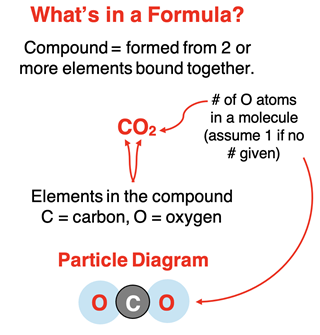
Atoms of different elements can combine with one another to produce compounds. Compounds you may be familiar with include dihydrogen monoxide (H2O, also known as water), carbon dioxide (CO2), sodium chloride (NaCl), and carbon monoxide (CO). The symbols in parenthesis are the chemical formulae of the compounds. Note that the chemical formula for each of these compounds includes two elemental symbols. This makes sense because a compound is composed of two or more different elements. The subscripted numbers indicate the number of atoms of each element in a single unit of the compound. The simplest unit is referred to as a molecule. There are two atoms of hydrogen and one atom of oxygen in a water molecule.
How to Read the Periodic Table of Elements
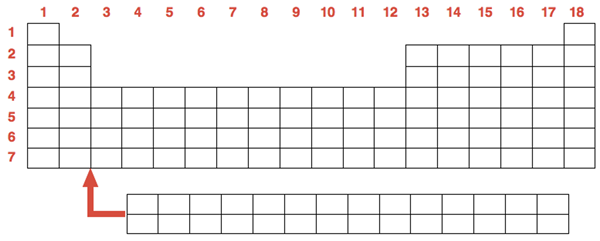
The Periodic Table may be the all-time greatest infographic. Information about each of the 118 elements is contained within the seven rows and 18 columns of the periodic table.
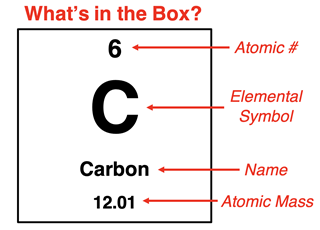 Each box or cell of the periodic table represents an element. Each element is represented by an elemental symbol consisting of 1 or 2 letters. The first letter is always capitalized. The second letter (if applicable) is lower case. Most elemental symbols are relatively intuitive – H for hydrogen, He for helium, C for carbon, S for sulfur, etc. The symbols for some elements have their roots in Latin words and are less intuitive. These include iron (Fe for ferrum, meaning sword), lead (Pb for plumbum, indicating one of its earliest uses in plumbing), gold (Au for aurum, meaning shine), and mercury (Hg for hydragyrum, which means liquid silver)
Every element has a whole number (an integer) associated with it. This number is known as the atomic number. The elements of the table are ordered by their atomic number. This number increases by 1 as you progress from element to element across the table. We will discuss the significance of the atomic number in greater detail in Chapter 3 of the Chemistry Tutorial. Each cell of the periodic table also lists the atomic mass of each element. This is the relative mass of an atom of each element. This will be of great importance in later chapters of the Chemistry Tutorial.
Periodic Table Organization of Groups, Periods, and Families
The unusual shape of the Periodic Table emerged from the observation that there were repeating patterns in the properties of elements. For instance, the size of the atoms of each element decreases as one proceeds across each row. And elements with similar properties (for instance the property of being inert or non-reactive) were placed in the same columns. The rows of the periodic table are referred to as periods. Each period is numbered; there are seven of them. The columns of the periodic table are referred to as groups. Each group is numbered from 1 to 18. There are 10 groups – groups 3-12 – which consist entirely of metals. These are referred to as Transition Metals. There are two rows of 14 elements each that are “pull-outs” from the table The top row of elements are called Lanthanides (atomic #57-#70). The bottom of these two rows are called Actinides (atomic #89-#102).
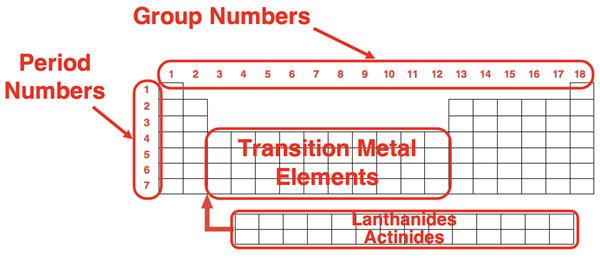
Because elements within the same group share similar physical and chemical properties, they are referred to as families. There are four notable families whose names you should commit to memory. Those families are:
- Alkali Metals (Group 1)
- Alkaline Earth Metals (Group 2)
- Halogens (Group 17)
- Noble Gases (Group 18)
Elements as Metals, Nonmetals, and Metalloids
In Lesson 2, we mentioned that elements can be identified by their unique
chemical and physical properties. Based on those properties, we can divide the 118 elements into two broad groups – metals and nonmetals. There are 6-8 elements (depending on the source) that share the properties of both metals and nonmetals. These elements are referred to as metalloids. The dividing line separating the metals from the nonmetals zigzags through the table as shown. There are six elements along the line that are considered to be metalloids by most sources. Their symbols are shown in red. Polonium (Po) and astatine (At) are the two elements for which there is the most disagreement regarding their classification as metalloids. Their symbols are shown in grey.
Some of the most common properties of metals and nonmetals are shown in the table below. While there are metal and nonmetal elements that display exceptions to some of these properties, the listing is generally fitting of metallic and nonmetallic elements.
Elements as Solids, Liquids, and Gases
Many periodic tables include some form of color-coding to indicate the state – solid, liquid, or gas – in which the elements naturally exist. Consistent with the property that metals have relatively high melting points, most metals are solids at room temperature. The exception is mercury (Hg) which is a liquid at room temperature. And at temperatures just above room temperature, gallium (Ga) will melt and form a liquid. Most nonmetals are gases. There are plenty exceptions to
the rule. For instance, you can find nonmetals that are solids (carbon, phosphorus, sulfur, selenium, iodine, and more) and liquids (bromine).
Elemental Forms
If you acquire a sample of pure copper, all the atoms in the sample will be copper atoms. And these copper atoms exist as single atom particles. If you acquire a sample of pure helium gas, all the atoms will be helium and the helium atoms will exist as single atom particles. We refer to copper and helium as being
monatomic – single atom. Most elements exist naturally as monatomic elements. But not all.
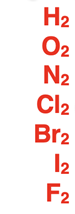
There are seven elements on the periodic table that exist naturally as diatomic elements. These elements, when found in nature by themselves, contain particles with two atoms of each element. We refer to these particles as
diatomic molecules. The seven elements are hydrogen, nitrogen, oxygen, fluorine, chlorine, bromine, and iodine. When a sample of oxygen is found as an isolated element in nature, it exists as two atoms of oxygen bound together to form the O
2 molecule. You can remember these seven elements if you remember the name of one of our favorite college Chemistry professors – Dr.
HONClBrIF.
Finally, there are a few other elements that exist in
polyatomic form in nature. The most notable of these is phosphorus and sulfur. Phosphorus is found in nature as P
4 and sulfur is found in nature as S
8.
 The Alphabet of Chemistry
The English language has 26 letters in its alphabet. These 26 letters can be combined together to form words. Different words are formed by varying the number of letters and the types of letters that we combine. It is estimated that anywhere between 600 000 and one million words can be formed from these 26 letters of the alphabet.
The elemental symbols of the periodic table are like the alphabet of Chemistry. These 118 symbols can be combined together to form chemical formulas for compounds. By varying which symbols (and elements) that you combine and how many atoms of each element you
combine, you can produce different chemical formulae for compounds. While not every combination is possible (and we will learn why in the next few units), the number of compounds that are currently known is in the millions.
In the
next part of Lesson 3, we will begin building a more thorough understanding of chemical formulae and relate that understanding to our growing vocabulary associated with matter – atoms, molecules, elements, and compounds.
Before You Leave - Practice and Reinforcement
Now that you've done the reading, take some time to strengthen your understanding and to put the ideas into practice. Here's some suggestions.
Check Your Understanding of the Periodic Table
Use the following questions to assess your understanding of the organization of elements in a Periodic Table. Tap the Check Answer buttons when ready.
1. How many …
- … transition metals are located in Group 4?
Check Answer
Answer: 4
A group is a column. There are four transition metals in column #4.
- … transition metals are located in Period 4?
Check Answer
Answer: 10
A period is a row. There are 10 transition metals in Period 4.
- … nonmetals are located in Period 3?
Check Answer
Answer: 4
Elements 15 - 18 are located in period 3; these are all nonmetals. The remaining elements of period 3 are either metalloids (Si) or metals.
- … metalloids are located in Group 14?
Check Answer
Answer: 2
Silicon (Si) and germanium (Ge) are the only metalloids in Group 14.
- …halogens have a mass greater than bromine?
Check Answer
Answer: 3
Halogens are in Group 17. The heaviest elements have the greater atomic numbers and are lower in the periodic table. Elements #53, 85, an 117 are heavier than bromine.
- … noble gases have atomic numbers less than 36?
Check Answer
Answer: 3
Noble gases are in group 18. There are three elements that have an atomic number less than 36. They are helium (He), neon (Ne), and argon (Ar).
- … transition metals have an atomic number greater than 74?
Check Answer
Answer: 16
Tengsten (W) has atomic number 74. It is in period 6. There are 6 more elements in period 6 with a greater atomic number and 10 more in period 7.
- … noble gases are in the same period as a transition metal?
Check Answer
Answer: 4
The noble gases in periods 4-7 are located in the same row as the transition metals.
2. What is/are the symbol(s) of …
- … the element in Period 4 of the halogen family?
Check Answer
Answer: Br
The halogens are in group 17. Find the halogen in the fourth period of that column.
- … the element in Period 3 of the alkaline earth metal family?
Check Answer
Answer: Mg
The alkaline earth metals are in group 2. Find the element in the third period of that column.
- … the element in Period 3, Group 4?
Check Answer
Answer: None
Period 3 is the row that starts with sodium (Na). There are no transition metals in this row. The first transition metal is located in period 4.
- … the element in Period 4, Group 3?
Check Answer
Answer: Sc
Group 3 is the third column. Period 4 is the fourth row. In the fourth row and the third column is the element scandium.
- … the element in Period 3, Group 17?
Check Answer
Answer: Cl
Period 3 is the the third row of the table. Group 17 is the next to last column that starts with fluorine (F) at the top. Chlorine is the element at this location.
- … the element in Period 6, Group 13?
Check Answer
Answer: Tl
Period 6 is the sixth row of the table (starts with Cs). Group 13 is the column that starts with boron (B) at the top. The element at this position is Thallium (Tl).
- … the element with an atomic number that is 4 greater than the Period 3 alkali metal?
Check Answer
Answer: P
The alkali metal family is Group 1 - the column starting with hydrogen (H) at the top. The period 3 alkali metal is sodium. Sodium has an atomic number of 11. The element that is 4 greater than 11 is the element with atomic number 15. That identifies phosphorus.
- … the elements that are noble gases and have a mass less than the first transition metal?
Check Answer
Answer: He, Ne, and Ar
The first transition metal is scandium (Sc); it is element #21. We are looking for elements with a mass less than scandium so there atomic number will also be less. AND we are looking for noble gases. Noble gasses are located in Group 18 (last column). There's three such elements - helium, neon, and argon.
- … the Period 4 metalloids?
Check Answer
Answer: Ge and As
Period 4 is the fourth row. There are two metalloids in that row. They have atomic numbers of 32 and 33. They are germanium (Ge) and arsenic (As).
- … all the nonmetal elements in Period 3?
Check Answer
Answer: P, S, Cl, and Ar
Period 3 is the third row of the table; it starts with sodium (Na) on the far left of the row. As you cross the row, the first three elements (up to aluminum, Al) are metals. Silicon (#14) is a metalloid. The remaining elements are nonmetals: #15 throuigh #18.
- … all the Period 6 gases?
Check Answer
Answer: Rn
Period 6 is the sixth row. Most elements in the row are solids. The exceptions are mercury (Hg) and radon (Rn). Mercury is a liquid and radon is a gas.
3. Ken Fused is pondering the concept of elements that are diatomic. He observes that carbon monoxide has a chemical formula of CO. Confused, he asks
Why shouldn’t there be a 2 after the O in the formula since oxygen is one of the diatomic elements?
Help straighten Ken’s thinking out by explaining what is meant by a diatomic element and why there doesn’t need to be a 2 in the compound’s formula.
Check Answer
The seven diatomic elements exist as two-atom molecules whenever they are by themselves as elements in nature. In saying "by themselves as elements", we mean not bonded to any other element to form a compound. If oxygen is bonded to carbon in a compound, then oxygen is not by itself as an element and the diatomic element rule does not apply. Does that help, Ken?