Pressure Differences in Fluids
One of the reasons we have a chapter devoted to fluids is that fluids (liquids and gases) behave differently from solids. Our study of physics in previous chapters has analyzed the motion of objects such as a ball, a car, a block, or a wheel. These are all solid objects. Not everything we encounter in everyday life, however, is a solid. We saw in Lesson 1 of this chapter that solids are depicted by an orderly arrangement of close-together particles occupying a fixed position. Unlike solids, fluids flow because their particles are not fixed in place. Because of this freedom, when a force is applied to a fluid, the particles rearrange. We call this rearrangement fluid flow. Understanding how fluids flow is the goal of this lesson.
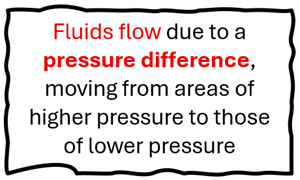
So what causes a fluid to flow? Fluids flow in response to a pressure difference, moving from areas of higher pressure to those of lower pressure. If you’ve ever watched a weather report, you’ve probably heard the meteorologist talk about high-pressure and low-pressure systems. Such a pressure difference can lead to windy days as air is moved from places of higher pressure to those of lower pressure. If you’ve ever stood in a river or the ocean, you also know about fluid flow. Currents constantly move water from one place to another due to a pressure difference.
Since pressure is defined as force per unit area, we might also say that it is an unbalanced force that pushes the fluid toward equilibrium. The way the meteorologist knows it’s going to be a windy day is because there is a big difference in air pressure between two regions. As a result, the air molecules are involved in more collisions from one direction than the other. This causes them to move toward the direction of the lower pressure.
There are several reasons why a pressure difference can arise in a fluid. Let’s consider five such reasons.
1: Gravity Creates Pressure Differences
We saw back in Lesson 2 that fluid pressure increases with depth. The water deep in the ocean is under much more pressure than that at the surface, as it has a significant weight of water above it. We saw that the same is true in our atmosphere. Air pressure at sea level is significantly higher than at several kilometers above sea level. The air at sea level has many kilometers of air above it to weigh it down.
2: Temperature Differences Create Pressure Differences
We also saw back in Lesson 2 that temperature is the measure of the average kinetic energy of molecules in a fluid. When the molecules are moving faster (that is, they have a lot of kinetic energy), they will collide more violently with other molecules. This is what causes the pressure in a tire to be higher on a hot day compared to a cold day. This is why warm air rises and also causes the wind to blow as it moves from an area of higher pressure to an area of lower pressure.
3: Density differences Create Pressure Differences
Even if the temperature is uniform, fluids that are next to each other can have different densities. Different salt content in different regions of the oceans, for example, results in different densities, which can drive ocean circulation and convection currents.
4: External Forces Directly Create Pressure Differences
A pump can push on one area of a fluid. This increases the collisions in that region, creating high pressure next to low pressure. This is what a water pump does as a municipality moves water to homes; similarly, this is what your heart does as it creates a pressure difference by pumping blood that circulates through your body.
5: Boundaries and Shape Changes Create Pressure Differences
We’ll learn later in this lesson that when a fluid speeds up through a narrow pipe or over an airplane wing, its pressure drops. This, too, creates a pressure difference. In general, whenever a fluid encounters a boundary or an obstacle in its path, it causes a change in pressure, which in turn leads to localized fluid motion.
In short, pressure differences in fluids can be produced by gravity, temperature differences, density variations, external forces, or the presence of objects. These cause one region of a fluid to have more particle collisions per area than another. This pressure difference causes a fluid to flow.
Describing Fluid Flow
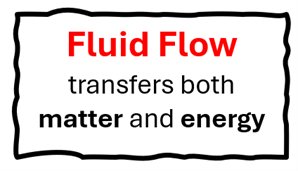
Now that we’ve looked at the cause of fluid flow, let’s develop some ways to describe this flow. Unlike mechanical waves, in which energy is transferred from one place to another but the particles of the medium are not, fluids move both matter and energy. The water molecules that pass through the faucet of your sink, for example, are the same water molecules that went through the water purification plant, to the water tower, through the city pipes, and to your faucet. Matter itself is transferred when fluids flow.
In Lesson 1, we introduced four characteristics of an ideal fluid. We observed that ideal fluids are incompressible, non-viscous, they flow with steady fluid motion, and they are non-turbulent. The table below gives a brief summary of these characteristics. For a more detailed description of each, you may want to refer to the description in Lesson 1.
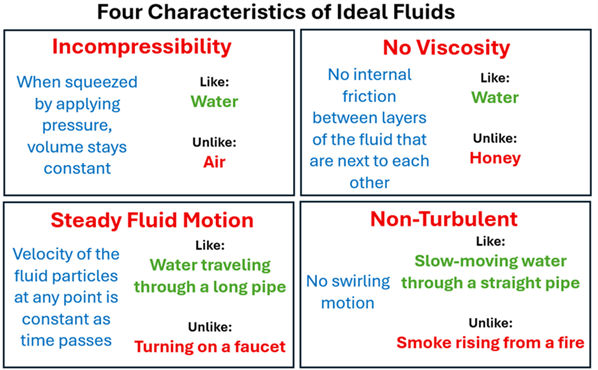
As we look at fluids in motion in this lesson, we’ll assume that our fluids are ideal. In other words, we’ll assume that they are characterized by these four properties. While no fluid is truly ideal, many fluids—such as water—can come pretty close to demonstrating all of these properties under certain conditions. So, we’ll assume that the fluids we’ll encounter in this lesson are ideal fluids. Making these assumptions will help us study the equation of continuity, Bernoulli’s equation, Torricelli’s Theorem, and several everyday applications of fluid dynamics. Good news, that is where we are going next!
Check Your Understanding
Use the following questions to assess your understanding. Tap the Check Answer buttons when ready.
1. A(n) ______________ causes fluids to flow.
- low pressure
- high pressure
- pressure difference
- absence of pressure
2. Fluids flow from a place of ___________ pressure to a place of ________ pressure.
- low … high
- high … low
- low … equal
- high … equal
3. Which of the following is NOT an example of something that causes a pressure difference?
- A temperature difference
- A density difference
- An external force
- A similar depth in a fluid
4. Which of the following is NOT a characteristic of an ideal fluid?
- Incompressibility
- Viscosity
- Steady fluid motion
- Non-turbulent
Figure 1 Borrowed from Wikimedia Commons (From Free Software Foundation) https://commons.wikimedia.org/wiki/File:Convection.gif under license GNU
Figure 2 Borrowed from Wikimedia Commons https://commons.wikimedia.org/wiki/File:Latidos.gif
Figure 3 Borrowed and Modified from Wikimedia Commons https://commons.wikimedia.org/wiki/File:Equal_transit-time_NASA_wrong1.gif