Hold down the T key for 3 seconds to activate the audio accessibility mode, at which point you can click the K key to pause and resume audio. Useful for the Check Your Understanding and See Answers.
 As learned earlier in Lesson 3 (as well as in Lesson 2), the net force is the vector sum of all the individual forces. In Lesson 2, we learned how to determine the net force if the magnitudes of all the individual forces are known. In this lesson, we will learn how to determine the acceleration of an object if the magnitudes of all the individual forces are known. The three major equations that will be useful are the equation for net force (Fnet = m•a), the equation for gravitational force (Fgrav = m•g), and the equation for frictional force (Ffrict = μ • Fnorm).
The process of determining the acceleration of an object demands that the mass and the net force are known. If mass (m) and net force (Fnet) are known, then the acceleration is determined by use of the equation.
a = Fnet / m
Your Turn to Practice
Thus, the task involves using the above equations, the given information, and your understanding of Newton's laws to determine the acceleration. To gain a feel for how this method is applied, try the following practice problems. Once you have solved the problems, click the button to check your answers.
Practice #1
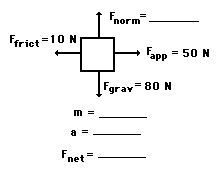
An applied force of 50 N is used to accelerate an object to the right across a frictional surface. The object encounters 10 N of friction. Use the diagram to determine the normal force, the net force, the mass, and the acceleration of the object. (Neglect air resistance.)
See Answer

Note: To simplify calculations, an approximated value of g is often used - 10 m/s/s. Answers obtained using this approximation are shown in parenthesis.
Fnorm = 80 N; m = 8.16 kg; Fnet = 40 N, right; a = 4.9 m/s/s, right
( Fnorm = 80 N; m = 8 kg; Fnet = 40 N, right; a = 5 m/s/s, right )
Since there is no vertical acceleration, normal force = gravity force.
The mass can be found using the equation Fgrav = m • g.
The Fnet is the vector sum of all the forces: 80 N, up plus 80 N, down equals 0 N. And 50 N, right plus 10 N, left = 40 N, right.
Finally, a = Fnet / m = (40 N) / (8.16 kg) = 4.9 m/s/s.
Practice #2
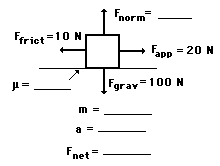
An applied force of 20 N is used to accelerate an object to the right across a frictional surface. The object encounters 10 N of friction. Use the diagram to determine the normal force, the net force, the coefficient of friction (μ) between the object and the surface, the mass, and the acceleration of the object. (Neglect air resistance.)
See Answer
Note: To simplify calculations, an approximated value of g is often used - 10 m/s/s. Answers obtained using this approximation are shown in parenthesis.
Fnorm = 100 N; m = 10.2 kg; Fnet = 10 N, right; "mu" = 0.1; a =0.980 m/s/s, right
( Fnorm = 100 N; m = 10 kg; Fnet = 10 N, right; "mu" = 0.1; a =1 m/s/s, right )
Since there is no vertical acceleration, the normal force is equal to the gravity force.
The mass can be found using the equation Fgrav = m * g.
Using "mu" = Ffrict / Fnorm, "mu" = (10 N) / (100 N) = 0.1.
The Fnet is the vector sum of all the forces: 100 N, up plus 100 N, down equals 0 N. And 20 N, right plus 10 N, left = 10 N, right.
Finally, a = Fnet / m = (10 N) / (10.2 kg) = 0.980 m/s/s.
Practice #3
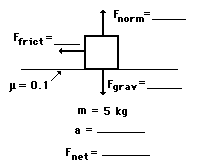
A 5-kg object is sliding to the right and encountering a friction force that slows it down. The coefficient of friction (μ) between the object and the surface is 0.1. Determine the force of gravity, the normal force, the force of friction, the net force, and the acceleration. (Neglect air resistance.)
See Answer
Note: To simplify calculatons, an approximated value of g is often used - 10 m/s/s. Answers obtained using this approximation are shown in parenthesis.
Fgrav = 49 N; Fnorm = 49 N; Ffrict = 4.9 N; Fnet = 5 N, left; a = 0.98 m/s/s, left
( Fgrav = 50 N; Fnorm = 50 N; Ffrict = 5 N; Fnet = 5 N, left; a = 1 m/s/s, left )
F
grav = m • g = (5 kg) • (9.8 m/s/s) = 49 N.
Since there is no vertical acceleration, the normal force equals the gravity force.
Ffrict can be found using the equation Ffrict ="mu"• Fnorm.
The Fnet is the vector sum of all the forces: 49 N, up plus 49 N, down equals 0 N. And 4.9 N, left remains unbalanced; it is the net force.
Finally, a = Fnet / m = (4.9 N) / (5 kg) = 0.98 m/s/s.
 A couple more practice problems are provided below. You should make an effort to solve as many problems as you can without the assistance of notes, solutions, teachers, and other students. Commit yourself to individually solving the problems. In the meantime, an important caution is worth mentioning:
Avoid forcing a problem into the form of a previously solved problem. Problems in physics will seldom look the same. Instead of solving problems by rote or by mimicry of a previously solved problem, utilize your conceptual understanding of Newton's laws to work towards solutions to problems. Use your understanding of weight and mass to find the m or the Fgrav in a problem. Use your conceptual understanding of net force (vector sum of all the forces) to find the value of Fnet or the value of an individual force. Do not divorce the solving of physics problems from your understanding of physics concepts. If you are unable to solve physics problems like those above, it is does not necessarily mean that you are having math difficulties. It is likely that you are having a physics concepts difficulty.
We Would Like to Suggest ...

Sometimes it isn't enough to just read about it. You have to interact with it! And that's exactly what you do when you use one of The Physics Classroom's Interactives. We would like to suggest that you combine the reading of this page with the use of our
Force Interactive. You can find it in the Physics Interactives section of our website. The
Force Interactive allows a learner to explore the effect of variations in applied force, net force, mass, and friction upon the acceleration of an object.
Check Your Understanding
1. Edwardo applies a 4.25-N rightward force to a 0.765-kg book to accelerate it across a tabletop. The coefficient of friction between the book and the tabletop is 0.410. Determine the acceleration of the book.
See Answer

Fgrav = 7.50 N; Fnorm = 7.50 N; Ffrict = 3.07 N; Fnet = 1.18 N, right; a = 1.54 m/s/s, right
The starting point for any problem such as this is the construction of a free-body diagram in which you show all the individual forces which are acting upon the book. There are two vertical forces - gravity and normal force. There are two horizontal forces - friction and the applied force.
Since there is no vertical acceleration, normal force = gravity force. Each of these forces can be determined using the equation Fgrav = m • g = (0.765 kg) • (9.8 m/s/s) = 7.497 N
The force of friction can be determined using the equation Ffrict = mu • Fnorm. So Ffrict = (0.410) • (7.497 N) = (3.0737 ... N)
The Fnet is the vector sum of all the forces: 4.25 N, right plus 3.0737 ... N, left = 1.176... N, right.
Finally, a = Fnet / m = (1.176... N) / (0.765 kg) = 1.54 m/s/s.
2. In a physics lab, Kate and Rob use a hanging mass and pulley system to exert a 2.45 N rightward force on a 0.500-kg cart to accelerate it across a low-friction track. If the total resistance force to the motion of the cart is 0.72 N, then what is the cart's acceleration?
See Answer
Fgrav = 4.90 N; Fnorm = 4.90 N; Fnet = 1.73 N, right; a = 3.46 m/s/s, right
The starting point for any problem such as this is the construction of a free-body diagram in which you show all the individual forces which are acting upon the book. There are two vertical forces - gravity and normal force. There are two horizontal forces - friction and the applied force.
Since there is no vertical acceleration, normal force = gravity force. Each of these forces could be determined using the equation Fgrav = m • g = (0.500 kg)•(9.8 m/s/s) = 4.90 N.
The Fnet is the vector sum of all the forces: 2.45 N, right plus 0.72 N, left = 1.73 N, right.
Finally, a = Fnet / m = (1.73. N) / (0.500 kg) = 3.46 m/s/s.