Lesson 2: The Quantum Mechanical Model
Part b: Orbitals
Part 2a: Schrodinger's Wave Mechanical Model
Part 2b: Orbitals
Part 2c: Energy Levels
Part 2d: Quantum Numbers
The Big Idea
This lesson describes atomic orbitals - regions within principal energy levels where electrons are likely to be found. You will learn that as the quantum number n increases, more orbital types (s, p, d, f) appear, each with unique geometric shapes, spatial orientations, and capacity to hold electrons.
 Describing Electrons and Orbitals in Atoms
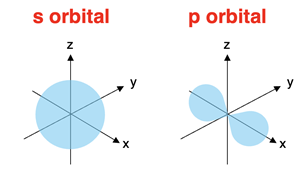
The quantum mechanical model describes electrons as being located in regions of space known as orbitals. There are four different orbital types that are important. Each type has a different shape. An s orbital is a spherically shaped orbital. A p orbital is a dumbbell shaped orbital with two lobes on the opposite sides of the nucleus. There are also d orbitals and f orbitals with shapes that are difficult to describe in words.
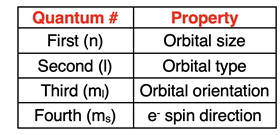 Each electron is described by a unique set of four quantum numbers. The first three quantum numbers define the size, shape, orientation, and energy associated with the orbital. The fourth quantum number describes the spin direction of the electron.
Principal Quantum Number
The first quantum number – n – is known as the principal quantum number. It has integer values of 1, 2, 3, etc. The principal quantum number describes the principal energy level of the electron. An electron with an n value of 1 is said to be in the first energy level. An electron with an n value of 2 is said to be in the second energy level. The energy level of the electron increases as the value of n increases. (The second quantum number – l – has a smaller effect upon the energy level.)
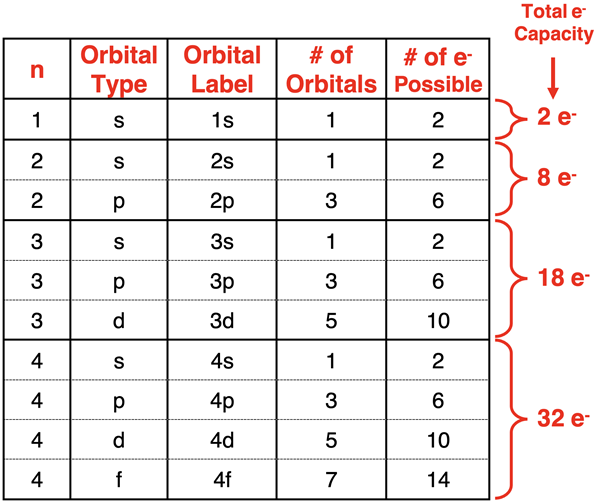
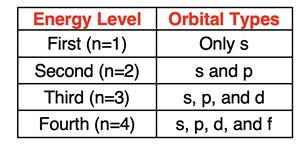 There can be several sets of orbitals having the same n value. The number of types of orbitals for any given energy level is equal to the principal quantum number. The first energy level (n=1) contains only s orbitals. The second energy level (n=2) contains two types of orbitals – s orbitals and p orbitals. The third energy level (n=3) contains three types of orbitals - s orbitals, p orbitals, and d orbitals. And the fourth energy level (n=4) has all four orbital types.
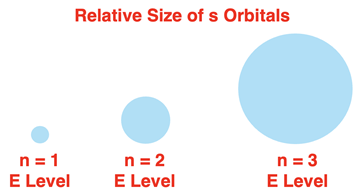 The principal quantum number also affects the size of the orbitals. An s orbital at the n=1 energy level is smaller than an s orbital at the n=2 energy level. And an s orbital at the n=2 energy level is smaller than an s orbital at the n=3 energy level. This is depicted in the diagram. The same pattern is observed of other orbital types.
The s Orbital
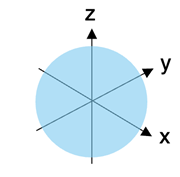 As mentioned above, every energy level has an s orbital. The s orbital is a spherical orbital. There is one s orbital at each energy level. It is the lowest energy sublevel for every principal energy level. The s orbital of the first energy level is referred to as the 1s orbital. The s orbital of the second energy level is referred to as the 2s orbital. Preceding the orbital type (“s”) with the principal quantum number (1, 2, 3, etc.) is common notation in quantum mechanics.
The p Orbitals
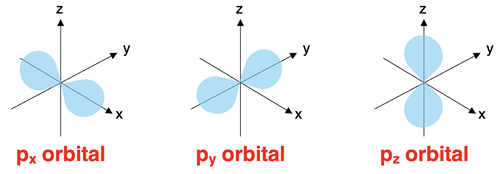
The p orbitals are found in all energy levels with a principal quantum number of 2 or higher. The p orbitals are described as dumbbell shaped orbitals. There are two lobes positioned on opposite sides of the nucleus. To help remember the p orbital shape, we call them pinched cylinders (with bulging ends). There are three p orbitals at each of these energy levels. They are distinguished by their orientation relative to the imaginary x-y-z axes and sometimes termed px, py, and pz orbitals. The p orbitals of the second energy level are referred to as the 2p orbitals. The p orbitals of the third energy level are referred to as the 3p orbitals.
The d Orbitals
The d orbitals are found in all energy levels with a principal quantum number of 3 or higher. There are five d orbitals at each of these energy levels. The shapes of the d orbitals are rather complex. Four of the d orbitals could be described as having a set of four lobes arranged perpendicular to each other. The fifth d orbital looks like a p orbital with a ring around its center. Most introductory Chemistry courses do not require any knowledge of their shapes. The d orbitals of the third energy level are referred to as the 3d orbitals. The d orbitals of the fourth energy level are referred to as the 4d orbitals.

Source: https://commons.wikimedia.org/wiki/File:Single_electron_orbitals.jpg
The f Orbitals
The f orbitals are found in all energy levels with a principal quantum number of 4 or higher. There are seven f orbitals at each of these energy levels. Like the d orbitals, their shapes are rather complex and typically not a required understanding in most introductory Chemistry courses. The f orbitals of the fourth energy level are referred to as the 4f orbitals.

Source: https://commons.wikimedia.org/wiki/File:Single_electron_orbitals.jpg
Electron Shells
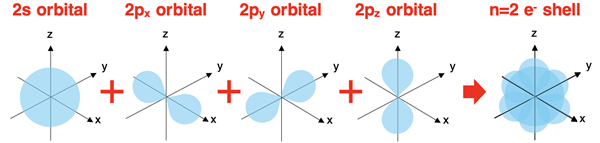
The collection of orbitals located in each energy level make up what is sometimes referred to as an electron shell. For instance, the second energy level contains both s orbitals and p orbitals. There are three p orbitals with one lying along each axis. These four orbitals (the one s and three p orbitals) combine to form the n=2 electron shell or the second electron shell.
Patterns for the Number of Orbitals and Electron Capacity
As inferred in the above discussion, there are clear patterns that emerge from the mathematical solutions of the Schrodinger equation. These patterns determine what orbital types are present at each energy level, how many of those orbitals are present, and the number of electrons that can be in those orbitals. The patterns are organized into the following table.
Before You Leave - Practice and Reinforcement
Now that you've done the reading, take some time to strengthen your understanding and to put the ideas into practice. Here's some suggestions.
- Download our Study Card on Atomic Orbitals. Save it to a safe location and use it as a review tool.
- Practice. Try our Quantum Mechanics Concept Builder. The first and third of the three activities would make great practice!
- The Check Your Understanding section below includes questions with answers and explanations. It provides a great chance to self-assess your understanding.
Check Your Understanding of Atomic Orbitals
Use the following questions to assess your understanding of the characteristics and properties of atomic orbitals. Tap the Check Answer buttons when ready.
1. Identify what is wrong with the following statement and make a corrected statement:
As the n value increases, the electron is orbiting with a radius that increases.
Check Answer
Answer:
In the Quantum Mechanical Model, electrons do not orbit. Instead they are located in orbitals. So a more accurate way to put this is to say that As the n value increases, the electron is located in orbitals that are larger. Quantum mechanics does not make any effort to locate the precise location of the electron within the region of space that we call the orbital.
2. Identify the following statements as being true or false:
- The n=1 principal energy level has a greater energy than the n=3 principal energy level.
Check Answer
Answer: FALSE
As the n value increases, the principal energy level increases.
- There are three orbitals present in the n=3 energy level.
Check Answer
Answer: FALSE
There are a total of nine orbitals present in the n=3 energy level. There is one s orbital, three p orbitals, and five d orbitals. That's three types of orbitals, but a total of nine orbitals.
- The five 2d orbitals have a higher energy than the three 2p orbitals.
Check Answer
Answer: FALSE
If there were such a thing as 2d orbitals, then they would likely be higher in energy than the 2p orbitals. BUT there are no such thing as 2d orbitals. The first that we see d orbitals is when we reach the n=3 principal energy level.
- The 3p orbitals are larger orbitals than the 2p orbitals.
Check Answer
Answer: TRUE
The 3p orbitals are in the n=3 energy level and the orbitals in that energy level are larger than the corresponding orbitals in the n=2 energy level.
- Every p orbital has the same basic shape regardless of the principal energy level that it is located in.
Check Answer
Answer: TRUE
Every p orbital is dumbbell shaped or (as we like to say) the shape of a pinched cylinder with bulging ends. It does not matter what energy level the p orbital is in.
- There are seven different orbitals in the n=2 electron shell.
Check Answer
Answer: FALSE
There are four orbitals in the n=2 energy level. There is one s orbital and three p orbitals. That's four total orbitals.
- The notation 2p is used when describing an orbital means there are two p orbitals.
Check Answer
Answer: FALSE
The notation 2p refers to the three p orbitals at the n=2 energy level.
- There are a total of four orbitals present in principal energy number of 2.
Check Answer
Answer: TRUE
There is one s orbital and three p orbitals in the n=2 principal energy level. That's four total orbitals.
- Principal energy level 4 consists of four different energy sublevels.
Check Answer
Answer: TRUE
An energy sublevel is referring to an orbital type. The s orbitals are of a different energy sublevel as the p orbitals. So at the n=4 principal energy level, there are four orbital types - s, p, d, and f. Each of these types of orbitals have a different energy sublevel. So there are four energy sublevels at the n=4 energy level.
- There are a total of six orbitals present in principal energy level 3.
Check Answer
Answer: FALSE
There are three orbital types - s, p, and d - present in the n=3 principal energy level. There are a total of nine orbitals. There is one s orbital, three p orbitals, and five d orbitals. Add that up and you get nine different orbitals.
3. How many types of orbitals have …
- … n=2 quantum numbers?
Check Answer
Answer: 2
There are two types of orbitals with n=2 quantum number. They are the s-type orbitals and the p-type orbitals. (NOTE: the question is asking for how many types of orbitals. That's a different question than asking for how many orbitals have n=2 quantum numbers.)
- … n=3 quantum numbers?
Check Answer
Answer: 3
There are three types of orbitals with n=3 quantum number. They are the s-type orbitals, the p-type orbitals, and the d-type orbitals. (NOTE: the question is asking for how many types of orbitals. That's a different question than asking for how many orbitals have n=3 quantum numbers.)
4. How many …
- … p orbitals are there in the n=3 energy level?
Check Answer
Answer: 3
Any energy level that has p orbitals (second energy level and higher) will have three p orbitals.
- … d orbitals are there in the n=3 energy level?
Check Answer
Answer: 5
Any energy level that has d orbitals (third energy level and higher) will have five d orbitals.
- … f orbitals are there in the n=3 energy level?
Check Answer
Answer: 0
The first energy level to have f orbitals is the n=4 energy level. There are no 3f orbitals.
5. What is the maximum number of electrons that can be present in all the ...
- … 2p orbitals?
Check Answer
Answer: 6
There are three orbitals at the n=2 energy level. Each orbital can hold at most 2 electrons. That's a total of 6.
- … 3d orbitals?
Check Answer
Answer: 10
There are five orbitals at the n=3 energy level. Each orbital can hold at most 2 electrons. That's a total of 10.