Lesson 3: Electrons
Part a: Electron Configurations
Part 3a: Electron Configurations
Part 3b:
Electrons and the Periodic Table
Part 3c:
Exceptions to the Rules
The Big Idea
A straightfoward procedure for using orbital box diagrams and the Aufbau Principle to write electron configurations will be explained and demonstrated using numerous examples. Abbreviated electron configurations and electron configurations for ions are also addressed.
Electron Configurations and Chemical Properties
We discussed chemical properties in Chapter 2. Chemical properties describe how a substance interacts with other substances to form 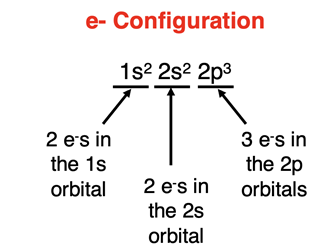 compounds. The chemical properties of an element include descriptions of how that element combines with other elements and the ratio of atoms in the resulting compound. These chemical properties are determined by the manner in which configuration of electrons in the atoms of those elements.
The quantum mechanical model will be used in Lesson 3 to build a foundation for understanding chemical properties. The foundation relies on the use of electron configurations. Electron configurations are a symbolic means of showing the location of electrons within an atom. Electrons are housed inside of orbitals. An electron configuration identifies the address of all the houses and the number of electrons residing in the houses. The orbitals are identified by standard orbital notation (1s, 2s, 2p, 3d, etc.) and a superscript indicates how many electrons are housed inside orbitals of that type.
 Energy Levels
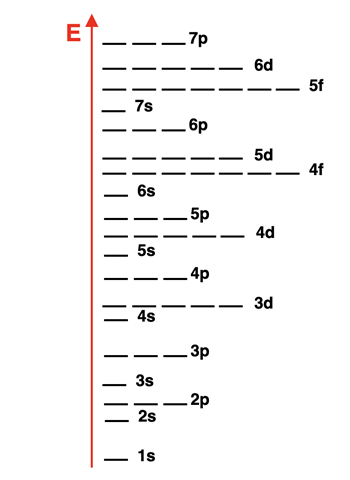
To write an electron configuration for an element, one must know the names of the orbitals and their relative energies. This was discussed quite thoroughly in Lesson 2. If the following brief review is not sufficient, please review Lesson 2c. The graphic at the right identifies the names (orbital notation) of all the orbitals and places them on a graph to show their relative energy. Generally, orbitals with a smaller n value (the number in the orbital notation) have lower energies. As was discussed in Lesson 2c, there are some surprises for any principal energy level containing d orbitals. The s orbitals of the 4th energy level are lower in energy than the d orbitals of the 3rd energy level. The same can be said for all other energy levels with an even higher n. The graph also shows that the 5s, 5p, and 6s orbitals are lower in energy than the 4f orbitals.
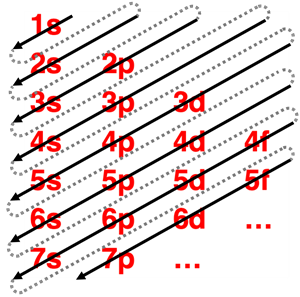
These surprise orderings make the task of ordering the orbitals by energy very memory intensive. One means of generating the order involves the use of the diagonal rule (sometimes referred to as the Madelung Rule). The orbitals are listed by principal energy level. Then diagonals are drawn through the listing. The use of this rule is depicted in the diagram. More details can be found in Lesson 2c.
Rules for Electron Configurations
Writing electron configurations for elements also demands an understanding of the order by which electrons enter the orbitals. This was also thoroughly discussed in Lesson 2c so the discussion here will be brief. There are three rules to adhere to when deciding the orbital that the 6th, the 8th, the 14th, the 16th, etc. electron will be housed in.
- Aufbau Principle: electrons will completely fill the lowest energy orbitals first before entering orbitals of the next highest energy.
- Hund’s Rule: electrons will half-fill the orbitals of a given energy sublevel with the same spin direction before pairing up inside such orbitals.
- Pauli Exclusion Principle: when electrons pair up inside of orbitals, they do so with opposite spin direction.
These rules and their application were thoroughly demonstrated in
Lesson 2c. Orbital box diagrams were used to show the placement of electrons. Electrons are represented by arrows. The direction that they point (up or down) reflect their spin direction. Examples of orbital box diagrams discussed in
Lesson 2c are shown here:
Orbital Box Diagrams and Electron Configurations
Orbital box diagrams are useful tools for determining electron configurations. Once the diagram is completed, begin writing the electron configuration. Begin on the left side of the diagram with the lowest energy orbital. Write the orbital notation of the orbital (1s). Add a superscript to indicate the number of electrons in the orbital (1s
2). Continue from left (lowest energy) to right (higher energies) across the orbital box diagram. Write the orbital notation plus superscript for any orbital type with electrons. The process is shown for carbon and chlorine below.
Examples of Electron Configurations
Eleven more examples of electron configurations are shown below. Observe how the orbital box diagram naturally translates into an electron configuration.
Writing Abbreviated Electron Configurations
Electron configurations can become quite long. Consider the configuration for barium with 56 electrons:
After writing a few barium-like configurations, one begins thinking
is there a shortcut? The good news is that there is. The shortcut is to write the so-called
abbreviated electron configuration. Writing the abbreviated form involves the following:
- Locate the element on the periodic table.
- Identify the noble gas element (Group 18) at the end of the row above the element.
- Write the symbol of the noble gas enclosed in brackets. That takes care of all the electrons included in the noble gas. For instance, if you write [Xe], you are accounting for the first 54 electrons.
- Write the remainder of the electron configuration, beginning with the electron after the noble gas’s last electron. For the abbreviated electron configuration of barium, write [Xe]. Then add the location of the 55th and 56th electrons.
To use the shortened configuration, one must know either the orbital notation for the element at the end of the row or the orbital notation for the element at the beginning of a row. This is shown below. (We will have more to say about it in
Lesson 3b.)
The table below shows the abbreviated electron configuration for a variety of elements. Notice that they always begin with the symbol of a noble gas element enclosed in brackets. Once that is written, the energy level diagram showing the ordering of orbitals is used to finish out the configuration in the usual manner.
How to Write Electron Configurations for Ions
The topic of ions was discussed in Chapter 3.
Ions have unequal numbers of protons and electrons and are thus charged. An ion can form when an atom gains or loses one or more electrons. Electron configurations can be written for charged ions in the same way they are written for neutral atoms. The first step is to determine the number of electrons in the ion. Look up the
atomic number on the periodic table. This indicates the number of protons. Use the atomic number and the charge of the ion to determine the number of electrons. A positively charged ion has less electrons than protons. A negatively charged ion has more electrons than protons. The table shows how these principles can be used to determine the number of electrons in an ion.
Once the number of electrons is determined, enter the electrons into the orbital box diagram. Then translate the diagram into an electron configuration. Examples are shown below. Note how the electron configuration of a charged ion with 18 electrons is the same as the electron configuration of a neutral atom with 18 electrons. Also note how the main group elements form ions that have the same configuration of electrons as the atoms of noble gas elements.
Core Electrons vs. Valence Electrons
The electrons in atoms are located in orbitals. The collection of orbitals at a given energy level (n value) form an
electron shell. For instance, the one 2s orbital and the three 2p orbitals of form the n=2 electron shell.
In Lesson 3 and subsequent chapters of this
Chemistry Tutorial, we will distinguish between the
outer shell electrons and the
core electrons. The outer shell electrons for main group elements (Groups 1-2 and 13-18), sometimes referred to as
valence shell electrons, are s- and p-orbital electrons in the outermost electron shell of atoms. Valence shell electrons are the electrons that are involved in bonding. And because of this, they are the electrons that determine the chemical properties of elements. Whether sodium and oxygen form NaO or NaO
2 or Na
2O or NaO
3 or Na
3O is dependent upon the number of valence shell electrons in the atoms of the two elements. The
core electrons are those electrons that are in the inner shells of atoms; they typically do not involve themselves in bonding. The number of valence shell electrons is evident when you inspect an electron configuration.
Note that d-orbital electrons are core electrons and are not counted towards the total number of valence electrons for main group elements. Only s- and p-orbital electrons are counted towards the total. (The definition of valence shell electrons changes slightly for transition metal elements ... but that's a topic for another page ... or another course.)
Electron Shell Diagrams
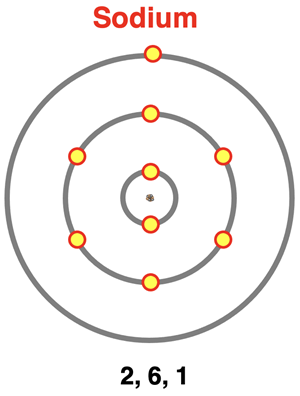
The core and valence shell electrons are often represented by electron shell diagrams. An electron shell diagram shows the electrons layered in
shells around a nucleus. Each principal energy level becomes an electron shell and the electrons of that level are represented by an X or a circle on the diagram. The electron shell diagram for oxygen and magnesium are shown below.
The notation “2, 6” and “2, 8, 2” shown below the diagram is commonly added. The numbers indicate the number of electrons in each shell, beginning with the innermost electron shell. The last number represents the outer shell or valence shell electrons. There are 2 core electrons and 6 valence shell electrons in oxygen. There are a total of 10 core electrons and 2 valence shell electrons in magnesium.
In
the next part of Lesson 3 we will discover one of the slickest tricks in Chemistry.
The electron configurations of elements are related to the location of the element in the periodic table. This relationship allows us to make quick work of writing electron configurations in complete and abbreviated forms.
Before You Leave - Practice and Reinforcement
Now that you've done the reading, take some time to strengthen your understanding and to put the ideas into practice. Here's some suggestions.
- Practice. Try our Complete Electron Configurations Concept Builder. It’s great practice!
- Have fun while learning. Try our Periodic Table Battleship Concept Builder. It’s great practice and lots of fun!
- Download our Study Card on Electron Configurations. Save it to a safe location and use it as a review tool.
- The Check Your Understanding section below includes questions with answers and explanations. It provides a great chance to self-assess your understanding.
Check Your Understanding of Electron Configurations
Use the following questions to develop your skill at constructing orbital box diagrams, electron configurations, abbreviated electron configurations, and electron shell diagrams. Tap the
Check Answer buttons when ready.
1. Construct orbital box diagrams for the following elements:
a.
15P
See Answer
Answer:

b.
26Fe
See Answer
Answer:

c.
35Br
See Answer
Answer:

d.
40Zr
See Answer
Answer:

2. Use orbital notation like 3s or 3p to identify the orbital into which the following electrons will be placed. And indicate if it will immediately join an earlier placed electron to be a paired electron or if it enters as an unpaired electron.
- 7th electron
See Answer
Answer: 2p orbital, unpaired
- 14th electron
See Answer
Answer: 3p orbital, unpaired
- 20th electron
See Answer
Answer: 4s orbital, paired
- 30th electron
See Answer
Answer: 3d orbital, paired
- 32nd electron
See Answer
Answer: 4p orbital, unpaired
- 52nd electron
See Answer
Answer: 5p orbital, paired
3. Write the complete (not abbreviated) electron configuration for the following elements:
- 4Be
See Answer
Answer: 1s2 2s2
- 9F
See Answer
Answer: 1s2 2s2 2p5
- 12Mg
See Answer
Answer: 1s2 2s2 2p6 3s2
- 14Si
See Answer
Answer: 1s2 2s2 2p6 3s2 3p2
- 20Ca
See Answer
Answer: 1s2 2s2 2p6 3s2 3p6 4s2
- 27Co
See Answer
Answer: 1s2 2s2 2p6 3s2 3p6 4s2 3d7
- 34Se
See Answer
Answer: 1s2 2s2 2p6 3s2 3p6 4s2 3d10 4p4
- 41Nb
See Answer
Answer: 1s2 2s2 2p6 3s2 3p6 4s2 3d10 4p6 5s2 4d3
- 50Sn
See Answer
Answer: 1s2 2s2 2p6 3s2 3p6 4s2 3d10 4p6 5s2 4d10 5p2
4. Write the abbreviated electron configurations for the following elements:
- 8O
See Answer
Answer: [He] 2s2 2p4
- 11Na
See Answer
Answer: [Ne] 3s1
- 17Cl
See Answer
Answer: [Ne] 3s2 3p5
- 18Ar
See Answer
Answer: [Ne] 3s2 3p6
- 35Br
See Answer
Answer: [Ar] 4s2 3d10 4p5
- 44Ru
See Answer
Answer: [Kr] 5s2 4d6
- 52Te
See Answer
Answer: [Kr] 5s2 4d10 5p4
- 63Eu
See Answer
Answer: [Xe] 6s2 4f7
- 72Hf
See Answer
Answer: [Xe] 6s2 4f14 5d2
- 85At
See Answer
Answer: [Xe] 6s2 4f14 5d10 6p5
5. Write the electron configuration for the following ions:
- O2-
See Answer
Answer: 1s2 2s2 2p6
- Ga3+
See Answer
Answer: 1s2 2s2 2p6 3s2 3p6 4s2 3d8
(The above configuration would be expected based on our rules and our energy levels for orbitals. For reasons not discussed until later, the configuration may more likely be: 1s2 2s2 2p6 3s2 3p6 3d10 with no 4s electrons.)
- Mg2+
See Answer
Answer: 1s2 2s2 2p6
- Ti2+
See Answer
Answer: 1s2 2s2 2p6 3s2 3p6 4s2
- Se2-
See Answer
Answer: 1s2 2s2 2p6 3s2 3p6 4s2 3d10 4p6
- I-
See Answer
Answer: 1s2 2s2 2p6 3s2 3p6 4s2 3d10 4p6 5s2 4d10 5p6
6. Construct an electron shell diagram for the sodium atom. Identify the number of core electrons and valence shell electrons.
See Answer
Answer: 10 core electrons, 1 valence shell electron
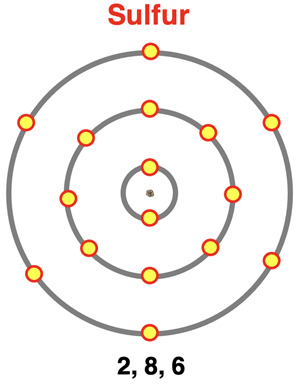
7. Construct an electron shell diagram for the sulfur atom. Identify the number of core electrons and valence shell electrons.
See Answer
Answer: 10 core electrons, 6 valence shell electrons
8. If you were to draw the electron shell diagram for the following ions: O
2-, F
-, Na
+, and Mg
2+, then what would they all have in common?
See Answer
Answer: They all have 10 electrons
These four ions have 10 electrons and an identical electron configuration. They would resemble Neon. Their electron shell diagrams would be identical. They differ in terms of the number of protons (and neutrons).
9. Determine the number of valence shell electrons in the following atoms:
- 12Mg
See Answer
Answer: 2
There are two electrons in its 3s orbital.
- 15P
See Answer
Answer: 5
There are two electrons in its 3s orbital and three electrons in its 3p orbitals.
- 18Ar
See Answer
Answer: 8
There are two electrons in its 3s orbital and six electrons in its 3p orbitals.
- 19K
See Answer
Answer: 1
There is one electron in its 4s orbital.
- 32Ge
See Answer
Answer: 4
There are two electrons in its 4s orbital. There are two electrons in its 4p orbitals. (The 3d electrons do not count as valence electrons.)
- 34Se
See Answer
Answer: 6
There are two electrons in its 4s orbital. There are four electrons in its 4p orbitals. (The 3d electrons do not count as valence electrons.)
- 36Kr
See Answer
Answer: 8
There are two electrons in its 4s orbital. There are six electrons in its 4p orbitals. (The 3d electrons do not count as valence electrons.)
10. Is it possible for an electron to be a core electron in one atom and a valence shell electron in another atom?
See Answer
Answer: Yes!!
As an example, the 12th electron in magnesium is a 3s electron. It is an outer shell electron in the magnesium atom. But for calcium, the 12th electron is a core electron since the outer shell for the calcium atom is the n=4 energy shell.
11. A magnesium atom has 2 valence shell electrons. If it loses 2 electrons and becomes the Mg
2+ ion, then how many valence shell electrons will it then have?
See Answer
Answer: 8
When magnesium loses its two 3s electrons, it then has emptied out its n=3 orbitals. The outer shell of the ion that is formed is then the n=2 energy level. It's electron configuration is 1s2 2s2 2p6. There are 8 total valence electrons in this configuration.