Bouyant Force
Earlier in this lesson, we explored the idea that the pressure in a fluid increases with depth. This means that the fluid pressure on the bottom of an object is greater than the fluid pressure on the top of that object. Consider, for example, a block of wood that is dropped into a lake. The water exerts pressure on every side of the block as it pushes in on it. Since pressure = force/area, each side of this block feels a force. After studying this situation, we notice that the forces on the left and right sides cancel each other out. This is because for every point on the left side, there is a point on the right side at the same depth. Both locations must experience the same pressure and thus the same force pushing in opposite directions.
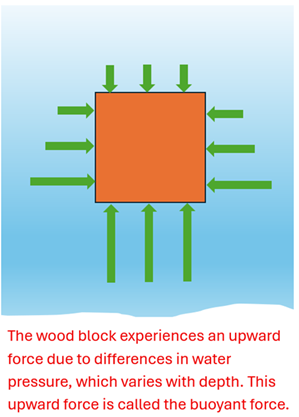
Notice, however, that the upward force on the bottom of the block is bigger than the downward force on the top of the block. This makes sense since the bottom of the block is deeper in the fluid. The bottom experiences greater pressure, and thus it feels a greater force. The net result of all these pressure-related forces pushing on the block is a net force that pushes upward. We call this the buoyant force. The buoyant force is the upward force exerted by a fluid on an object.
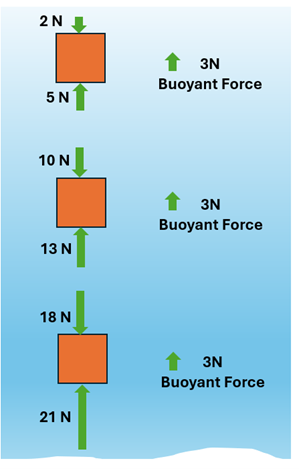
It is also important to note that, while the pressure increases with depth, the change in pressure (and thus the net result force due to the pressure-related forces on the object) will be the same at any depth. This means that the buoyant force doesn’t change with depth.
Consider our block of wood at three different depths. We notice that the forces pushing inward on the box due to the water pressure do increase with depth. We also notice, however, that the difference in these forces between the top and bottom of the box is always the same amount. This is significant. This means that the buoyant force depends on the size of the box and the density of the fluid, rather than on its depth in the fluid.
You might be wondering, “How do I calculate the buoyant force on an object?” Recall that since pressure = force/area, then force = pressure • area. Let’s assume that the top and bottom of the block have area A. If the fluid pressure at the top of an object is P1 and the pressure at the bottom of the object is P2, then we can calculate the forces acting on the top and bottom of the object.
TOP: Ftop = P1 • A
BOTTOM: Fbottom = P2 • A
Since the buoyant force is merely the difference between these two forces (Fbottom – Ftop), we can write the buoyant force, Fb, as:

You might recall that from our pressure-depth equation earlier in this lesson, the pressure difference P2 – P1 in a fluid can be found using P2 – P1 = ρ g h, where ρ is the density of the fluid, g is the acceleration due to gravity (g = 9.8 m/s2 near the Earth’s surface), and h is the height of the object. Thus, our buoyant force equation can also be written as
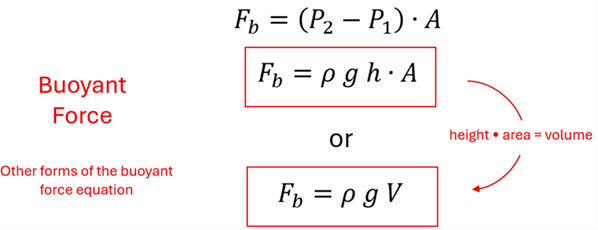
As we predicted above, the buoyant force depends on the density of the fluid and the size (technically, the volume) of the object. We see that it also depends on the gravitational field strength g.
Let’s apply what we’ve just learned in order to calculate the buoyant force on an object.
Example 1: Finding Buyant Force
Problem: A wooden cube and an iron cube are submerged in water (ρ = 1000 kg/m3). Both cubes are identical in size, with each dimension measuring 0.20 m. Calculate the buoyant force on each. (Assume g = 9.8 m/s2).
Answer: Let’s start by finding the volume of the cubes. If each cube has dimensions 0.20 m x 0.20 m x 0.20 m, then each cube has a volume of 0.0080 m3. Now, using the buoyant force equations above, we find that Fb = 78.4 N for each of the cubes. It is important to note that the buoyant force does not depend on the material of which the object is made. It depends only on the volume of the object.
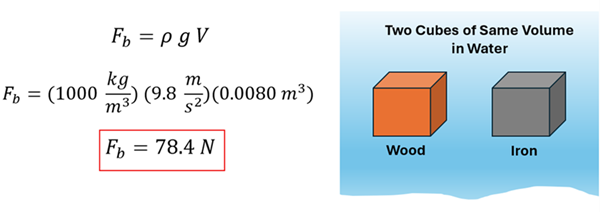
You might be wondering, "Do both of these cubes sink?" The answer to this question emerges as we consider another force that acts on each block—a force that we’ve ignored until now—the block’s weight. Let’s say that the weight (the force of gravity that points downward) of the wooden cube is 70 N and the weight of the iron cube is 620 N. For the wooden cube, the upward buoyant force is greater than the cube’s weight. As a result, the wooden cube will float. For the iron cube, the upward buoyant force is less than the cube’s weight. The iron cube will sink. There is much more to say about floating and sinking. We’ve devoted the whole next section of this lesson to this important concept.
Archimedes' Principle
Archimedes was one of the most renowned mathematicians and physicists of his time. Living from approximately 287 to 212 B.C., Archimedes derived the equation for the volume of a sphere and determined an accurate value for pi. However, his greatest discovery is likely a concept known as Archimedes’ Principle.
The story goes that the king of Syracuse had commissioned the making of a gold crown. He gave a specific amount of gold to the goldsmith who fashioned a beautiful crown. The king, however, became suspicious that the craftsman was dishonest. Goldsmiths had been known for mixing gold with cheaper metals (such as silver), yet still producing pieces that resembled pure gold. So, the king called Archimedes, his close friend, to solve the problem. Archimedes knew that gold and silver have different densities. He knew, for example, that a lump of gold would weigh about twice as much as a lump of silver of the same size. He knew how to find the volume of a regularly shaped object, such as a cube or a sphere, but how would he determine the volume of an irregularly shaped object, like a crown?
The story continues that Archimedes went to take a bath. As he got into the water, some spilled over the edge. He realized that the displaced water must have exactly the same volume as his body. He already had a way to determine the mass of any object; now he had a way to find the volume of any object, too. With this realization, he could calculate the density of any object…including a crown! Archimedes would merely need to determine if the crown weighed the same as an equal volume of pure gold. Thrilled with his epiphany, Archimedes jumped out of the bath and ran naked down the streets shouting, “Eureka!” – “I’ve found it!”
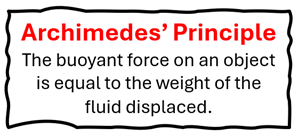
Archimedes continued with this line of thought and arrived at what is now known as Archimedes’ Principle. His principle states that the buoyant force on an object is equal to the weight of the fluid displaced.
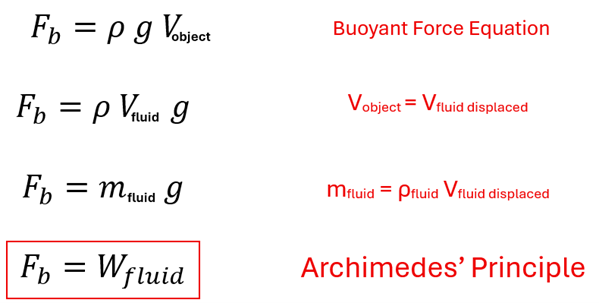
How did his rather simple discovery lead to this principle? We saw above that the buoyant force on an object, Fb, is equal to the density ρ of the fluid in which the object is submerged, multiplied by the acceleration due to gravity g, and multiplied by the volume V of the object. Since the volume of the object must equal the volume of the fluid displaced (this was Archimedes’ eureka moment), and since ρ • V = m, the mass of the fluid, the buoyant force equals the mass of the fluid times the acceleration due to gravity. Well, this is just the weight of the fluid displaced! In other words,
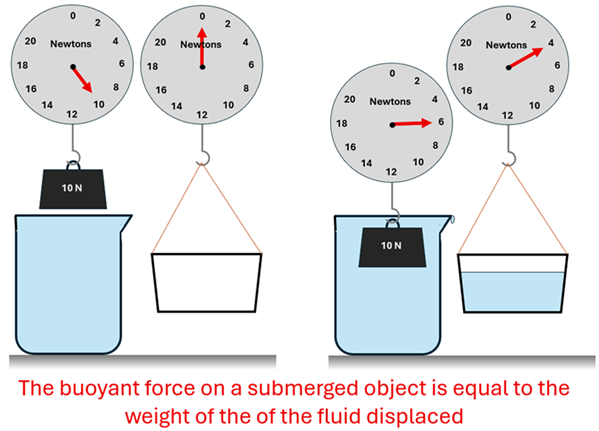
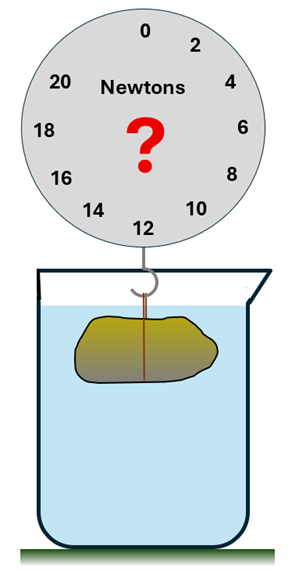
To illustrate how this works, consider an object that weighs 10 N and is suspended from a scale above a completely full container of water. If this object is lowered into the water, some of the water will spill out. In fact, the volume of the water that spills out is exactly equal to the volume of the submerged object. Let’s say that we were able to collect all the water that spilled out and measured its weight to be 4 N. This would be the weight of the fluid displaced. We also notice that the object now appears to weigh 4 N less—which is the amount of the upward buoyant force on the object. Archimedes’ Principle tells us that the buoyant force on the submerged object will be equal to the weight of the water displaced. That is exactly what we see!
Example 2: Predicting Scale Readings
Problem: A rectangular scale with the beaker of water reads 10 N. A round scale holding a rock reads 8 N, which then decreases to 6 N when the rock is lowered into the water. The rock is then allowed to rest on the bottom of the beaker.
(A) What is the buoyant force on the rock in the left picture (a)?
(B) What does the rectangular scale read when the rock is suspended in the water (b)?
(C) What does the rectangular scale read with the rock resting at the bottom (c)?
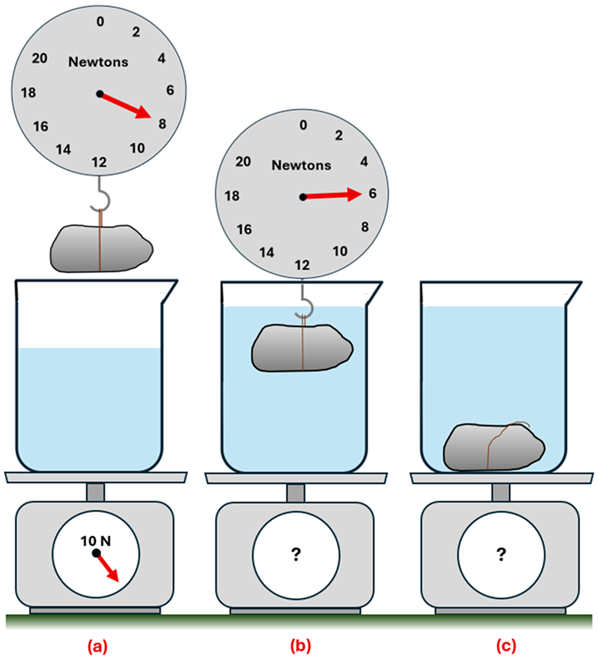
Solution:
(a) There is no measurable buoyant force on the rock now, as no water is displaced. (It is true that air is a fluid and will offer a very small buoyant force on the rock, but we will ignore its small effects in this case.)
(b) Since the round scale decreased by 2 N, this must now be the buoyant force. The rectangular scale now reads 12 N. This is because, by Newton’s 3rd Law, the buoyant force is met with an equal and opposite downward force exerted by the rock on the water.
(c) The rectangular scale now reads 18 N. It measures the weight of the beaker and water (10 N) + the weight of the rock (8 N).
Example 3: How Much Water is Needed to Float a Boat?
Problem: A 10,000 N boat floats in a body of water. What is the minimum amount of water necessary to float the boat?
Solution: Analyze the below picture:
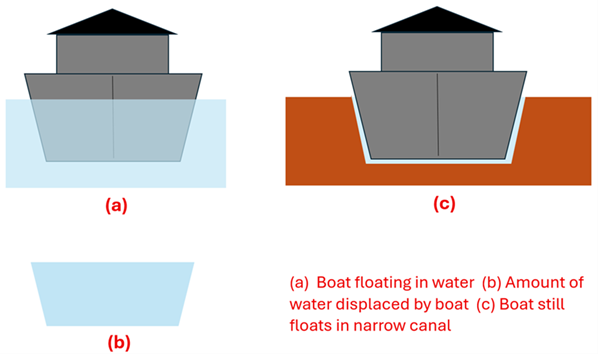
Figure (a) shows the boat floating in a large body of water. The upward buoyant force on the boat must be 10,000 N (equal to the force of gravity on the boat) if the boat floats. This means that the weight of the water displaced, shown in Figure (b), is also 10,000 N. This does not mean, however, that 10,000 N of water is needed to float the boat. Figure (c) illustrates that the boat can float in a narrow canal with less than 10,000 N of water. This is possible because the buoyant force describes the weight of the fluid displaced, not the amount of water required. You might imagine that, if the canal were filled to the brim with water, 10,000 N of water would have poured over the sides of the canal when the boat was placed in it. In short, only a tiny amount of water would do the trick!
Example 4: Airship Carrying a Load
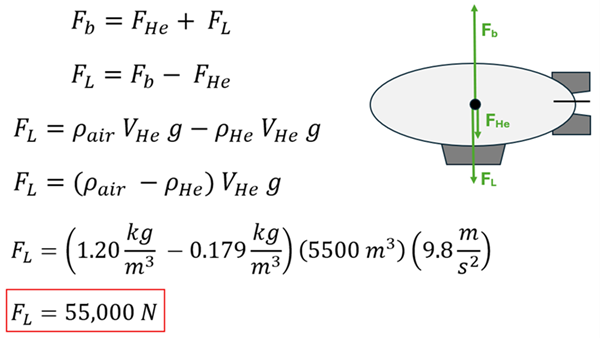
Problem: When fully inflated, the Goodyear airship is filled with approximately 5.50 x 10³ m3 of helium. The density of helium is 0.179 kg/m3. What load will allow this airship to be in equilibrium (not rising or falling) when in air that has a density of 1.20 kg/m3?
Solution: While we’ve only applied Archimedes’ Principle to a liquid such as water up to this point, it applies to all fluids. This includes air. Let’s begin by making a free-body diagram for the airship. We can see that the weight of the helium, plus the weight of the load (including the fabric shell and cargo), must be balanced by the upward buoyant force. Recall that the weight of the helium can be found by FHe = mHe g. From our density equation solved for mass, we can write mHe = ρHe VHe. Thus, the FHe = ρHe VHe g. From earlier in this section, we learned that the buoyant force equals the weight of the fluid displaced. In this example, the displaced fluid is the air surrounding the airship. Thus, the weight of the air displaced (and thus the buoyant force) is Fb = ρair VHe g. The reason we use the volume of helium here is that this is the volume of the airship—this is the volume of the air displaced by the airship. We can now find that the airship can carry a load of about 55,000 N.
In this section, we explored the fact that the pressure difference between the bottom and top of a submerged object is the reason a buoyant force exists when an object is placed in a fluid. We also learned that the magnitude of the buoyant force is equal to the weight of the fluid displaced. This is Archimedes’ Principle. We can begin to see how such a buoyant force can help us understand why some objects float and others sink. However, there is much more to explore about sinking and floating. That is where we will go next!
Check Your Understanding
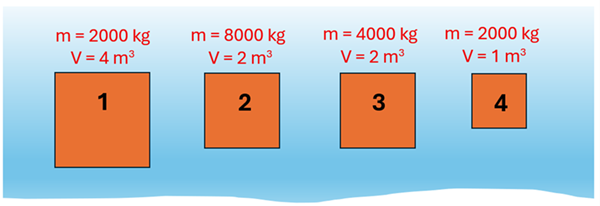
1. Four objects are placed in the same fluid as shown. The masses and volumes of the objects are given. Rank the buoyant force on each from greatest to least.
2. A rock is thrown into a deep lake. As the rock sinks deeper and deeper in the water, does the buoyant force on it increase, decrease, or remain the same?
3. Atmospheric pressure varies from one day to the next. The level of a floating ship in the ocean on a high-pressure day is (a) higher, (b) lower, or (c) no different from that on a low-pressure day.
4. The density of lead is greater than that of iron, and both metals are denser than water. Is the buoyant force on a solid lead object (a) greater than, (b) equal to, or (c) less than the buoyant force acting on a solid iron object of the same dimensions when placed in water?
5. Consider the same questions as number 4 above, with the exception that now we have a solid lead ball and a solid iron ball of the same mass. Is the buoyant force on a solid lead ball (a) greater than, (b) equal to, or (c) less than the buoyant force acting on a solid iron ball of the same dimensions?
6. A questionable merchant sells you a 1.00-kg gold nugget for a very reasonable price. Wondering if you got a deal or were ripped off, you lower the nugget into water and measure the volume of the displaced water (density is 0.00100 kg/cm3). You find the volume to be 51.8 cm³. The density of gold is 0.0193 kg/cm3.
(A) Did you get the real thing?
(B) What is the buoyant force acting on this nugget when submerged in the water? Assume g = 9.8 m/s2.
(C) What is the apparent weight (scale reading in Newtons) of the nugget when suspended in water?
7. Rank (from smallest to greatest) the buoyant force on a beach ball when it is floating on the surface, pushed 1 m below the surface of the water, and pushed 2 m below the surface of the water.
Looking for additional practice? Check out the CalcPad (CPFM3) for additional practice problems.
Figure 1 Borrowed from Wikimedia Commons https://commons.wikimedia.org/wiki/File:Goodyear_Blimp.jpg