What Makes an Object Sink or Float?
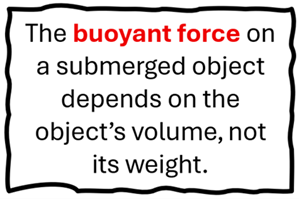
In the previous section, we learned about Archimedes' Principle. This principle states that the upward buoyant force on an object placed in a fluid is equal to the weight of the fluid it displaces. We also learned that an important result of this principle is that the buoyant force on a submerged object depends on the object’s volume, not its weight. Since a large object displaces a large volume of fluid, it experiences a large buoyant force. Similarly, a small object will displace a small volume of this fluid and thus experience a smaller buoyant force. While the object’s weight doesn’t play a role in determining the buoyant force, it does play a role in determining whether an object will sink or float. In fact, we will see in this section that, by comparing the size of the buoyant force to the size of the force of gravity (weight), we can predict whether or not an object will float.
Let’s consider the forces acting on a totally submerged object in a fluid. We can see that there are two forces acting on the object: the force of gravity (Fg) and a buoyant force (Fb). Let’s look carefully at the free-body diagram for this situation:
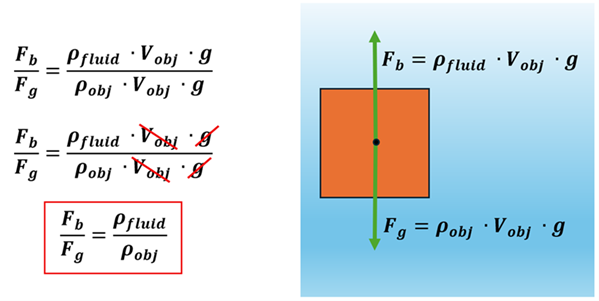
From Archimedes’ Principle, we know Fb = Wfluid = mfluid • g. From our definition of density in Lesson 1, we can write mfluid = ρfluid • Vfluid. Substituting this into the buoyant force expression, we have Fb = ρfluid • Vfluid • g. Archimedes’ eureka moment, however, was that the volume of the object (Vobj) is equal to the volume of the fluid (Vfluid) displaced. So, we can substitute Vobj for Vfluid and write Fb = ρfluid • Vobj • g. This is how we derived the expression for buoyant force shown on the free-body diagram above.
Now let’s turn our attention to the force of gravity on the object. We know that Fg = mobj • g. Making a similar substitution for the mass of the object as we did for the mass of the fluid, namely mobj = ρobj • Vobj, we can write the force of gravity as Fg = ρobj • Vobj • g. This is how we derived the expression for the force of gravity on the free-body diagram.
Let’s now look at the ratio of Fb / Fg. Substituting in the expressions for the buoyant force and the force of gravity from our free-body diagram, we find that the ratio of the buoyant force to the force of gravity is just the ratio of the density of the object to the density of the fluid.
How does this help us predict whether an object will sink or float? To answer this question, let’s consider three cases where we look at the ratio of the buoyant force to the force of gravity on the object.
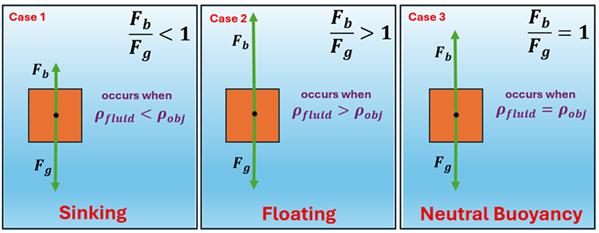
Case 1: Sinking. When the buoyant force on a submerged object is less than the force of gravity on it, the object will sink. We observe that this condition occurs when the density of the fluid is less than that of the object.
Case 2: Floating. When the buoyant force on a submerged object is greater than the force of gravity on it, the object will float. In this case, we observe that this occurs when the density of the fluid is greater than the density of the object. We’ll say much more about the special case of floating below. For now, however, we observe that a submerged object will rise to the surface whenever its density is less than that of the surrounding fluid.
Case 3: Neutral Buoyancy. A special case for submerged objects is when the buoyant force on it exactly equals the force of gravity. This occurs when the density of the fluid exactly matches the density of the object. Wouldn’t this be a very rare occurrence? Actually not if the density of the object can be controlled. Fish achieve neutral buoyancy through their swim bladder. This bladder can inflate or deflate. By adding gas from their bloodstream or by gulping air from the surface, they can increase their volume, which in turn increases the buoyant force on them (and decreases their density) until they reach neutral buoyancy. If needed, they expel some of this gas to decrease their buoyancy and become neutrally buoyant. Submarines do something similar. Rather than taking in gases, however, they simply adjust the amount of water in their ballast tanks so that the submarine's total weight equals the weight of the water it displaces.
So, by simply comparing the density of the fluid to the density of the object, we can determine whether or not the object will sink or float. Let’s apply what we’ve learned thus far by tackling a couple of examples.
Example 1: Sink or Float?
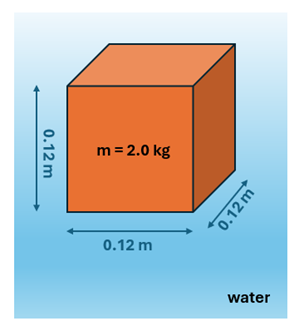
Problem: A 2.0-kg cube of wood measuring 0.12 m on each side is submerged in water (ρ = 1000 kg/m3).
(A) What is the weight of this cube of wood (in Newtons)?
(B) What is the buoyant force on the block (in Newtons)?
(C) Will this block sink or float in water?
Solution:
(A) We find the weight (Fg) of the cube using Fg = m • g = 2.0 kg • 9.8 m/s2 = 19.6 N.
(B) To find the buoyant force, we’ll need to first find the volume of the wood cube. Its volume is 0.12 m x 0.12 m x 0.12 m = 0.00173 m3. To find the buoyant force (Fb) then, we use Fb = ρfluid • Vobj • g = (1000 kg/m3) • (0.00173 m3) • (9.8 m/s2) = 16.9 N.
(C) Since the ratio of Fb/Fg = 16.9 N/19.6 N = 0.86 (which is less than 1), the wood cube will sink.
Example 2: Density Column
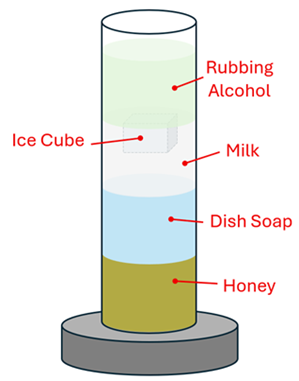
Problem: The four liquids shown below are poured into a graduated cylinder.
(A) In what order (from top to bottom) will they settle?
(B) An ice cube (ρ = 0.92 g/cm3) is now dropped into the cylinder. Where will it eventually come to rest?
| Object |
Density (g/cm3) |
Color |
| Honey |
1.42 |
Light Brown |
| Milk |
1.03 |
White |
| Rubbing Alcohol |
0.79 |
Green |
| Dish Soap |
1.06 |
Blue |
Solution:
(A) These liquids will arrange themselves from least dense (top) to most dense (bottom) in the density column. The order (from top to bottom) will be rubbing alcohol, milk, dish soap, and honey. They stay separate due to the fact that each liquid has a unique density and the fact that they are immiscible (do not mix easily).
(B) If an ice cube is dropped in, it will sink below the rubbing alcohol but float in the layer of milk.
An Extra Look at Floating
It makes sense that a steel ball will sink when dropped into a tank of water. After all, steel is more dense than water. But wait a minute, aren’t huge ships made of steel, and yet they float? A huge ship might have a mass that is thousands of times greater than that of a steel ball, yet the ship floats, and the ball sinks. How do we explain this?
To answer this question, let’s consider a very large, 100,000 N steel ball that is dropped into the ocean. The ball will surely sink to the bottom of the ocean. Consider, however, that we reshape that 100,000 N steel ball into a 100,000 N steel bowl. When this heavy steel bowl is placed in the ocean, it displaces a much greater volume of water than the steel ball did. In fact, the further the bowl sinks into the ocean, the more volume of water it displaces. It will continue to sink until it displaces 100,000 N of water. It’s at this point that the buoyant force on the bowl equals its weight. It will sink no further. We can even add the 100,000 N steel ball to the inside of our bowl, and though it sinks a little deeper into the water, it will still float. As it does, it will displace more water until the new buoyant force equals 200,000 N—the weight of the bowl + the weight of the ball.
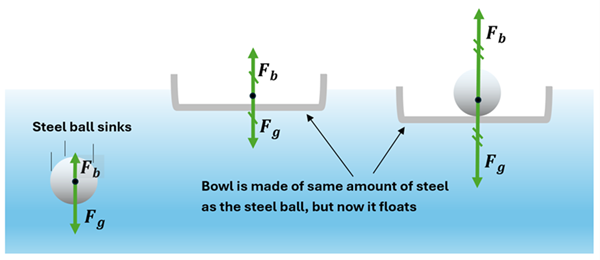
This is how massive ships can float. In fact, any material can float as long as it is fashioned so that it experiences a buoyant force equal to its weight!
Example 3: What's My Reading?
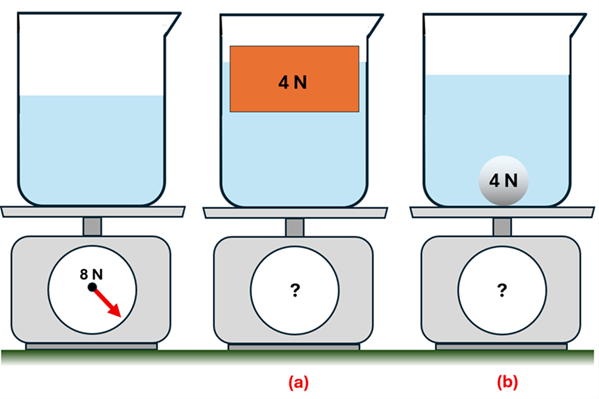
Problem: A beaker with some water rests on a scale that reads 8 N.
(a) A floating 4 N wood block is placed in the water. What does the scale read?
(b) If a 4 N steel ball were placed in the water instead, would the scale read more, less, or the same as your answer to (a)?
Solution:
(a) 12 N. The scale is holding up the beaker with water + the 4 N wood block.
(b) Still 12 N. The scale is still holding up the beaker with water + the 4 N steel ball.
In both cases, it is true that an upward buoyant force acts on the object by the fluid. According to Newton’s Third Law, however, there must also be an equal but opposite downward on the fluid by the object. Thus, these internal forces cancel out, and the scale merely reads the weight of whatever it is holding up.
Example 4: What's My Reading Now?
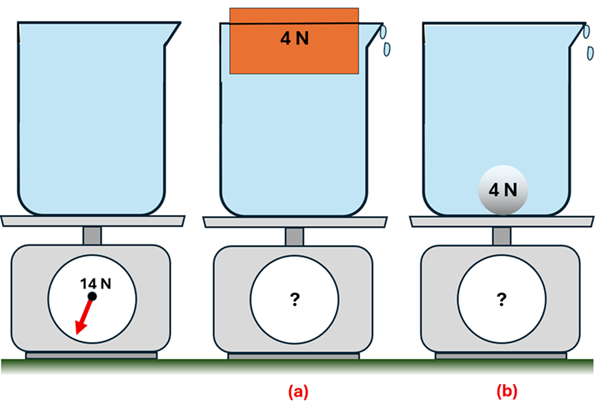
Problem: A beaker, filled to the rim with water, rests on a scale that reads 14 N.
(a) A floating 4 N wood block is placed in the water, and some water spills over. What does the scale read now?
(b) If a 4 N steel ball were placed in the water instead, would the scale read more, less, or the same as your answer to (a)?
Solution:
(a) 14 N. The weight of the water that spills out is equal to the buoyant force on the wood block. Since the block is floating, the buoyant force must equal the weight of the block itself (which is 4 N). Thus, 4 N of water spilled out when a 4 N block was added. The net result is that the scale still reads 14 N.
(b) More than 14 N. The weight of the water that spills out will still equal the buoyant force of the steel ball. Since the object sinks, however, this buoyant force is less than the weight of the ball. Thus, less than 4 N of water spilled out when the 4 N steel ball was added. The net result is that the scale reads more than 14 N.
Percent Submerged
Perhaps you’ve heard the saying, “It’s just the tip of the iceberg,” to describe a situation where there is a lot more going on than we can see. There’s a whole lot of truth to this figure of speech. About 90% of a floating iceberg is submerged in water. The same is true of an ice cube in a glass of water. But why is this the case? And is there a way to predict what percentage of an object is submerged in the fluid in which it floats?
Archimedes' Principle can be used to explain the percentage of an iceberg (or any floating object, for that matter) that is submerged in a fluid. In the previous section, we discussed the power of this principle over objects that were totally submerged. Now, let’s apply this concept to a floating object.
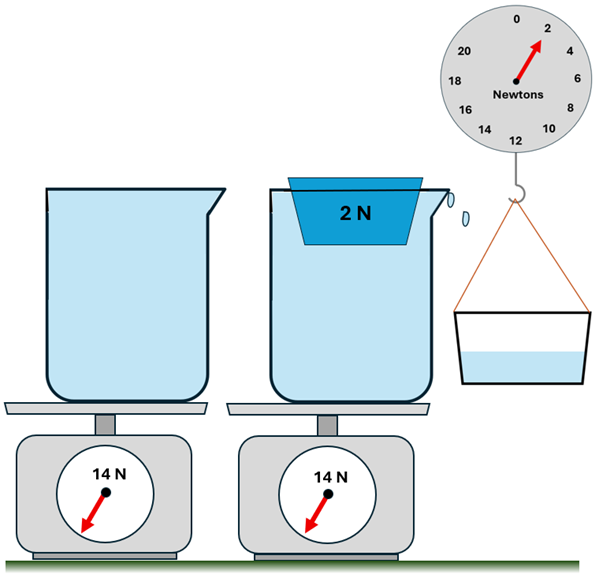
Consider, for example, a beaker, filled to the rim with water, resting on a scale. The scale reads 14 N, the weight of the beaker and water inside. A 2 N ice cube is now placed in the beaker of water. In the process, some of the water spilled out. In fact, we can reason that the volume of the submerged portion of the floating ice cube is equal to the volume of the water displaced (the amount that spilled out). If we measure the weight of the water that spills out, we find it to be 2 N. This makes sense because, when the cube was placed in the water, it continued to sink until the buoyant force on the cube was equal to the weight of the cube—which is 2 N. The cube floats in this position since the net force acting on it equals zero.
As we saw in Example 4 above, the reading on the scale remains at 14 N. This makes sense since, although there is 2 N less water in the beaker, it is made up for by the weight of the 2 N cube. In other words, the ice cube continues to sink in the water until the weight of the water displaced equals the weight of the cube itself.
This simple example leads us to a helpful equation that will allow us to predict the exact percentage of the ice cube that is submerged. We know that for the floating ice cube, the buoyant force (Fb) must equal the cube’s weight (Fg). We can make the same substitutes that we did earlier in this section and write Fb = ρfluid • Vsub • g, where ρfluid is the density of the liquid water and Vsub is the volume of the submerged portion of the ice cube. Using similarly reasoning, we can write Fg = ρobj • Vobj • g, where ρobj is the density of the cube and Vobj is the volume of the entire ice cube. Equating these two forces leads us to an equation for the ratio of the volume of the submerged portion of the cube to the cube’s entire volume (Vsub/Vobj). This ratio tells us the percentage of the cube that is submerged.
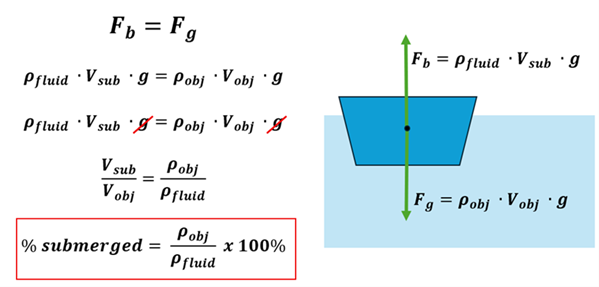
What’s really interesting is that the fraction submerged is equal to the ratio of the density of the object to the density of the fluid. Multiplying this by 100% merely gives us this fraction as a percentage. In summary, for a floating object, all we need to know to determine the percentage submerged is the density of the object and the density of the fluid it is immersed in. Let’s apply this equation to predict the exact percentage of an iceberg that is submerged!
Example 5: Icebergs in Freshwater and Seawater
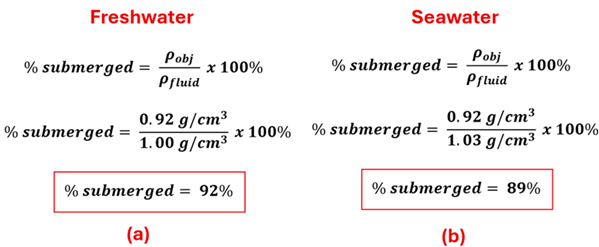
Problem: Ice has a density of 0.92 g/cm3. Freshwater has a density of 1.00 g/cm3, whereas seawater has a density of approximately 1.03 g/cm3. Find the percentage of an iceberg that will be submerged in (a) freshwater and (b) seawater.
Solution: Using the percent submerged equation, we find that ice is slightly more submerged (0.92 / 1.0 or 92%) in freshwater when compared to seawater (0.92 / 1.03 or 89%). This tells us that icebergs float just a little higher in the ocean than they would in a body of freshwater.
Example 6: Water Level Puzzle
Problem: A glass of drinking water (ρ = 1.00 g/cm3) contains an ice cube (0.92 g/cm3). The original water level is marked on the side of the glass. When the ice has melted, will the water level rise, fall, or remain the same?
Solution: We saw in the previous example that 92% of the ice cube's volume is submerged, and thus 8% is above the original water level. However, since the density of the ice cube is 92% that of liquid water, when the ice cube melts, it will be in the form of liquid water occupying only 92% of the original ice cube's volume. Since that is exactly the fraction of the volume submerged, the water level must remain the same! You can imagine that the 8% above the water line ‘fills in’ the space for the 8% less dense submerged ice cube. You might try to reason that this works the same for an iceberg floating in seawater, too!
Example 7: Percent Visible Above the Surface
Problem: A perfectly spherical ball (Vsphere = 4/3 π r3) has a mass of 750 grams and a radius of 7.5 cm.
(a) Show that this ball floats in mineral oil (ρ = 0.85 g/cm3).
(b) What percentage of the ball is visible above the surface of the mineral oil?
Solution: (a) Let’s begin by finding the volume of the ball. We find that Vsphere = 4/3 π r3 = 4/3 π (7.5)3 = 1767 cm3. We find the sphere’s density to be ρ = m / V = 750 g /1800 cm3 = 0.42 g/cm3. Since this is less than the density of mineral oil, we know that the ball will float. (b) Since the percent submerged is = (0.42 g/cm3 / 0.85 g/cm3) x 100% = 49%, then 51% of the ball is visible above the surface of the mineral oil.
Check Your Understanding
Use the following questions to assess your understanding. Tap the Check Answer buttons when ready.
1. The masses and volumes of 4 different liquids are listed in the table below. If these liquids were poured into a graduated cylinder, in what order would they settle (from top to bottom)?
| Liquid |
Mass (g) |
Volume (mL or cm3) |
| Maple Syrup |
54.8 |
40.0 |
| Seawater |
51.5 |
50.0 |
| Vegetable Oil |
36.8 |
40.0 |
| Corn Syrup |
39.9 |
30.0 |
2. A can of diet soda and a can of regular soda are dropped in water. The can with diet soda floats while the can with regular soda sinks.
(A) What can be said about the density of a can with regular soda compared to a can with diet soda?
(B) What can be said about the density of a can with regular soda compared to water?
3. A 20.0 g block of lead (ρ = 11.34 g/cm3) and a 20.0 g block of aluminum (ρ = 2.70 g/cm3) are placed in a beaker of water filled to the rim. Does the aluminum block displace more, less, or the same water compared to the lead block?
4. A 20.0 cm3 block of lead (ρ = 11.34 g/cm3), a 20.0 cm3 block of aluminum (ρ = 2.70 g/cm3), and a 20.0 cm3 block of oak wood (ρ = 0.60 g/cm3), are placed in a beaker of water filled to the rim. How much water is displaced by the
(A) Lead block
(B) Aluminum block
(C) Oak wood block
5. Why will a block of steel float in mercury but sink in water?
6. Will a ship float higher in seawater (ρ = 1.03 g/cm3) or freshwater (ρ = 1.00 g/cm3)?
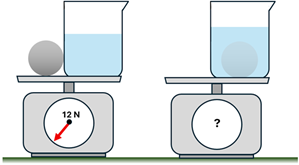
7. A wooden ball and a beaker of water sit on a scale reading 8 Newtons. When the wooden ball (ρ = 0.60 g/cm3) is placed into the beaker of water, does the reading on the scale go up, down, or stay the same?
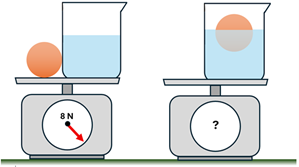
8. A steel ball and a beaker of water sit on a scale reading 12 Newtons. When the steel ball (ρ = 7.85 g/cm3) is placed into the beaker of water, does the reading on the scale go up, down, or stay the same?
9. Find the percent submerged of the following fruits in a container of water (ρ = 1.00 g/cm3).
(A) Apple (ρ = 0.70 g/cm3)
(B) Grapefruit (ρ = 0.80 g/cm3)
(C) Pineapple ((ρ = 1.10 g/cm3)
Figure 1 Borrowed from Wikimedia Commons (From Dr. Robert Ricker, NOAA/NOS/ORR.) https://commons.wikimedia.org/wiki/File:Rikr0134_-_Flickr_-_NOAA_Photo_Library.jpg under license Creative Commons