Chapter 2: 1D Kinematics - Lesson 5: Free Fall and the Acceleration of Gravity
The Big Misconception
Hold down the T key for 3 seconds to activate the audio accessibility mode, at which point you can click the K key to pause and resume audio. Useful for the Check Your Understanding and See Answers.
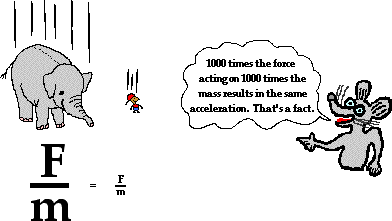
 Earlier in this lesson, it was stated that the acceleration of a free-falling object (on earth) is 9.8 m/s/s. This value (known as the acceleration of gravity) is the same for all free-falling objects regardless of how long they have been falling, or whether they were initially dropped from rest or thrown up into the air. Yet the questions are often asked "doesn't a more massive object accelerate at a greater rate than a less massive object?" "Wouldn't an elephant free-fall faster than a mouse?" This question is a reasonable inquiry that is probably based in part upon personal observations made of falling objects in the physical world. After all, nearly everyone has observed the difference in the rate of fall of a single piece of paper (or similar object) and a textbook. The two objects clearly travel to the ground at different rates - with the more massive book falling faster.
 The answer to the question (doesn't a more massive object accelerate at a greater rate than a less massive object?) is absolutely not! That is, absolutely not if we are considering the specific type of falling motion known as free-fall. Free-fall is the motion of objects that move under the sole influence of gravity; free-falling objects do not encounter air resistance. More massive objects will only fall faster if there is an appreciable amount of air resistance present.
The actual explanation of why all objects accelerate at the same rate involves the concepts of force and mass. The details will be discussed in Unit 2 of The Physics Classroom. At that time, you will learn that the acceleration of an object is directly proportional to force and inversely proportional to mass. Increasing force tends to increase acceleration while increasing mass tends to decrease acceleration. Thus, the greater force on more massive objects is offset by the inverse influence of greater mass. Subsequently, all objects free fall at the same rate of acceleration, regardless of their mass.