Chapter 7: Mole - Lesson 2: Quantitative Analysis of Compounds
Empirical and Molecular Formulae
Hold down the T key for 3 seconds to activate the audio accessibility mode, at which point you can click the K key to pause and resume audio. Useful for the Check Your Understanding and See Answers.
The Big Idea
This page discusses the distinction between an empirical formula, which indicates the smallest whole-number ratio of atoms, and a molecular formula, which indicates the actual number of atoms present in the molecule. The lesson also explains and demonstrates through examples how to determine the empirical and molecular formulae.
What's in a Chemical Formula?
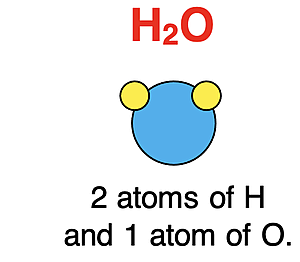 On the previous page, the importance of the question…
What is an Empirical Formula?
Laboratory chemists are capable of analyzing a compound and determining the mass of each element present in the compound. Typical data from such analyses look like this:
Mass of Hydrogen in Sample = 0.593 g
Mass of Oxygen in Sample = 9.407 g
This mass information can be used to determine the moles of the two elements – H and O – in the 10.000-gram sample. By dividing by the molar mass, we can determine …
Moles of O = 9.407 g • (1 mol/15.9994 g) = 0.588 mol O
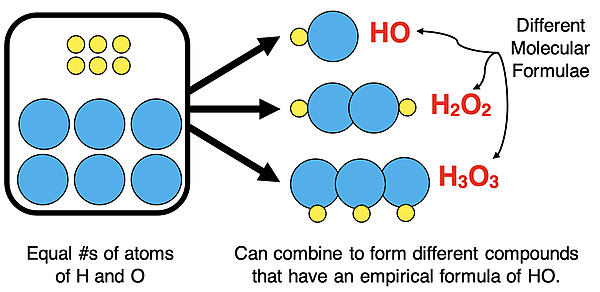
Chemists settle on what is referred to as the simplest formula. The simplest formula indicates the simplest ratio of atoms of the elements. For the above compound, the simplest formula is HO (subscripts of 1 are not included). Another name for simplest formula is empirical formula. It is referred to as an empirical formula because it is determined empirically (by experimental analysis).
Empirical Formula vs. Molecular Formula
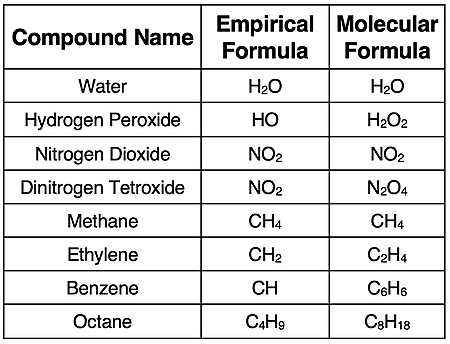
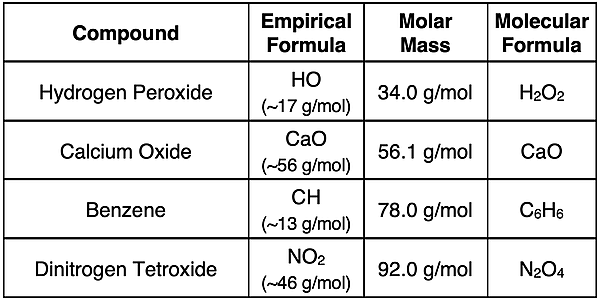
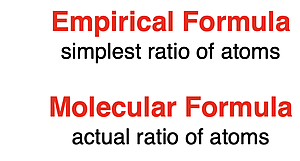 The empirical or simplest formula is not necessarily the molecular formula and is sometimes quite different than the molecular formula. While the empirical formula shows the simplest ratio of atoms, the molecular formula shows that actual ratio of atoms in a molecule of the compound. The subscripts on the molecular formula are always a whole number (1, 2, 3, 4, etc.) multiple of the subscripts on the empirical formula. The table below shows the molecular formula and empirical formula for several compounds.
Analysis of Mass Composition Data
There are a variety of experimental methods used to determine the mass composition for the elements in an unknown compound. Our goal is to learn how to use such data and determine the empirical formula. The method is quite straightforward and based primarily on the skill of converting from mass to moles. After several examples, we will learn how to determine a molecular formula from the empirical formula and molar mass data.From Mass Data to Empirical Formula
Experimental analysis of an unknown compound will most commonly yield data in one of two formats. One format includes the mass in grams of each element in the compound. The method for determining the empirical formula from mass data is:- For each element, use molar mass values and conversion factors to determine the # of moles of each element.
- Determine the simplest ratio of moles for all the elements. This is typically done by dividing the larger number of moles by the smaller number of moles.
- Analyze the results to determine the simplest set of whole number subscripts.

The process that takes place after step 2 can be quite varied. It takes much thoughtful practice to acquire the skill of determining the whole number subscripts from the step 2 results. Let's talk through some examples that assume three elements (X, Y, and Z) in a compound with an empirical formula of the format XaYbZc where a, b, and c are the simplest whole number subscripts.
For Compound XaYbZc, step 2 results:
Y: 1.99
Z: 1.00
The resulting numbers are close enough to whole numbers to round to 1, 2, and 1. This yields the empirical formula of X1Y2Z1 or more appropriately XY2Z.
As a second example, suppose step 2 provides the ratios …
For Compound XaYbZc:
Y: 1.00
Z: 1.02
The X ratio is nowhere close to a whole number. The most reasonable approach at this point is to multiply each ratio by two. This yields new ratios of 2.98, 2.00, and 2.04. These ratios are close enough to whole numbers to conclude on an empirical formula of X3Y2Z2.
As a final example, suppose step 2 provides the ratios …
For Compound XaYbZc:
Y: 1.34
Z: 1.00
Once again there are one or more ratios (the X and the Y ratios) that are nowhere close to a whole number. The most reasonable approach at this point is to multiply each ratio by three. This yields new ratios of 3.96, 4.02, and 3.00. These ratios are close enough to whole numbers to conclude on an empirical formula of X4Y4Z3.
Always keep in mind that you are analyzing experimental data and it is sometimes messy, and at other times, real messy. Don't expect the analysis to yield perfect whole numbers. Errors in the experimental process are going to result in ratios like 3.96, 4.02, and 3.00 instead of the more perfect 4.00, 4.00, and 3.00. With relatively accurate data, you should be able to comfortably arrive at a set of whole number subscripts using simple multipliers of 2, 3, 4, and 5. Avoid taking ratios like 1.24, 1.01, and 1.00 and using large multipliers like 100 to end up with an empirical formula of X124Y101Z100.
Examples 1 and 2 illustrate the use of these strategies.
Example 1 - Determining the Empirical Formula
1.231 g of S
1.798 g of O
Determine the empirical formula of the compound.
Solution:
Step 1: Determine moles of each element
Sulfur: 1.231 g S • (1 mol S/32.065 g S) = 0.03839 mol S
Oxygen: 1.798 g O • (1 mol O/15.9994 g O) = 0.1123 mol O
Sulfur: 0.03839 mol S / 0.03839 mol S = 1.00
Oxygen: 0.1123 mol O / 0.03839 mol S = 2.927
Step 3: Determine whole number subscripts for each element
Example 2 - Determining the Empirical Formula
1.119 g of H
13.401 g of C
35.541 g of O
Determine the empirical formula of the compound.
Solution:
Step 1: Determine moles of each element
Carbon: 13.401 g C • (1 mol C/12.0107 g C) = 1.1158 mol C
Oxygen: 35.541 g O • (1 mol O/15.9994 g O) = 2.2214 mol O
Step 2: Determine the simplest ratio of the three elements
Carbon: 1.1158 mol C / 1.110 mol H = 1.005
Oxygen: 2.2214 mol O / 1.110 mol H = 2.001
Step 3: Determine whole number subscripts for each element
Method for Determining an Empirical Formula from Percent Composition Data
Experimental analysis of an unknown compound can also yield data as percent composition (by mass) for each element in the compound. The method for determining the empirical formula from percent composition data is:- Assume a 100.00-gram sample. Use the percent composition data to determine the mass of each element in a 100.00-gram sample.
- For each element, use molar mass values in conversion factors to determine the # of moles of each element in the 100.00-gram sample.
- Determine the simplest ratio of moles for all the elements. This is typically done by dividing the larger number of moles by the smaller number of moles.
- Analyze the results to determine the simplest set of whole number subscripts. This final analysis will proceed in an identical manner as described above.
Examples 3 and 4 illustrate the use of this method.
Example 3 - Determining the Empirical Formula
Solution:
Step 1: Determine mass of each element in a 100.00-gram sample
Oxygen: 100.00 g • (0.30055) = 30.005 g O
Step 2: Determine moles of each element
Oxygen: 30.005 g O • (1 mol O/15.9994 g O) = 1.8785 mol O
Step 3: Determine the simplest ratio of the two elements
Oxygen: 1.8785 mol O / 1.2525 mol Fe = 1.4998
Step 4: Determine whole number subscripts for each element
Example 4 - Determining the Empirical Formula
Solution:
Step 1: Determine mass of each element in a 100.00-gram sample
Hydrogen: 100.00 g • (0.69945) = 6.714 g H
Oxygen: 100.00 g • (0.53287) = 53.287 g O
Step 2: Determine moles of each element
Hydrogen: 6.714 g H • (1 mol H/1.0079 g H) = 6.661 mol H
Oxygen: 53.287 g O • (1 mol O/15.9994 g O) = 3.3306 mol O
Step 3: Determine the simplest ratio of the three elements
Hydrogen: 6.661 mol H / 3.3303 mol C = 2.000
Oxygen: 3.3306 mol O / 3.3303 mol C = 1.0001
Step 4: Determine whole number subscripts for each element
Determining a Molecular Formula
A molecular formula cannot be determined solely from mass composition data. A molar mass value is required to determine the molecular formula from an empirical formula. The subscripts of a molecular formula are a whole number multiple (1, 2, 3, 4, etc.) of the subscripts in the empirical formula. For this reason, the molar mass of the actual compound is also the same whole number multiple of the mass per mole of the empirical formula.Suppose that you determine an unknown compound has an empirical formula of CH2O. And suppose that you determine that the molar mass is 60.0 g/mol. The mass per mole of CH2O is …
The molar mass (given as 60.0 g/mol) is two times the mass per mole of CH2O. Therefore, the subscripts in the molecular formula must be two times those of CH2O. The molecular formula is C2H4O2.
The table below demonstrates the relationship between the empirical formula, the molar mass, and the molecular formula. If you know the empirical formula and the molar mass, then you can determine the subscript multiplier and determine the molecular formula.
Before You Leave - Practice and Reinforcement
Now that you've done the reading, take some time to strengthen your understanding and to put the ideas into practice. Here's some suggestions.
- Our Calculator Pad section has two sets of Practice Problems on this topic. Your answers are evaluated and feedback is provided; you have infinite opportunities to correct your mistakes. Try …
- Problem Set PMG13 – Determining Formula from Percent Composition 1.
- Problem Set PMG14 – Determining Formula from Percent Composition 2.
- Download our Study Card on Empirical vs. Molecular Formulae. Save it to a safe location and use it as a review tool.
- The Check Your Understanding section below includes questions with answers and explanations. It provides a great chance to self-assess your understanding.
Check Your Understanding of Empirical Formulae
Use the following questions to assess your ability to determine an empirical formula. Tap the Check Answer buttons when ready.1. A chemical formula of a compound represents ______.
- the relative mass of each element in the compound
- the relative number of each type of atom in the compound
- the relative atomic masses of each element in the compound
2. A distinction is made between the simplest formula and the molecular formula. The simplest formula is sometimes referred to as the empirical formula. What is the empirical formula of a compound which has the molecular formula of …
- … P4O10? Check Answer
- … C8H18? Check Answer
- … H2SO4? Check Answer
3. Formulae of compounds indicate atom ratios of the elements in the compound.
- So, the formula CO2 indicates that there is/are _____ atom(s) of C and _____ atom(s) of O in 1 molecule of CO2. Check Answer
- Similarly, the formula Ca3(PO4)2 indicates that there is/are _____ atom(s) of Ca, _____ atom(s) of P, and _____ atom(s) of O in 1 molecule of Ca3(PO4)2. Check Answer
4. Determine the empirical formula for a compound having the following ratio of C, N, H, and O atoms?
- 1.20 x 10²¹ N atoms
- 2.40 x 10²¹ O atoms
- 6.00 x 10²¹ C atoms
- 12.00 x 10²¹ H atoms
- C5H10O2N
- C6H12O2N
- C6H12O3N
- C6H12O24N
5. The subscripts in the molecular formula _____ the subscripts in the empirical formula.
are always the same as
- are always a whole number multiple of
- are often unrelated to
- can seldom be found from
6. A compound is analyzed and found to contain the following percentages by mass: 45.56% tin (Sn) and 54.43% chlorine (Cl). Determine the empirical formula of this compound.
7. A highly odiferous organic compound has the empirical formula CH2 and a molar mass of 70 g/mol. Determine the molecular formula of the compound.