Chapter 19: Reflection and Mirrors - Lesson 3: Concave Mirrors
Spherical Aberration
Hold down the T key for 3 seconds to activate the audio accessibility mode, at which point you can click the K key to pause and resume audio. Useful for the Check Your Understanding and See Answers.
Spherical mirrors have an aberration. There is an intrinsic defect with any mirror that takes on the shape of a sphere. This defect prohibits the mirror from focusing all the incident light from the same location on an object to a precise point. The defect is most noticeable for light rays striking the outer edges of the mirror. Rays that strike the outer edges of the mirror fail to focus in the same precise location as light rays that strike the inner portions of the mirror. While light rays originating at the same location on an object reflect off the mirror and focus to a point, any light rays striking the edges of the mirror fail to focus at that same point. The result is that the images of objects as seen in spherical mirrors are often blurry.
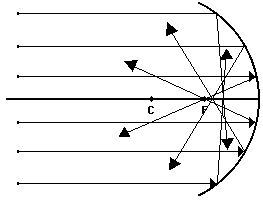
The diagram below shows six incident rays traveling parallel to the principal axis and reflecting off a concave mirror. The six corresponding reflected rays are also shown. In the diagram we can observe a departure from the expected or proper course; there is an aberration. The two incident rays that strike the outer edges (top and bottom) of the concave mirror fail to pass through the focal point. This is a departure from the expected or proper course.
This problem is not limited to light that is incident upon the mirror and traveling parallel to the principal axis. Any incident ray that strikes the outer edges of the mirror is subject to this departure from the expected or proper course. A common Physics demonstration utilizes a large demonstration mirror and a candle. The image of the candle is first projected upon a screen and focused as closely as possible. While the image is certainly discernible, it is slightly blurry. Then a cover is placed over the outer edges of the large demonstration mirror. The result is that the image suddenly becomes more clear and focused. When the problematic portion of the mirror is covered so that it can no longer focus (or mis-focus) light, the image appears more focused.
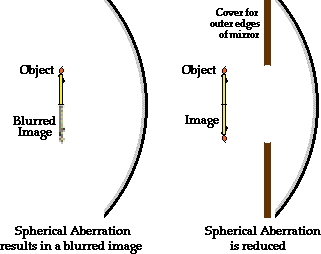
Spherical aberration is most commonly corrected by use of a mirror with a different shape. Usually, a parabolic mirror is substituted for a spherical mirror. The outer edges of a parabolic mirror have a significantly different shape than that of a spherical mirror. Parabolic mirrors create sharp, clear images that lack the blurriness which is common to those images produced by spherical mirrors.