Chapter 20: Refraction and Lenses - Lesson 6: The Eye
Nearsightedness and its Correction
Hold down the T key for 3 seconds to activate the audio accessibility mode, at which point you can click the K key to pause and resume audio. Useful for the Check Your Understanding and See Answers.
The human eye's ability to accommodate allows it to view focused images of both nearby and distant objects. As 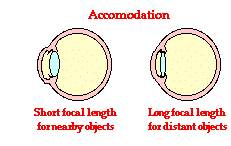 mentioned earlier in Lesson 6, the lens of the eye assumes a large curvature (short focal length) to bring nearby objects into focus and a flatter shape (long focal length) to bring a distant object into focus. Unfortunately, the eye's inability a wide variance in focal length leads to a variety of vision defects. Most often, the defect occurs at one end of the spectrum - either the inability to assume a short focal length and focus on nearby objects or the inability to assume a long focal length and thus focus on distant objects.
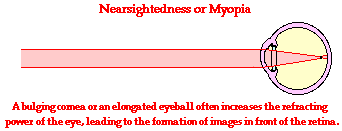
Nearsightedness or myopia is the inability of the eye to focus on distant objects. The nearsighted eye has no difficulty viewing nearby objects. But the ability to view distant objects requires that the light be refracted less. Nearsightedness will result if the light from distant objects is refracted more than is necessary. The problem is most common as a youth, and is usually the result of a bulging cornea or an elongated eyeball. If the cornea bulges more than its customary curvature, then it tends to refract light more than usual. This tends to cause the images of distant objects to form at locations in front of the retina. If the eyeball is elongated in the horizontal direction, then the retina is placed at a further distance from the cornea-lens system. Subsequently the images of distant objects form in front of the retina. On the retinal surface, where the light-detecting nerve cells are located, the image is not focused. These nerve cells thus detect a blurry image of distant objects.
Correcting for Nearsightedness
The cure for the nearsighted eye is to equip it with a diverging lens. Since the nature of the problem of nearsightedness is that the light is focused in front of the retina, a diverging lens will serve to diverge light before it reaches the eye. This light will then be converged by the cornea and lens to produce an image on the retina.
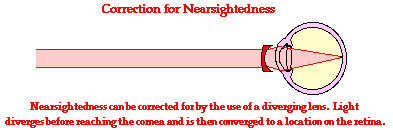
(Note: In the diagram above that the light approaching the eye from a distant object is traveling as a bundle of rays that are roughly parallel to each other. Suppose for a moment that the distant object is the lettering on the chalk board in the front of the room as you sight at it from the back of the room. Geometrically, whatever light rays from a particular letter or word that reach your eye will be traveling roughly parallel to each other. This is not the case when viewing nearby objects as demonstrated on the previous page.)