Circular and Satellite Motion Legacy Problem #10 Guided Solution
Problem*
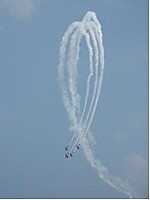
A 76-kg pilot at an air show performs a loop de loop with his plane. At the bottom of the 52-m radius loop, the plane is moving at 48 m/s. Determine the normal force acting upon the pilot.
Audio Guided Solution
A pilot at an airshow is doing a loop-the-loop. The mass the pilot is given is 76 kilograms, and the speed at which the pilot is moving at the very bottom of this loop is 48 meters per second. That's the V in our A equal V squared over R equation. And I know that the radius at the bottom of the loop is 52 meters. Knowing the V and knowing the R, I can calculate the acceleration. I'm eventually asked to determine the normal force acting upon the pilot. So my understanding is that if I can calculate the acceleration and then the net force, I ought to be able to reason what the normal force is based upon a free-body diagram. So going 48 squared over 52 gets me an acceleration value. It comes out to be 44.3077 meters per second per second. That's the acceleration, and if I multiply it by the mass of 76 kilograms and get a net force, it comes out to be 3,367.38 newtons. The direction of this net force would be towards the center of the circle. What I tend to draw is a section of the bottom of a circle, and then I put a dot at the 6 o'clock position. And I think, OK, which direction is the net force if it's towards the center of the circle for the 6 o'clock position? And the answer is it's got to be up because the center of the circle is above the 6 o'clock position. So the net force is 3,367.38 newtons up. I write that down. I'm going to use it later. Now I draw a free-body diagram for this dot at the 6 o'clock position. As always, there's a gravity force pulling down. Its value can be calculated as m times g, where m is 76 kilograms. This brings the gravity force to 744.8 newtons. Now there's a second force on the pilot, thankfully for the pilot, and that's the normal force. That's the seat pushing upwards on the pilot. It's got to be a big force because we need upward net force, and gravity is going down. So we have to have more normal force than gravity force such that when we add the two together as vectors, we get this 3,367.38 newtons. One way I approach this situation for finding the normal force is I say the net force is equal to the forces in the direction of the acceleration minus those that oppose it. Putting it that way, I have an equation that says that F net equal the F normal minus F gravity. That's just the net force. It's the forces in the direction of the acceleration minus those which oppose it. Now I rearrange that equation to be F normal equal F net plus F grav. I plug in 3,367.38 newtons for my F net, and I plug in 744.8 newtons in for my F grav, end up with 4,112.18 newtons. I can round that to two significant digits, and it's about 4,100 newtons.
Solution
4.1 x 10³ N
Habbits of an Effective Problem Solver
- Read the problem carefully and develop a mental picture of the physical situation. If necessary, sketch a simple diagram of the physical situation to help you visualize it.
- Identify the known and unknown quantities in an organized manner. Equate given values to the symbols used to represent the corresponding quantity - e.g., \(\descriptive{m}{m,mass} = 61.7\unit{kg}\), \(\descriptive{v}{v,velocity} = 18.5 \unit{\meter\per\second}\), \(\descriptive{R}{R,radius} = 30.9\unit{m}\), \(F_\text{norm} = \colorbox{gray}{Unknown}\).
- Use physics formulas and conceptual reasoning to plot a strategy for solving for the unknown quantity.
- Identify the appropriate formula(s) to use.
- Perform substitutions and algebraic manipulations in order to solve for the unknown quantity.
Read About It!
Get more information on the topic of Circular and Satellite Motion at The Physics Classroom Tutorial.