Reflection and Mirrors Legacy Problem #6 Guided Solution
Problem*
A meter stick (object) is placed in an upright position in front of a plane mirror as shown in the diagram below.
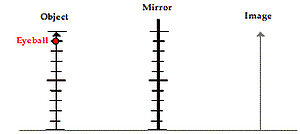
The image of the meter stick is equidistant from the mirror. Suppose that the meter stick is equipped with a working eyeball capable of viewing the top and the bottom of its image. The eyeball is located at the 90-cm mark on the meter stick. Using either a ray diagram or geometry, determine …
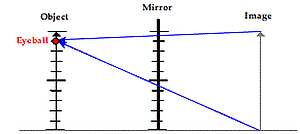
- The location of the intersection of the eye's line of sight with the mirror as the eyeball sights at the top of the image.
- The location of the intersection of the eye's line of sight with the mirror as the eyeball sights at the bottom of the image.
- The amount of mirror required by the meter stick to view the image.
Audio Guided Solution
There's a lot going on in this problem, and I'm going to try to step you through the answer using a ray diagram. You see that ray diagram drawn on this page. And then after I've done that, I'm going to try to stumble through a geometric proof to get to the same answer. What we have in this question is we have a mirror, and we have an object, and the object happens to be a meter stick. And on the meter stick, we're imagining there's an eyeball, and so this meter stick is sort of simulating a person. And of course, since there's a mirror, there's also an image, and the image is just as far behind the mirror as the object is in front of it. And you see the image of the object drawn that distance away. And the eyeball wishes to view the image of itself. And to do so, it must sight at the very top of the image and at the very bottom of the image. And as it does, there will be a ray of light that comes from the top of the image to the eyeball, and a ray of light that seems to come from the bottom of the image to the eyeball. Now, these rays of light would intersect the mirror at a given location, and in Part A, we wish to find the location where the ray of light or line of sight intersects the mirror as we look at the top of the image. And in Part B, the location where the ray of light or line of sight intersects the mirror as we sight at the bottom of the image. And finally, we wish to find the amount of mirror that this eyeball needs to have in order to view the image of itself. And so, as you can see in the ray diagram, a ray of light has been drawn from the top of the mirror, the top of the image towards the eyeball. And that ray of light appears to be intersecting the mirror at the 95 centimeter mark. That would be halfway from 90 centimeters to 100 centimeters. So, 5 centimeters above the actual eyeball location. And then if you look at the other ray of light that comes from the bottom of the image up to the eyeball, it seems to intersect the mirror at about the 45 centimeter mark. That would be halfway between 90 centimeters and 0 centimeters. And so, the Part B answer is 45 centimeters. And finally, the amount of mirror that this 1 meter person needs to use to view the entire image of itself would be the distance from the 95 centimeters Part A answer and the 45 centimeters Part B answer. And that distance is 50 centimeters. And it ends up that it will always be the case that this 50 centimeters distance will be one half the height of the object, which was 100 centimeters. In other words, in order to view an entire image of yourself within a plain mirror, you need to have an amount of mirror that's equal to exactly one half your height. And oddly enough, as long as it's truly a plain mirror, it doesn't matter where you put yourself, what distance you are from the mirror, it's always one half the height. Now, that's sort of the ray diagram answer, and now I'm going to try to stumble through a geometric proof of the same answer. So, let's begin by imagining that this entire area here is divided up into two rectangles. The first rectangle is the rectangle that has as its corners the eyeball location, the top of the object, the top of the image, and then a point below the top of the image that's at the same height as the eyeball. That's a very narrow and wide rectangle, and the line of sight happens to be the diagonal of that rectangle, and the mirror line happens to be the vertical midline of that rectangle. And as such, we can imagine that that diagonal line intersects the vertical mirror line at its midpoint. And so, the distance from 90 centimeters up to where that ray of light intersects the mirror is simply 5 centimeters. Then there's another imaginary rectangle in here that has as its corners the eyeball location, the bottom of the object, the bottom of the image, and then another point on the image which is at the same height as the eyeball, which is 90 centimeters. And then you'll notice also that this second line of sight also intersects the mirror line, which is the vertical midline, at a point which is at its midpoint, and that's the midpoint between 90 and 0 centimeters, and that would be 45 centimeters, and there you have the answer to Part B. And now the answer to Part C just comes from subtracting the 95 centimeters for Part A answer and the 45 centimeters for Part B answer, and you get 50 centimeters. And that's my stumbling through effort of giving a geometric proof.
Solution
- 95 cm
- 45 cm
- 50 cm
Habbits of an Effective Problem Solver
- Read the problem carefully and develop a mental picture of the physical situation. If necessary, sketch a simple diagram of the physical situation to help you visualize it.
- Identify the known and unknown quantities in an organized manner. Equate given values to the symbols used to represent the corresponding quantity - e.g., \(\descriptive{d_o}{d_o,distance object} = 24.2\unit{cm}\); \(\descriptive{d_i}{d_i,distance image} = 16.8\unit{cm}\); \(\descriptive{f}{f,focal length} = \colorbox{gray}{Unknown}\).
- Use physics formulas and conceptual reasoning to plot a strategy for solving for the unknown quantity.
- Identify the appropriate formula(s) to use. Perform substitutions and algebraic manipulations in order to solve for the unknown quantity.
Read About It!
Get more information on the topic of Reflection and Mirrors at The Physics Classroom Tutorial.