Sound Waves Legacy Problem #22 Guided Solution
Problem*
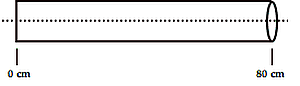
An 80-cm length closed-end air column is forced to vibrate in its fifth harmonic. Determine the locations of the nodal positions (positions where air is undisturbed). Express the locations in cm using the diagram below. Note that the closed end is at 0 cm.
Audio Guided Solution
A closed-in air column is simply a long column of air, usually enclosed within a tube, which has on one end an open end exposed to the surrounding air or atmosphere, and on the other end it's actually sealed off and closed. Now when you blow into it or somehow vibrate the air inside of it, there's a collection of frequencies at which it naturally vibrates at. If you get the air to vibrate at these frequencies, you'll hear a loud sound, and the air is vibrating in what's known as a standing wave pattern, with positions which aren't vibrating at all and other positions which are undergoing vigorous vibrations. These standing wave patterns can be seen if you click the link back to the physics classroom tutorial for the closed-in air column page. It's worth a look because those patterns are going to be extremely important for understanding how to approach this problem. Now we have an 80 cm long air column. It's vibrating in what's called the 5th harmonic. Being that it's vibrating in the 5th harmonic means that you're going to have a displacement node at the closed-in and a displacement antinode at the open-in. Because at the closed-in, air won't be moving at all, and at the open-in, air will be vigorously vibrating back and forth, back and forth. Now between the closed-in and the open-in, there are going to be two additional nodes and two additional antinodes. And if I were to break this 80 cm length up into five equal length sections, I could try to figure out the positions of all these nodes and antinodes, this question asking me about the position of the nodes. So dividing 80 cm by 5 gives you 16 cm, and 16 cm from the 0 cm mark will be an antinode. Another 16 cm from that mark will be a node, putting the first node past 0 cm at 32 cm. Go another 16 cm to 48 cm and you have an antinode. Go another 16 cm to 64 cm and you have your third node, the second one between the ends. Now go another 16 cm and you have your final antinode, putting again the antinode at the 80 cm mark, the open-in, just as we suspected. So the answer to where are the nodal positions are at 0 cm, 32 cm, and 64 cm.
Solution
Nodes are located at 0 cm, 32 cm, and 64 cm
Habbits of an Effective Problem Solver
- Read the problem carefully and develop a mental picture of the physical situation. If necessary, sketch a simple diagram of the physical situation to help you visualize it.
- Identify the known and unknown quantities and record in an organized manner, often times they can be recorded on the diagram itself. Equate given values to the symbols used to represent the corresponding quantity (e.g., \(\descriptive{v}{v,velocity} = 345\unit{\meter\per\second}\), \(\descriptive{λ}{λ,wavelength} = 1.28 \unit{m}\), \(\descriptive{f}{f,frequency} = \colorbox{gray}{Unknown}\)).
- Use physics formulas and conceptual reasoning to plot a strategy for solving for the unknown quantity.
- Identify the appropriate formula(s) to use.
- Perform substitutions and algebraic manipulations in order to solve for the unknown quantity.
Read About It!
Get more information on the topic of Sound Waves at The Physics Classroom Tutorial.