Chapter 4: Compounds, Names, and Formulas - Lesson 3: Acids - Names and Formulae
Naming Acids (no O Atoms)
Getting your Trinity Audio player ready...
Hold down the T key for 3 seconds to activate the audio accessibility mode, at which point you can click the K key to pause and resume audio. Useful for the Check Your Understanding and See Answers.
The Big Idea
This lesson explains how to write formulas and names for acids that lack oxygen. Apply the hydro- prefix, add the anion root with an '-ic' ending, and finish with the word acid, yielding names like hydroiodic acid (HI) and hydrocyanic acid (HCN).What is an Acid?
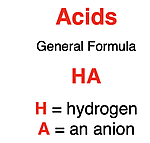 There is a certain class of compounds that produce H+ ions when dissolved in water. We refer to such compound as acids. The ability of acids to produce H+ when dissolved is most often due to the presence of H in the molecule. The general formula of an acid is HA where A is an anion. We will devote an entire chapter to the discussion of acids in Chapter 15 of this Chemistry Tutorial. For now, we simply want to learn how to name and write formulae (plural for formula) for acids.
How to Recognize Two Types of Acids
The manner in which we name acids is dependent upon the nature of the anion A that accompanies H in the acid, HA. We distinguish between two types of anions. One type contains oxygen and the other that does not. The anions that contain oxygen are referred to as oxyanions. These can include nitrate (NO3-), sulfate (SO42-), phosphate (PO43-), and many others. The non-oxygen containing anions can be nonmetal elements like fluoride (F-), chloride (Cl-), bromide (Br-), and many others or even polyatomic ions like cyanide (CN-). Several examples of both types of acids are listed below.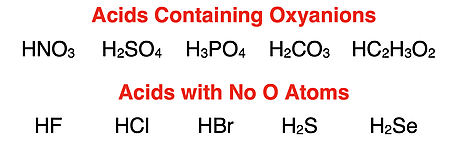
We will discuss the names and formulae of acids containing oxyanions on the next page of Lesson 3. We will concern ourselves on this page with the names and formulae of those acids that do not contain oxygen atoms.
Rules for and Examples of Naming Acids (with no O atoms)
The three acids displayed below do not contain oxygen atoms. The names of each are given.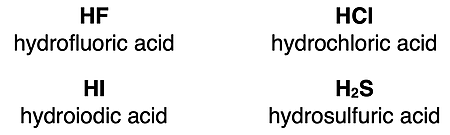
A clear pattern is shown in these names. There are two words. The second word is acid. The first word begins with hydro- and ends with -ic. The hydro- precedes the root name for the anion. The ending of the anion is removed and the -ic ending replaces it. We can summarize this procedure as follows:

How to Write Formula if Given the Name of an Acid
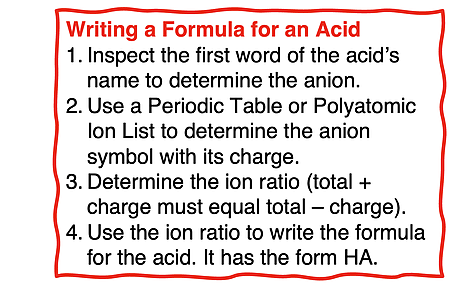 If you understand how acids (without oxygen atoms) are named, then the process of writing the formula when given the name is relatively straight forward. Attention must be given to the relative ratio of the H+ ion to the anion. This ratio determines the subscripts in the formula. The moment you see the hydro- as the beginning of the name, you will know that the anion is likely a nonmetallic element. But the anion could also be a polyatomic ion that does not contain oxygen. An inspection of our polyatomic ion list reveals that most of the anions contain oxygen. The two notable exceptions are cyanide (CN-) and thiocyanate (SCN-). Inspect the first word of the name between the hydro- and the -ic to identify the ion that is with H+. Use a periodic table or polyatomic ion list to determine its symbol and charge. Then use the charges to determine the ratio of H+ to the anion in the compound. Use the ion ratio to write the formula with the appropriate subscripts.
Before You Leave - Practice and Reinforcement
Now that you've done the reading, take some time to strengthen your understanding and to put the ideas into practice. Here's some suggestions.
- Download our Study Card on Acids - Names and Formulae. Save it to a safe location and use it as a review tool. The Study Card covers all of Lesson 3, not just this page.
- The Check Your Understanding section below includes questions with answers and explanations. It provides a great chance to self-assess your understanding.
Check Your Understanding of the Names and Formulae of Acids
Use the following questions to practice the skill of naming and writing formulae for acids that do not contain oxygen atoms. Tap the Check Answer buttons when ready.1. What's wrong with the following names? Make the corrections.
- H2S → sulfuric acid Check Answer
- HI → hydroiodine acid Check Answer
2. Write the names for the for the following acids.
- H2Te → Check Answer
- HF → Check Answer
- HCN → Check Answer