Newton's Laws Legacy Problem #12 Guided Solution
Problem*
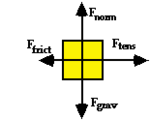
Unfortunately for Vanessa, the wheels on her suitcase are not working. She pulls on the strap in an effort to budge it from rest and drag it to the curbside check-in desk. The free body diagram at the right depicts the forces acting upon the suitcase. Use force values to determine the net force, the mass and the acceleration of the suitcase. The values of the individual forces are:
\(F_\text{grav} = F_\text{norm} = 207 N\)
\(F_\text{tens} = 182 N\)
\(F_\text{frict} = 166 N\)
Audio Guided Solution
The diagram that you see at the right is known as a free body diagram. It provides a visual representation of the types of forces which are acting up on Vanessa's suitcase. Each force is represented by an arrow, and the arrow points in the direction of the force. Each arrow is also labeled. The label tells us the type of force which is acting in that direction. You can read more about these forces if you use the link that goes to the physics classroom that you find below this question. Here we are to calculate three things based upon the diagram. We're to calculate the net force, we're to calculate the mass, and we're to calculate the acceleration. Two of these things are vectors. They have a magnitude, a value, and a direction. So as we express the answer, we're going to be expressing both magnitude and direction for the net force and for the acceleration. Determining the net force involves adding up all the individual forces as vectors. That is, you take the up and the down forces, which act in opposite directions, and you add them. You take the right and the left forces, which also act in opposite directions, and you add them. When adding forces which act in opposite directions, you have to assume some form of a reference frame in which, say, up is positive and down is negative, or to the right is positive and to the left is negative. So as you add 207 for the F-norm up and 207 for the F-gram down, you'd be adding 207 plus negative 207. That adds to zero. You do the same thing for the horizontal forces. The 182 newtons to the right plus the 166 newtons to the left would add up to 16 newtons since the leftward force would be treated as a negative force. So you have a net force of 16 newtons to the right. Now what you have to do is determine the mass and the acceleration. The mass is important because in order to calculate the acceleration, you'd have to do this F-net value of 16 divided by a mass. So you have to think, how do I get the acceleration? So you look at what you have, and one thing that you have is the F-graph, and having these concepts linked in your mind will help significantly. The F-graph and the mass are always related. The F-graph is known as the weight of the object, and it's related to the mass according to the equation weight equals mg, where the g is 9.8 newtons per kilogram. So take the 207 newtons for F-graph and take the 9.8 for g, plug it into that equation and calculate your mass. Once you determine your mass, you can now use the equation A equals F-net over m in order to calculate the acceleration. Once you get the value, don't forget about the direction. It's always, always, always in the same direction as the net force.
Solution
Fnet: 16 N, right
m: 21.1 kg
a: 0.76 m/s/s, right
Habbits of an Effective Problem Solver
- Read the problem carefully and develop a mental picture of the physical situation. If necessary, sketch a simple diagram of the physical situation to help you visualize it.
- Identify the known and unknown quantities in an organized manner. Equate given values to the symbols used to represent the corresponding quantity - e.g., \(v_o = \units{0}{\unitfrac{m}{s}}\); \(a = \units{4.2}{\unitfrac{m}{s^2}}\); \(v_f = \units{22.9}{\unitfrac{m}{s}}\); \(d = \colorbox{gray}{Unknown}\).
- Use physics formulas and conceptual reasoning to plot a strategy for solving for the unknown quantity.
- Identify the appropriate formula(s) to use.
- Perform substitutions and algebraic manipulations in order to solve for the unknown quantity.
Read About It!
Get more information on the topic of Newton's Laws at The Physics Classroom Tutorial.