Newton's Laws Legacy Problem #13 Guided Solution
Problem*
The shipment of the new physics supplies has arrived. They are placed on the freight elevator and transported up to the third floor for delivery to the physics rooms. The free body diagram at the right depicts the forces acting upon the freight elevator as it begins its ascent through the elevator shaft. Use force values to determine the net force, the mass and the acceleration of the elevator. The values of the individual forces are:
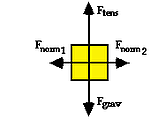
\(F_\text{tens} = 2340 N\)
\(F_\text{grav} = 2120 N\)
\(F_\text{norm1} = F_\text{norm2} = 276 N\)
Audio Guided Solution
The diagram that you see at the right is known as a free body diagram. It provides a visual representation of the forces, or the pushes and pulls, which act up on our freight elevator. In the diagram, each force is represented by an arrow. The arrow points in the direction of the force. Each arrow is labeled with a symbol. The symbols represent the types of forces which are acting in that direction. You can read more about these symbols if you use the link that goes to the physics classroom that you see below this audio help file. In this problem, we're to calculate three things. The net force acting on our freight elevator, its mass, and its acceleration. We can determine the net force if we understand it to be the vector sum of all the individual forces. That is, you need to take all four forces and add them up as though they are vectors. You would treat the up force and the down force as being in opposite directions, and one would have a positive and the other would have a negative value. So you would take the 2340 Newtons up and you would add to it the 2120 Newtons down, treating that 2120 as a negative value. What you end up getting is 220 Newtons up for the vertical addition of the two forces. Now if you look at the horizontal forces, one is pointing to the left and the other is pointing to the right, opposite directions, and they have the same magnitude. So those two forces add up to zero. So our net force is 220 Newtons up. Now if you need to determine the acceleration, you have to think of Newton's second law equation, A equals F net over M. So in order to get the A, you need to know both F net, which we just calculated, and the mass. So now you have to think hard. How can you get the mass from this given information? They don't directly tell you, but you can use what you know to figure it out. You know that F grab, or the weight of the object, is 2120 Newtons. That's listed in the problem. So if you take that weight and plug it into the equation, weight equals mg, where g is 9.8 Newtons per kilogram, you can determine the mass of the object in units of kilograms. Now once you get that mass, it's a straightforward process to get the acceleration. The acceleration is equal to F net over M, the 220 Newtons divided by the mass. Now once you get that value, don't forget to include the direction. The direction of the acceleration is always, always, always in the same direction as the net force.
Solution
- Fnet: 220 N, up
- m: 216 kg
- a: 1.0 m/s/s, up
Habbits of an Effective Problem Solver
- Read the problem carefully and develop a mental picture of the physical situation. If necessary, sketch a simple diagram of the physical situation to help you visualize it.
- Identify the known and unknown quantities in an organized manner. Equate given values to the symbols used to represent the corresponding quantity - e.g., \(v_o = \units{0}{\unitfrac{m}{s}}\); \(a = \units{4.2}{\unitfrac{m}{s^2}}\); \(v_f = \units{22.9}{\unitfrac{m}{s}}\); \(d = \colorbox{gray}{Unknown}\).
- Use physics formulas and conceptual reasoning to plot a strategy for solving for the unknown quantity.
- Identify the appropriate formula(s) to use.
- Perform substitutions and algebraic manipulations in order to solve for the unknown quantity.
Read About It!
Get more information on the topic of Newton's Laws at The Physics Classroom Tutorial.