Work and Energy Legacy Problem #15 Guided Solution
Problem*
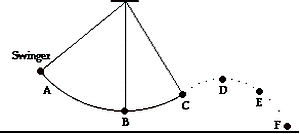
Olive Udadi is at the park with her father. The 26-kg Olive is on a swing following the path as shown. Olive has a speed of 0 m/s at position A and is a height of 3.0-m above the ground. At position B, Olive is 1.2 m above the ground. At position C (2.2 m above the ground), Olive projects from the seat and travels as a projectile along the path shown. At point F, Olive is a mere picometer above the ground. Assume negligible air resistance throughout the motion. Use this information to fill in the table.
| Position | Height (m) | PE (J) | KE (J) | TME (J) | Speed (m/s) |
|---|---|---|---|---|---|
| A | 3.0 | 0.0 | |||
| B | 1.2 | ||||
| C | 2.2 | ||||
| F | 0 |
Audio Guided Solution
This problem pertains to I Love You Daddy, who is at the park swinging in the swing. On her last swing, she jumps from the swing and follows the trajectory that you see shown on the diagram. There are six points marked on the trajectory, and for four of the points, we are to do an analysis and fill in the table that is provided. We are to determine the P.E. and the K.E. and the total mechanical energy values and the speed values at these points. I am going to begin the problem by calculating the total mechanical energy at point A. Point A is a strategic point because we know the height and we know the speed. Knowing these two quantities allows us to calculate the P.E., the K.E., and the total mechanical energy. Then I am going to presume that the total amount of mechanical energy is conserved, since the amount of air resistance can be neglected during the motion. So if I assume that the total mechanical energy is conserved, then I can figure out from the heights the P.E. and subtract that from the T.M.E. to calculate the K.E. And any time we know the K.E. and the mass of an object, we can find its speed. So that's my strategy. Here we go. For point A, the P.E. can be calculated by using the equation P.E. equals mgh, where the m is 26 kilograms, the g is 9.8 newtons per kilograms, and the h is 3 meters. When I do the multiplication, I get 764.4 joules. The K.E. at this location is zero, since the speed is zero. So the total mechanical energy is simply equal to the P.E. for this location. That's 764.4 joules. I can fill in the first row of the table. Now once I do that, I can also take the 764.4 joules for the total mechanical energy, and since it's conserved, I can fill in row B, C, and F for that column. Now I go to row B, where I know the height to be 1.2 meters. And if we know the height and the mass, we can always calculate the P.E. Doing that involves multiplying 26 by 9.8 by 1.2. When I do, I get 305.76 joules. Now the 305.76 joules is one of the two forms of mechanical energy. The total amount's got to add to 764.4 joules. So if I subtract this 305.76 from the total, the difference becomes 458.64 joules, and that's my kinetic energy. So finally, for row B, I'm going to calculate the speed of the object by saying this K.E. value of 458.64 is equal to 1 half times the mass of 26 times the V squared. Solving for V involves multiplying both sides of the equation by 2, and dividing through by 26, then taking the square root of each side. I get 5.9397 meters per second. I can round that to a few significant digits. In row C of this table, I can do much the same thing, given the height is 2.2 meters. I can calculate the P.E. going mgh. That gives me 560.56 joules. And then I can take this 560.56 joules of P.E. and subtract it from the total in order to find the K.E. It comes out to be 203.84 joules. Now I can say 203.84 joules is equal to 1 half times the 26 times the V squared for this row. And when I do, I can solve for V. I get 3.9596, which I can round to two significant digits. Finally, in row F, I'm told that the height is zero. This makes for an easier problem. If the height is zero, the P.E. is zero, and all the energy is in the form of K.E. So the amount of K.E. that I have is 764.4 joules. And I set this equal to 1 half times 26 times V squared. Solving for V by multiplying by 2 and dividing by 26 and then taking the square root gives me 7.668 meters per second for this V. I can round this to 7.7 meters per second.
Solution
| Position | Height (m) | PE (J) | KE (J) | TME (J) | Speed (m/s) |
|---|---|---|---|---|---|
| A | 3.0 | 760 | 0 | 760 | 0.0 |
| B | 1.2 | 310 | 460 | 760 | 5.9 |
| C | 2.2 | 560 | 200 | 760 | 4.0 |
| F | 0 | 0 | 760 | 760 | 7.7 |
Habbits of an Effective Problem Solver
- Read the problem carefully and develop a mental picture of the physical situation. If necessary, sketch a simple diagram of the physical situation to help you visualize it.
- Identify the known and unknown quantities in an organized manner. Equate given values to the symbols used to represent the corresponding quantity - e.g., \(\descriptive{v}{v,velocity}_\descriptive{o}{o,original} = 0 \unit{\meter\per\second}\); \(\descriptive{a}{a,acceleration} = 4.2\unit{\meter\per\square\second}\); \(\descriptive{v}{v,velocity}_\descriptive{f}{f,final} = 22.9 \unit{\meter\per\second}\); \(\descriptive{d}{d,distance} = \colorbox{gray}{Unknown}\).
- Use physics formulas and conceptual reasoning to plot a strategy for solving for the unknown quantity.
- Identify the appropriate formula(s) to use.
- Perform substitutions and algebraic manipulations in order to solve for the unknown quantity.
Read About It!
Get more information on the topic of Work and Energy at The Physics Classroom Tutorial.