Light Waves and Colors Legacy Problem #10 Guided Solution
Problem*
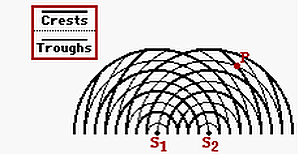
Like light waves, water waves emerging from two sources interferes in the space surrounding the sources to produce a pattern of nodes and antinodes lying along lines. The diagram at the right represents the interference pattern created by two water waves. The waves were created by two objects bobbing up and down in phase at the same frequency. Point P on the pattern is a distance of 34.0 cm from S1 and 23.8 cm from S2. Determine the wavelength (in cm) of the water waves.
Audio Guided Solution
When light from two sources create waves, an interference pattern results, resulting from the constructive and destructive interference of the waves from the two sources. If the sources have this same frequency in wavelength, then what we will observe is a very stable pattern characterized by a collection of nodes and antinodes, with the nodes lying along lines and the antinodes lying along their lines. We see such a pattern in the diagram to the right of this question, and what we can do with the pattern is we can analyze it in order to determine the wavelength of the waves. One of the big principles is that the path difference, that is, the difference in distance traveled for light waves or water waves or whatever waves, from one source to a point compared to the other source to the point, is equal to either a whole or a half number of wavelengths. It is equal to a whole number of wavelengths if the point that we are speaking of lies along an antinode, and a half number of wavelengths if the point we are speaking of lies along a node. Now here the point P on our diagram is on the second nodal line, and so the path difference is equal to one and a half wavelengths. The path difference is simply the difference in distance traveled, the 34.0 centimeters minus the 23.8 centimeters. That comes out to be a 10.2 centimeter difference in distance traveled. I can divide that by 1.5, and I end up finding the wavelength to be 6.8 centimeters.
Solution
6.8 cm
Habbits of an Effective Problem Solver
- Read the problem carefully and develop a mental picture of the physical situation. If necessary, sketch a simple diagram of the physical situation to help you visualize it.
- Identify the known and unknown quantities and record in an organized manner, often times they can be recorded on the diagram itself. Equate given values to the symbols used to represent the corresponding quantity (e.g., \(\descriptive{v}{v,velocity} = \num{3e8}\unit{\meter\per\second}\), \(\descriptive{λ}{λ,wavelength} = 554 \unit{\nano\meter}\), \(\descriptive{f}{f,frequency} = \colorbox{gray}{Unknown}\)).
- Use physics formulas and conceptual reasoning to plot a strategy for solving for the unknown quantity.
- Identify the appropriate formula(s) to use.
- Perform substitutions and algebraic manipulations in order to solve for the unknown quantity.
Read About It!
Get more information on the topic of Light Waves and Colors at The Physics Classroom Tutorial.