Light Waves and Colors Legacy Problem #14 Guided Solution
Problem*
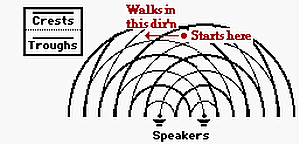
Two audio speakers have been arranged in a large room so as to produce a sound interference pattern. Miguel starts at a position on the central antinodal line and begins to slowly walk parallel to the imaginary line connecting the speakers. Miguel stops at the first position of minimum loudness. At this position, he is a distance of 17.9 m from the nearest speaker. Sound waves travel through the room at 345 m/s and the speakers are sounding out a frequency of 244 Hz.
- Determine the wavelength of the sound waves.
- Determine the distance from Miguel to the furthest speaker.
Audio Guided Solution
This problem pertains to two-point source sound interference pattern. In a two-point source interference pattern, crests interfere with troughs and other crests and troughs with troughs in such a manner to produce a series of nodes and antinodes in the space that surround the sources. In this case, the sources are speakers. And these nodes and antinodes tend to lie along lines. Further information about these patterns and how they're formed and the equations and mathematics that relate features of the pattern can be found if you click the little link back to the tutorial, the Physics Classroom tutorial, where you'll see a collection of pages where the whole topic is explained in an easy-to-understand language. Now, here we have Miguel, who starts at a position on the central antinode line and begins to walk parallel to the speakers. And as he does, he would encounter a series of soft sounds and loud sounds as he listens carefully with one ear. Now, when he reaches a point of minimum loudness, what we could say is that he's clearly on a nodal position. Now, if he's on a nodal position as described as the first nodal position, then what we would have to say is that the difference in distance traveled from the two different speakers to that one point where he's standing is equal to one-half of a wavelength. So, if we can find the wavelength, and that's the first part of this question, then what we can do is take one-half of its value, and that will give us what's called the path difference. The difference in the distance traveled from one of the speakers to that very point. And from that path difference, we can calculate the distance from that point to the furthest speaker. So, let's begin by using the wave equation to calculate the wavelength. In doing so, we demand that we say v equal f times lambda, and then rearrange the equation for lambda. The equation becomes lambda equal v over f, and substituting in values of v, 345 meters per second, and f of 244 hertz, gives me a wavelength value of 1.4139 meters. I can express that to three significant digits as 1.41 meters. Now, in the next part of the question, part b, that's where the two-point source interference stuff comes in. So, what we know is that the distance from one speaker, the nearest one, the left one, to where Miguel is standing is 17.9 meters. And we know, or at least we can calculate the path difference by going one-half times the wavelength of 1.4139 meters. That's a path difference of 0.7070 meters. That means that this point that Miguel is standing on is 0.707 meters further from the furthest source than it is from the nearest source, which is 17.9 meters away. So, adding the 0.7070 to the 17.9 meters gives me a value of 18.6070 meters, and I can round that to the first decimal place.
Solution
- 1.41 m
- 18.6 m
Habbits of an Effective Problem Solver
- Read the problem carefully and develop a mental picture of the physical situation. If necessary, sketch a simple diagram of the physical situation to help you visualize it.
- Identify the known and unknown quantities and record in an organized manner, often times they can be recorded on the diagram itself. Equate given values to the symbols used to represent the corresponding quantity (e.g., \(\descriptive{v}{v,velocity} = \num{3e8}\unit{\meter\per\second}\), \(\descriptive{λ}{λ,wavelength} = 554 \unit{\nano\meter}\), \(\descriptive{f}{f,frequency} = \colorbox{gray}{Unknown}\)).
- Use physics formulas and conceptual reasoning to plot a strategy for solving for the unknown quantity.
- Identify the appropriate formula(s) to use.
- Perform substitutions and algebraic manipulations in order to solve for the unknown quantity.
Read About It!
Get more information on the topic of Light Waves and Colors at The Physics Classroom Tutorial.