Light Waves and Colors Legacy Problem #3 Guided Solution
Problem*
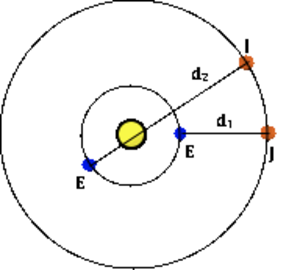
In the 1600s, Ole Roemer became one of the first scientists to make a measurement of the speed of light. Roemer observed the orbits of Jupiter’s nearest moon and recognized that its orbital period was observed to be approximately 22 minutes longer when measured from Earth when it was furthest from Jupiter compared to when it was closest to Jupiter. Roemer reasoned that the difference was due to the fact that it took longer for light from Jupiter to travel the extra distance when Earth’s position was on the opposite side of the Sun from Jupiter. The distance d2 is 2.98x10¹¹ m greater than the distance d1. Determine Roemer’s estimate of the speed of light in the 1600s.
Audio Guided Solution
In the latter half of the 1600s, Danish astronomer Ole Romer was able to measure the speed of light. He did it by observing the moons of Jupiter. They were eclipsed behind Jupiter for a certain amount of time. But the amount of time that they were eclipsed was affected by where Ole was when he was observing the moons of Jupiter. The graphic at the right makes an attempt to explain. In order to observe the eclipse of the moon Io that was orbiting about Jupiter, he would have to observe light coming from Io to the Earth. So as he looked through his telescope at the moon Io, he would notice it would begin to orbit around Jupiter and would hide or be eclipsed by Jupiter. And then it would come out on the other side and the eclipse would be over. Now he observed that when he was at the position furthest from Jupiter in Earth's orbit about the sun, that it actually took 22 minutes longer for the moon of Jupiter to be eclipsed by Jupiter. Now when Ole was observing this event from a distance further from Jupiter on the opposite side of the sun, light would have to travel an extra 2.98 times 10 to the 11th meters further in order to reach his telescope. So that extra 22 minutes, which represented the extra time it took for Io to be eclipsed by Jupiter, is equivalent to the time it takes to travel that extra distance of 2.98 times 10 to the 11th meters. So now Ole has a distance and a time that he can use to calculate the speed of light. So if we first get the 22 minutes into units of seconds by multiplying by 60, we get 1,320 seconds. And if we divide that number into the distance of 2.98 times 10 to the 11th meters, we can get the speed of light. It comes out to be 2.257 times 10 to the 8th meters per second. We could round that to two significant digits and we could observe that he had a 25% error based on today's known value. But for that day, that was a great measurement of the speed of light.
Solution
2.2x10⁸ m/s
Habbits of an Effective Problem Solver
- Read the problem carefully and develop a mental picture of the physical situation. If necessary, sketch a simple diagram of the physical situation to help you visualize it.
- Identify the known and unknown quantities and record in an organized manner, often times they can be recorded on the diagram itself. Equate given values to the symbols used to represent the corresponding quantity (e.g., \(\descriptive{v}{v,velocity} = \num{3e8}\unit{\meter\per\second}\), \(\descriptive{λ}{λ,wavelength} = 554 \unit{\nano\meter}\), \(\descriptive{f}{f,frequency} = \colorbox{gray}{Unknown}\)).
- Use physics formulas and conceptual reasoning to plot a strategy for solving for the unknown quantity.
- Identify the appropriate formula(s) to use.
- Perform substitutions and algebraic manipulations in order to solve for the unknown quantity.
Read About It!
Get more information on the topic of Light Waves and Colors at The Physics Classroom Tutorial.