Light Waves and Colors Legacy Problem #25 Guided Solution
Problem*
Noah Formula lives near the airport and frequently notices poor AM radio reception occurring as planes use the approach path which passes over his home. Having just finished the unit on light wave behavior, Noah now understands that the reception problem occurs because of radio wave signals reflecting off the planes and destructively interfering with waves which approach his antenna directly from the station. Noah’s favorite station – WFIZ – broadcasts at 1240 kHz and is located several miles from his home. Determine the five lowest heights above his home for which reflection off of planes will lead to destructive interference of this 1240 kHz signal. (Assume that the reflected waves do not undergo a phase change upon reflection off the plane.)
Audio Guided Solution
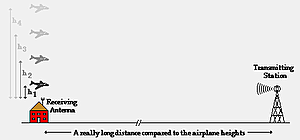
Here is an example of a problem which is mathematically easy, but conceptually difficult. Before I discuss the physics concepts behind this problem, I want to call your attention to the link at the bottom of the page that leads back to the physics classroom tutorial. There you'll see a link and a page titled, Other Applications of Two-Point Source Interference Patterns. And on that page, the discussion centers around situations like this problem in which there are interference taking place, and it's not your typical two-point source interference, but it's two paths going to the same point, and that's what we have in this problem, where we have a single source with light waves taking two different paths to the same receiver. Receiver being the antenna on top of NOAA formula's home, and he likes to listen to broadcast at a frequency of 1240 kilohertz. From that frequency, we can get the wavelength, and we know that we would get destructive interference whenever there's two waves meeting up at the same point in such a manner that the crest, the so-called crest of one, intersects or interferes with the so-called trough of another wave. Now we actually have one source, two paths. One path being from the transmitting station directly to NOAA's antenna, and the other being a very long path, same path nearly, but hits a plane above his home and then reflects off the plane and down to the home itself. And that path is just a little bit longer because of, as you see in the diagram below, it has to kind of go up and then back down, just up a little bit and back down. It's not much, but the amount that it goes up and down is actually equal to the path difference. So the heights above the house of the planes for the various cases of destructive interference are representative of PD, path difference. We know that destructive interference occurs for the conditions that meet the equation PD equals m times lambda, where m takes on values of 1 half, 3 halves, 5 halves, and in this case, we wish to find the 5 lowest heights all the way up to 9 halves. So if I can find the wavelength, I can plug that into this equation, PD equals m lambda, and I can put in the various values of m, and I can calculate the heights or the path differences. So how do I get wavelength? Well, that's quite simple, actually, because I recognize that 1240 kilohertz happens to be the frequency. I can convert that to hertz, becomes 1.240 times 10 to the 6th hertz, and then I can use the wave equation and solve for wavelength. Wavelength equal the speed of light divided by the frequency. That would be 2.998 times 10 to the 8th meters per second divided by the frequency of 1.240 times 10 to the 6th hertz. That gives me a wavelength value of 241.77 meters. Now that I have the wavelength, I can plug that into my PD equation, where the PD is the height, and it's equal to 1 half, 3 halves, 5 halves, 7 halves, and 9 halves times the wavelength. It gives me 5 answers for the 5 lowest heights. Those answers come out to be, in the case of PD equal half, 121 meters, and the other m values give you 363, 604, 846, and 1088 meters.
Solution
121 m, 363 m, 604 km, 846 m, and 1088 m
Habbits of an Effective Problem Solver
- Read the problem carefully and develop a mental picture of the physical situation. If necessary, sketch a simple diagram of the physical situation to help you visualize it.
- Identify the known and unknown quantities and record in an organized manner, often times they can be recorded on the diagram itself. Equate given values to the symbols used to represent the corresponding quantity (e.g., \(\descriptive{v}{v,velocity} = \num{3e8}\unit{\meter\per\second}\), \(\descriptive{λ}{λ,wavelength} = 554 \unit{\nano\meter}\), \(\descriptive{f}{f,frequency} = \colorbox{gray}{Unknown}\)).
- Use physics formulas and conceptual reasoning to plot a strategy for solving for the unknown quantity.
- Identify the appropriate formula(s) to use.
- Perform substitutions and algebraic manipulations in order to solve for the unknown quantity.
Read About It!
Get more information on the topic of Light Waves and Colors at The Physics Classroom Tutorial.