Vectors and Projectiles Legacy Problem #10 Guided Solution
Problem*
Consider the map of the United States below. Given the scale that 1 cm = 340 km (original map size, actual size and scale will vary), a protractor and a ruler can be used to determine the magnitude and direction for the following trips. All directions are expressed using the counter-clockwise from east convention. For each trip, use the sine, cosine and tangent functions to determine the horizontal and vertical components of the displacement. Be sure to indicate E, W, N, or S as the direction for each component.
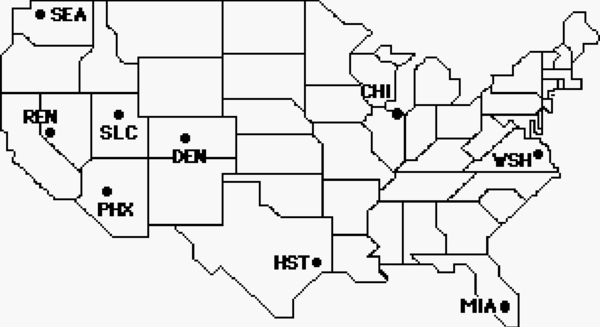
- Trip: Chicago to Denver. Displacement 1430 km, 187°
- Trip: Reno to Miami. Displacement 4030 km, 341°
- Trip: Seattle to Washington. Displacement 3480 km, 344°
- Trip: Houston to Salt Lake City. Displacement 2030 km, 143°
Audio Guided Solution
This problem involves a map and a table, and in the table are several listed trips. For each trip, the displacement from the beginning location to the final location is listed. It's listed with magnitude and direction. In fact, displacement will always have magnitude and direction. You'll notice the number 1430 kilometers for the first row of the table, and that's the magnitude of a trip from Chicago to Denver. And then it says comma 187 degrees, and that's the direction of that displacement. Now, if I think about that direction, 187 degrees, it may not seem quite like a direction to me, but that's a direction expressed as a counterclockwise angle of rotation from due east. Now, the physics classroom tutorial has a good discussion of what it means when we speak of that convention, and if you're having difficulty with it, you may want to go back and look at it. What we're asked to do is to find the north-south and the east-west displacements for these four trips. That's going to involve an understanding of what a component is in the use of the SOHCAHTOA, as we sometimes call it. Now, I'm going to kind of describe it, the long method, and then I'm going to describe the short method. I'm going to do that for the Chicago to Denver trip, and then for the other trips we'll go pretty quickly. Now, for the long method, what I might do is I might, right there on my map, draw a vector from Chicago towards Denver. That's a vector that's heading mostly west and a little bit south. In fact, I have the direction as 187 degrees, which would tell me that it's a vector that is relative to 180 degrees or west, rotated 7 degrees towards the south. We might call that 7 degrees southwest. So, it's a triangle that has a very, very small angle there, 7 degrees, with respect to the west. Now, what I want to do is find the west leg and the south leg. Now, to get the west leg, I have to imagine that being a vector that is heading due west that is the side adjacent to that 7 degree angle. And then what I have to do is imagine the 1430 kilometers being the hypotenuse of that triangle. And so, to find the side adjacent, I might say something like the cosine of 7 degrees is equal to the ratio of the side adjacent to the side up the side hypotenuse. I might write an equation that says cosine of 7 degrees equals W for west over 1430 kilometers and solve for the W. Now, I have to do a similar thing for the vertical component. For the southerly component, it's the side opposite that 7 degree angle. And so, I might say the sine of 7 degrees is the ratio of the side opposite to the side hypotenuse on that right triangle. In other words, I'd say sine of 7 equals S for south divided by 1430 and then solve for S. To make sure my calculator for both these calculations is in the mode of degrees, if you don't know how to do that, check with a classmate to figure out how to take your personal calculator and set it to the mode of degrees. Once I get that done, I can solve for my two answers and I get horizontal, vertical, or western and southern components. Now, the shortcut method involves simply using that 187 degrees counterclockwise from East Convention. In my calculation, it ends up that if you have a vector that's going southwest, you can find the southerly component if you go 1430 times the sine of 187 degrees. When you do that on the calculator, it will give you a negative answer. The negative simply means south for a north-south component. You use sine to get the north-south components and to get the east-west components, you use cosine. You go 1430 times the cosine of 187 degrees, that always gives you the east-west component. It will give it to you as a negative number where the negative for an east-west component simply means west. You can do the same thing for the Reno to Miami trip. For the x or horizontal component, you go 4030 times the cosine of 341. And for the southern component, you go 4030 times the sine of 341. You get a negative there for the southerly component. You can repeat the process. The idea is ax equals a times the cosine of theta, where theta is the counterclockwise angle of rotation with east. And ay equals a times the sine of theta, where theta is the counterclockwise angle of rotation for east. Good luck.
Solution
- Trip: Chicago to Denver. Horizontal Component 1419 km, West. Vertical Component: 174 km, South.
- Trip: Reno to Miami. Horizontal Component 3810 km, East. Vertical Component: 1312 km, South.
- Trip: Seattle to Washington. Horizontal Component 3345 km, East. Vertical Component: 959 km, South.
- Trip: Houston to Salt Lake City. Horizontal Component 1629 km, West. Vertical Component: 1228 km, North.
Habbits of an Effective Problem Solver
- Read the problem carefully and develop a mental picture of the physical situation. If necessary, sketch a simple diagram of the physical situation to help you visualize it.
- Identify the known and unknown quantities in an organized manner. Equate given values to the symbols used to represent the corresponding quantity - e.g., \(v_\text{ox} = \units{12.4}{\unitfrac{m}{s}}\), \(v_\text{oy} = \units{0.0}{\unitfrac{m}{s}}\), \(d_x = \units{32.7}{m}\), \(d_y = \colorbox{gray}{Unknown}\).
- Use physics formulas and conceptual reasoning to plot a strategy for solving for the unknown quantity.
- Identify the appropriate formula(s) to use.
- Perform substitutions and algebraic manipulations in order to solve for the unknown quantity.
Read About It!
Get more information on the topic of Vectors and Projectiles at The Physics Classroom Tutorial.