Vectors and Projectiles Legacy Problem #14 Guided Solution
Problem*
Mia Ander exits the front door of her home and walks along the path shown in the diagram at below (not to scale). The walk consists of four legs with the following magnitudes:
- A = 88 m
- B = 272 m
- C = 136 m
- D = 183 m
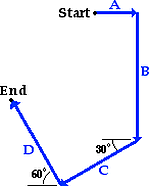
Determine the magnitude and direction of Mia's resultant displacement.
Audio Guided Solution
This is a very difficult problem, but what's most amazing about the problem is that while the problem's very difficult, it's just simply a collection of very easy steps that have to be done in order to get from the givens to the unknown. We have Meander who's walking around her home, and we see the path of Meander, and what I wish to do is to find the overall displacement, the sum of the four displacements, both magnitude and direction. One of the first things you need to commit yourself to in a problem such as this is being organized, documenting everything you have, and relying on visual information. So you'll notice that a table has been provided for you. This is a table in which we're going to list each vector, A, B, C, D, and for each one of those vectors we're going to find the amount of horizontal and vertical components. I'd recommend you use a table such as this to solve this problem. I can't imagine even a physics teacher trying to solve this problem without a table such as that. Now inside each cell of the table what you should be writing are the horizontal components and the vertical components for each of the vectors. You should list a number, a value, or a magnitude, and you should also list a direction. Something like north-south for the vertical, or east-west for the horizontal, or a plus-minus will do as well. Now what you'll need to do is you'll take each vector and find the horizontal and vertical components. So for vector A, that's an easy one, it's just 88 meters to the west. So inside my table under horizontal, I'm sorry, 88 meters to the east. In my table under horizontal I'm going to write positive 88, or 88 meters east. And under vertical I'm going to write zero, because there's no vertical moving in that little leg A. In leg B it's directly south, and so in that row of my table for horizontal I'm going to write zero. And for vertical I'm going to write 272 meters south. And don't forget directions here, because it's all about directions. Or I'm going to write negative 272 meters. Personally I prefer negative for situations like this. Now for C, that's a vector leg that has both horizontal and vertical components. So you'll need to find the magnitude and the direction of each component. So we'll talk direction first because it's quite easy. Notice that C is directed south, so I'll have a negative value under the vertical. And it's also directed west, so I'll have a negative under the horizontal column. And so to find the horizontals, a horizontal line at 30 degrees from C is going to be the side adjacent 30 degrees. So I'd have to use cosine to get horizontal. I'd have to go 136 cosine of 30. And to get vertical, I'd go 136 sine of 30 degrees. Put that in your table and make sure you're including negatives there. And then for D, let's talk direction first again. That's going west, so we have negative for horizontal. And it's going north, so we have positive for vertical. Now, to find D's magnitude and direction, I have to make a triangle there with a 60 degree angle down at the horizontal. And the right triangle has a horizontal side. The shorter side is going to be found as D cosine 60. And the longer side, the vertical side, will be found from D sine 60. So go 183 cosine 60 for horizontal, 183 sine 60 for vertical, and fill in your table. Now, you've got the table filled in, at least most of it, except for the all-important last row. And now to get that last row, add everything up. Now, isn't that very simple? Add everything up. It's arithmetic, taking into account pluses and minuses. Now, just as a check at this point, if you've done this right, under horizontal, you should get 121.28-ish. I'll round at the end. I'll keep my digits in the middle of the problem. And then under vertical, you should get negative 181.52 meters. Take a deep breath. You're ready to finish up the problem. Now, to finish up the problem, redraw a triangle. Draw a triangle that has as a horizontal component 121.28 going off to the west. Be sure to put an arrowhead on that vector. And then add to it a southerly vector, one that's going 158.48 meters in the southerly direction. Do draw the triangle. Don't try to take a shortcut here. Now, draw the resultant, which is simply the sum of the sums of the horizontals and the sums of the verticals. And that resultant should look pretty much like what you've got up there in your original diagram given to you. It should be going south and it should be going west. And then find the hypotenuse of the right triangle using Pythagorean theorem and find the direction that that vector makes south of west. There's an angle theta inside there back at the tail of the diagonal resultant vector. You can go there and find the value of theta as the inverse tangent of the southerly side divided by the westerly side.
Solution
218 m, 56.3° S of W (or236.3° CCW)
Habbits of an Effective Problem Solver
- Read the problem carefully and develop a mental picture of the physical situation. If necessary, sketch a simple diagram of the physical situation to help you visualize it.
- Identify the known and unknown quantities in an organized manner. Equate given values to the symbols used to represent the corresponding quantity - e.g., \(v_\text{ox} = \units{12.4}{\unitfrac{m}{s}}\), \(v_\text{oy} = \units{0.0}{\unitfrac{m}{s}}\), \(d_x = \units{32.7}{m}\), \(d_y = \colorbox{gray}{Unknown}\).
- Use physics formulas and conceptual reasoning to plot a strategy for solving for the unknown quantity.
- Identify the appropriate formula(s) to use.
- Perform substitutions and algebraic manipulations in order to solve for the unknown quantity.
Read About It!
Get more information on the topic of Vectors and Projectiles at The Physics Classroom Tutorial.