Static Electricity Legacy Problem #23 Guided Solution
Problem*
Two identical balloons are inflated and charged in the same manner. They are tied by threads and hung from the same pivot point on the ceiling. The balloons hang down, with the threads making an angle of 14° with each other and the balloons being separated by a distance of 58 cm (center-to-center). Each balloon has a charge of -3.5x10⁻⁷ C. Draw a free-body diagram for the balloons and consider them to act as point objects.
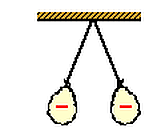
- Calculate the force of electrical repulsion between the balloons.
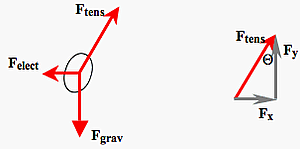
- What is the horizontal component of force in the thread that supports either one of the balloons?
- What is the vertical component of force in the thread that supports either one of the balloons?
- What is the mass of either one of the balloons?
Audio Guided Solution
Good problem solvers rely on good habits, and here in this question, we're going to have to rely on good habits. We're going to have to read the problem carefully. We're going to have to develop a mental picture of what's going on. We're going to have to record what we know. We're going to have to represent it in terms of variables in our typical physics equations. And we're going to have to plot a strategy to get from the known information to the unknown information. Now fortunately, in this problem, they break it up into several parts, a part A, B, C, D. If that were not done, this would be a very difficult problem. As it is, it's a very doable problem. What we know is we have two balloons which are charged with an identical amount of charge, and we're given that amount of charge is 3.5 times 10 to the negative 7 of the coulombs. Knowing that charge, or having that charge and having like charge, they're going to repel. So when they're suspended from a common pivot point on the ceiling, what they do is repel, and the threads begin to angle outward, the balloons begin to spread apart, and they reach an equilibrium position of 58 centimeters apart, center to center. That's 0.58 meters. That's the D equal 0.58 meters in the equation. F equal K times Q times Q divided by D squared. Now the Q in that equation is 3.5 times 10 to the negative 7 of the coulombs, and that's the Q1 and the Q2, and the K is the usual constant, 8.99 times 10 to the 9th Newtons times meter squared per coulomb squared. So if I substitute in known values of Q1, Q2, K, and D into my equation, I can answer part A of this question, which is find the force of electrical repulsion between the balloons. Now when I do that, I end up getting a value of about 3.2737 times 10 to the negative 3rd Newtons. You'll notice on that force triangle that I have drawn the components Fx and Fy. The horizontal component of that tension force has got to be balanced by the electrical force, so whatever numerical value I've calculated for the electrical force, it's the same as the horizontal component of the force on the string. And so part B answer is just simply the same as the part A answer, rounded answer being 3.3 times 10 to the negative 3rd Newtons. Now the next part of the question is what is the vertical component of force in the thread? Now if I think about that, what I can do is I can figure that that tension force makes an angle of 7 degrees with the vertical. That's just half of the 14 degrees that's mentioned here in this problem. And so if that's the 7 degrees with the vertical line, then I have a force triangle and I can use a trig function in order to find Fy. I can say that the tangent of 7 degrees is equal to the side opposite to the side adjacent. That's the TOA, the old SOCA TOA mnemonic. So I can say tangent of 7 equals Fx, which is the 3.2737 times 10 to the negative 3rd Newtons, divided by the Fy. And I can do good algebra there to solve for the Fy. Doing so means that Fy is equal to Fx divided by the tangent of 7 degrees. And when I do that, I end up getting a force of 2.6662 times 10 to the negative 2nd Newtons. And I can simply round that to two significant digits, such as 2.7 times 10 to the negative 2nd Newtons. Finally, what is the mass of either one of the balloons? It's simply a matter of equating this Fy value from part C with the Fg value. After all, those are the two vertical forces. The Fy for the vertical component of the tension force has got to balance the Fg or mg down. So I take this numerical value I've just calculated, part C, of 2.6662 times 10 to the negative 2nd Newtons, and I divide it by the value g, 9.8 Newtons per kilograms. And that will give me my mass of my balloon. 2 point ends up being 2.7206 times 10 to the negative 3rd kilograms. I can round that to two digits, or I can express my answer in units of grams as 2.7 grams.
Solution
- 3.3x10⁻³ N
- 3.3x10⁻³ N
- 2.7x10⁻² N
- 2.7 grams of 2.7x10⁻³ kg
Habbits of an Effective Problem Solver
- Read the problem carefully and develop a mental picture of the physical situation. If necessary, sketch a simple diagram of the physical situation to help you visualize it.
- Identify the known and unknown quantities; record them in an organized manner. A diagram is a great place to record such information. Equate given values to the symbols used to represent the corresponding quantity - e.g., \(Q_1 = 2.4 \unit{\micro\coulomb}\); \(Q_2 = 3.8 \unit{\micro\coulomb}\); \(d = 1.8 \unit{m}\); \(F_\text{elect} = \colorbox{gray}{Unknown}\).
- Use physics formulas and conceptual reasoning to plot a strategy for solving for the unknown quantity.
- Identify the appropriate formula(s) to use.
- Perform substitutions and algebraic manipulations in order to solve for the unknown quantity.
Read About It!
Get more information on the topic of Static Electricity at The Physics Classroom Tutorial.