Static Electricity Legacy Problem #33 Guided Solution
Problem*
Three negative charges are arranged as shown in the diagram below.
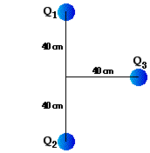
The charges of the three objects are:
- Q1 = -6.2 nC
- Q2 = -3.8 nC
- Q3 = -5.5 nC
(1 nC = 1 nanoCoulomb = 1x10⁻⁹ C)
Determine the magnitude of the net electric force exerted on Q3.
Audio Guided Solution
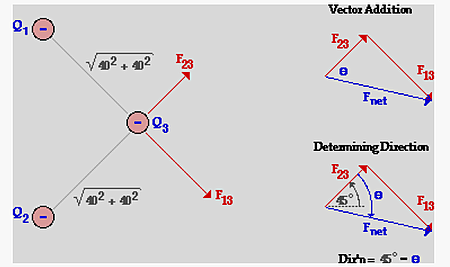
Here is a very difficult problem that's going to require that you employ the habits of an effective problem solver. One of the most important habits is plotting strategies to how to get from the given information to the unknown information. And here the unknown quantity is to determine the net electric force that is acting up on charge Q3 as seen in the diagram. Now all three charges are negatively charged and so they repel each other and when we're considering charge 3, there's two repulsive forces which act upon it. There's the force of charge 1 pushing charge 3 downwards and to the right and that's depicted in the diagram that you see here on this audio help page. And then there's the force of charge 2 pushing charge 3 upwards and to the right as well. And that is also shown in this diagram. Now what we'll need to do is calculate the values of F13 and the values of F23, the force of charge 1 on 3 and the force of charge 2 on 3. We do that using the Coulomb's law equation. That is that F is equal to K times Q times Q divided by the distance of separation squared. So let's begin by determining the distance of separation squared here for these two objects. We have to use the diagram. We notice that the dimensions of 40 centimeters given for the halfway distance from charge 2 to charge 1 and the distance of 40 centimeters given is the horizontal distance from this vertical line connecting charge 1 and 2 all to charge 3. Now if I were to consider the distance from charge 1 to charge 3, it would end up being the hypotenuse of a right triangle that has as its sides 40 centimeters and 40 centimeters. A better way to put 40 centimeters here in these problems is to put it as 0.40 meters. And so finding that hypotenuse as a matter of going 0.4 squared plus 0.4 squared equals distance squared. And so the distance squared comes out to be 0.3200. You could take the square root of it to find the distance itself. But what we really need in our equation is distance squared. So I'm just going to keep D squared equal 0.4, 0.3200. And that's the distance from Q1 to Q3 and also the distance from Q2 to Q3. So I'm calculating F13. What I need to do is I need to use the charges of charge 1 and charge 3 and that distance and the value of k. So F13 is equal to 6.2 times 10 to the negative 9th multiplied by 5.5 times 10 to the negative 9th multiplied by the value of k, 0.99 times 10 to the positive 9th, all divided by this 0.32. And when I do my math, I end up finding that F13 is equal to 9.58 times 10 to the negative 7th newtons. Now I can repeat this similar calculation for F23, just simply replacing Q1 with Q2. I end up getting 5.8716 times 10 to the negative 7th newtons. Now I draw these forces on a diagram, you see it there on my diagram, and you'll notice that they're at right angles one to another. This follows from the fact that F13 is at an angle of 45 degrees below the rightward direction and F23 is at an angle of 45 degrees above the rightward direction. And as a result, these are at right angles to one another. And whenever you have to add two vectors that are at right angles to one another, you would simply be employing the Pythagorean theorem. So you'll notice that these two vectors are added at right angles, F23 plus F13, and there's the resultant drawn as the hypotenuse of a right triangle. And finding its magnitude is simply a matter of employing the Pythagorean theorem. So I go F13 squared plus F23 squared, I find out the sum of those two quantities, and then I take the square root of the whole thing to get 1.1236 times 10 to the negative 6. I simply round to the third significant digit, and I have my answer.
Solution
1.12x10⁻⁶ N
Habbits of an Effective Problem Solver
- Read the problem carefully and develop a mental picture of the physical situation. If necessary, sketch a simple diagram of the physical situation to help you visualize it.
- Identify the known and unknown quantities; record them in an organized manner. A diagram is a great place to record such information. Equate given values to the symbols used to represent the corresponding quantity - e.g., \(Q_1 = 2.4 \unit{\micro\coulomb}\); \(Q_2 = 3.8 \unit{\micro\coulomb}\); \(d = 1.8 \unit{m}\); \(F_\text{elect} = \colorbox{gray}{Unknown}\).
- Use physics formulas and conceptual reasoning to plot a strategy for solving for the unknown quantity.
- Identify the appropriate formula(s) to use.
- Perform substitutions and algebraic manipulations in order to solve for the unknown quantity.
Read About It!
Get more information on the topic of Static Electricity at The Physics Classroom Tutorial.