Static Electricity Legacy Problem #28 Guided Solution
Problem*
A thread is tied to a 2.50-gram pith ball and attached to the ceiling at a location of a uniform electric field with an intensity of 5.00x10² N/C. The pith ball experiences a force which causes it to deflect from an otherwise vertical alignment by an angle of 12.6° from the vertical. Use a free-body diagram and electrostatic principles to perform the following calculations.
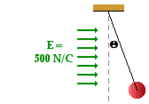
- Determine the force of gravity acting upon the pith ball.
- Determine the vertical component of the tension force of the thread.
- Determine the horizontal component of the tension force of the thread.
- Determine the quantity of charge on the pith ball.
- What type of charge - positive or negative - does the pith ball possess?
Audio Guided Solution
When there is an electric field in a given region of space, any charged object that is brought into that region of space will experience a force from that electric field. In this case we have a 2.50 gram pith ball that is tied to a thread and hung from the ceiling. Normally it would hang straight down, but because of the presence of an electric field and because of the fact that our little pith ball is charged, that little string will deflect outward from its usual downward hanging position by some angle theta of 12.6 degrees. And that is due to the fact that the pith ball interacts with the electric field. Now the fact that it is being pushed to the right indicates that the pith ball must be positively charged, for a negatively charged object would be pushed to the left. This is true because the electric field is shown to be directed rightward. By definition or convention, the direction of an electric field is in the direction that positive charges would be pushed. So since this little pith ball is being pushed to the right, it must be charged positively. And that is actually the answer to question E, the part E of this five part problem. Now let's get into the mathematics and it begins by calculating the force of gravity acting upon the pith ball. The force of gravity or weight of an object is simply its mass in kilograms multiplied by the value of g, which is 9.8 newtons per kilogram. So to calculate the force of gravity acting upon the pith ball, I have to convert the 2.50 grams to 0.0025 kilograms and then multiply by 9.8 newtons per kilogram. What I do, I get 0.0245 newtons and that is the answer to part A. In part B they ask me, what is the vertical component of the tension force of the thread? So this is when I begin to think about the free body diagram acting upon the pith ball. There are three forces, one we have discussed in great detail and that is the force of electrical interaction with the field and that is directed to the right. So I draw an arrow on my little pith ball directed to the right and then there is force of gravity that is directed straight down as usual. And the third force is the force of tension in the string directed upwards towards the pivot point. That is upwards and leftwards. Now the force of gravity down is going to have to be balanced by some other vertical force and the only choice is the vertical component of the tension force. So when the problem asks me in part B to calculate the vertical component of the tension force, it is just simply a matter of recognizing that that must balance the gravity force and as such must also be 0.0245 newtons. In part C of this problem I am asked to calculate the horizontal component of the tension force in this same thread. So to do so I will have to use a trigonometric function. What I know is that the thread makes an angle of 12.6 degrees with the vertical at the very top of the thread. So I am thinking of a tension force that is going upwards and to the left. If I were to sketch a force triangle out of this showing how the tension force is comprised of a leftward component and an upward component, then what I would know is that the tangent of 12.6 degrees is equal to the ratio of the side opposite of it which is the horizontal component Fx divided by the side adjacent to that angle which is the vertical component which I have just calculated in part A and B. And so I say tangent of 12.6 degrees is equal to the side opposite which is Fx divided by Fy which is 0.0245 newtons. Doing good algebra on this leads to the equation that Fx is equal to 0.0245 times the tangent of 12.6 degrees. When I do my math I get 0.005464 newtons which I can round to three significant digits. And that is the force exerted horizontally on the pith ball. Now I know that this horizontal component of the tension force is equal to F electrical since the pith ball is at rest. And so to calculate part D answer, the quantity of charge on the pith ball, I simply have to use the idea that the electric field is equal to the ratio of F per Q. And if I wish to calculate the value of Q, I simply rearrange the equation to say that this Q of the pith ball is equal to F divided by E where my F is the 0.005464 newtons and my E is the given 5.020 times 10 to the second newtons per coulomb. Completing my math I end up with 1.0953 times 10 to the negative fifth coulombs of charge. And I can round that to three significant digits.
Solution
- 0.0245 N
- 0.0245 N
- 5.48x10⁻³ N
- 1.10x10⁻⁵ C
- Positive charge
Habbits of an Effective Problem Solver
- Read the problem carefully and develop a mental picture of the physical situation. If necessary, sketch a simple diagram of the physical situation to help you visualize it.
- Identify the known and unknown quantities; record them in an organized manner. A diagram is a great place to record such information. Equate given values to the symbols used to represent the corresponding quantity - e.g., \(Q_1 = 2.4 \unit{\micro\coulomb}\); \(Q_2 = 3.8 \unit{\micro\coulomb}\); \(d = 1.8 \unit{m}\); \(F_\text{elect} = \colorbox{gray}{Unknown}\).
- Use physics formulas and conceptual reasoning to plot a strategy for solving for the unknown quantity.
- Identify the appropriate formula(s) to use.
- Perform substitutions and algebraic manipulations in order to solve for the unknown quantity.
Read About It!
Get more information on the topic of Static Electricity at The Physics Classroom Tutorial.