Static Electricity Legacy Problem #25 Guided Solution
Problem*
Three charges are arranged as shown in the diagram below.
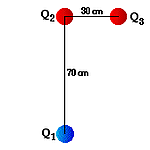
GIVEN: Q1 = -15 nC Q2 = +14 nC Q3 = +11 nC 1 nC = 1 nano Coulomb = 1x10⁻⁹ C
- Determine the magnitude and direction of the force exerted by Q1 upon Q2.
- Determine the magnitude and direction of the force exerted by Q3 upon Q2.
- Determine the magnitude and direction of the net electrostatic force on Q2.
Audio Guided Solution
Any two objects with charge will interact with one another in such a manner as to produce attractive or repulsive forces upon one another. In this question, what we have are three charges aligned in what is somewhat of a triangle, and they exert forces upon each other, and we're to determine the net electric force acting upon charge 2. It's broken down for us into three steps, with step A being a matter of determining the force of charge 1 acting upon charge 2, and step B of charge 3 acting upon charge 2. In step C, we have to add these two force factors up in order to determine the net electrostatic force. Now, we notice that charge 1 and charge 2 are oppositely charged, and as such they attract one another, so charge 1 will be pulling charge 2 towards itself, which is in a downward direction. In order to determine the magnitude of the force, I must use Coulomb's Law and substitute into the equation the value q1 and q2 and the distance between them, which is 70 centimeters. This distance of 70 centimeters needs to be converted to units of meters by moving the decimal place two places to the left, such that it's .70 meters. Now when I go to substitute into my equation, I have to make sure that I use Coulombs as the unit on charge, so the 15 nano-Coulombs can simply be converted to 15 times 10 to the negative 9th Coulombs, and the 14 nano-Coulombs can be converted to 14 times 10 to the negative 9th Coulombs. So I would be going 15 times 10 to the negative 9th Coulombs multiplied by 14 times 10 to the negative 9th Coulombs multiplied by 8.99 times 10 to the negative 9th in the numerator and dividing the whole thing by .70 squared. When I'm done, I end up calculating the value of 3.8529 times 10 to the negative 6 in the unit here is Newtons. Now, I must do the same thing in part b for charges 2 and charges 3. I notice that they are like charges, and so they will repel one another, which means that charge 3 will be pushing up on charge 2 away from itself or in the leftward direction. Now when it comes to calculating the magnitude of these forces, I need to substitute in the quantity of charge 14 in the 11 nano-Coulombs into my Coulombs law equation again. So that would be 14 times 10 to the negative 9th multiplied by 11 times 10 to the negative 9th multiplied by the value of K, 8.99 times 10 to the 9th. I have to divide the whole thing by the distance squared, I need to use meters, and so I will be dividing by .30 meters in the whole quantity squared. Now when I'm done, I end up getting a value of 1.5383 times 10 to the negative 5th Newtons. Now as I've done this problem, I've actually sketched out on my sheet of paper the direction of these forces, with one of them being downward and the other one being leftward. I've indicated the magnitude, even though I've expressed my answer as rounded values. What I'm going to do is use my complete numerical value, unrounded, in order to calculate the parts of the answer, which is a matter of adding up these two force vectors, the downward vector and the leftward vector. Now you might recall from our unit on vectors that when we add vectors that are at right angles to one another, we must use the Pythagorean theorem. And what I do is I simply sketch one of the vectors, say the leftward vector, and where its arrowhead ends, I sketch the downward vector, and I add them head to tail, and then I'm going to draw a resultant from the beginning point of that leftward vector down to the very arrowhead of the downward vector. Now I need to find the hypotenuse of the triangle formed by this resultant vector, and that's a matter of going part A answer squared plus part B answer squared equals part C answer squared. And by substituting and solving, I end up getting 1.5858 times 10 to the negative fifth Newtons, and then I'll just round this. Now comes a matter of getting that direction, and the direction can be found using a trigonometric function. I have a very long leftward vector, and added to it is a little shorter downward vector. When it comes to calculating the angle between the resultant diagonal vector and the leftward direction, I must use the tangent function, and I say the tangent of this unknown angle is equal to the side opposite, which is the down vector, divided by the side adjacent, which is the leftward vector. So I go tangent of theta equals 3.9 times 10 to the negative sixth divided by 1.5 times 10 to the negative fifth. I find out what this ratio is of these two sides of the triangle, and then I do on my calculator the second tangent of this ratio, and I end up getting 14 degrees as my answer. That would be 14 degrees down below the leftward direction, or I could express it as a counterclockwise angle of direction from the right, or east direction, and that comes to be 194 degrees counterclockwise.
Solution
- F1 on 2 = 3.9x10⁻⁶ N, downward
- F3 on 2 = 1.54x10⁻⁵ N, leftward
- Fnet electric = 1.59x10⁻⁵ N, 14° down from left (194° CCW)
Habbits of an Effective Problem Solver
- Read the problem carefully and develop a mental picture of the physical situation. If necessary, sketch a simple diagram of the physical situation to help you visualize it.
- Identify the known and unknown quantities; record them in an organized manner. A diagram is a great place to record such information. Equate given values to the symbols used to represent the corresponding quantity - e.g., \(Q_1 = 2.4 \unit{\micro\coulomb}\); \(Q_2 = 3.8 \unit{\micro\coulomb}\); \(d = 1.8 \unit{m}\); \(F_\text{elect} = \colorbox{gray}{Unknown}\).
- Use physics formulas and conceptual reasoning to plot a strategy for solving for the unknown quantity.
- Identify the appropriate formula(s) to use.
- Perform substitutions and algebraic manipulations in order to solve for the unknown quantity.
Read About It!
Get more information on the topic of Static Electricity at The Physics Classroom Tutorial.