Static Electricity Legacy Problem #30 Guided Solution
Problem*
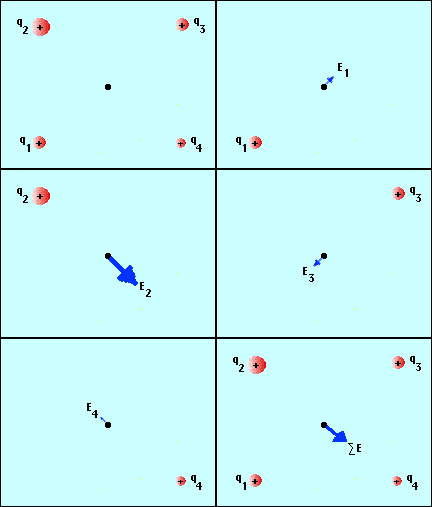
Four positive charges are positioned in such a manner than they form a square with sides which are 5.0 cm long. A 3.0 μC charge is placed at the (0 cm, 0 cm) mark. A 9.0 μC charge is placed at the (0 cm, 5 cm) mark, a 3 μC charge is placed at the (5 cm, 5 cm) mark, and a 6.0 μC charge is placed at the (5 cm, 0cm) mark. Determine the magnitude and direction of the electric field at the exact center of the square.
Audio Guided Solution
This is most certainly a difficult problem, the solution to which is going to require that you practice the habits of a good problem solver, that you do a good deal of strategizing and visualizing and diagramming before you ever begin to pick up a calculator. Now what I have here are four charges which form a square, a square which is five centimeters along each edge. What I wish to do is to determine the net electric field at the very center of this square. It's going to be the sum of the four individual electric field vectors created by q1, q2, q3, and q4. Now I have a diagram that's going to kind of help. It's an animated diagram that shows the various individual electric fields and how they would sum up. What's unique about this particular situation is that the electric fields from q1 and q3 are going to be in the exact opposite direction in equal magnitude. Equal magnitude because they're created by two charges which have equal charge of three microcoulombs in an equal distance away, which happens to be half the diagonal distance of this square. So these two electric field vectors are going to cancel each other out. So when it comes to summing up the four individual vectors, it's simplified by this fact. And so the final answer is just going to be the sum of the electric field created by q2 plus the electric field created by q4. Now I have to consider direction whenever I'm adding vectors of any type, electric field vectors included. So when I think about the direction of the electric field, it's always in the direction a positive test charge would be pushed or pulled when placed in a given location. So if I think about the electric field created by charge two, it's going to be away from charge two. Since charge two is positive, electric field is defined as the direction it would push a positive test charge. Same thing can be said of charge four. The direction of electric field created by charge four is going to be away from charge four. And so the result is that the electric field created by q2, I'm going to call it e2, is directed along the diagonal line away from q2 and towards q4. And the electric field created by charge q4, I'm going to call that one e4, is again directed along the diagonal line away from q4 and towards q2. Thus these are in opposite directions. Once I determine their magnitude, it's simply a matter of subtracting the smaller one from the larger one, as is done whenever you have two vectors in the opposite direction. Now I have to calculate the value of e2 and the value of e4, and to do so one of the things I'm going to need to know is the distance from the center of the square to the corners of the square. As I mentioned earlier, it's half the diagonal line. So what I could probably do is I could probably take the length, 0.05 meters, the length of the square, and I could find the diagonal using the Pythagorean Theorem, 0.05 squared plus 0.05 squared equals the diagonal squared. And then if I get that value and I halve it, I'm going to end up finding the distance from the corner of the square to the center of the square, and it ends up being 0.035355 meters. Now what's really important is the square of the distance, because that's what goes in the denominator of my electric field equation, ends up being 0.0012500 meters squared. And so now to calculate e2, I go k, the same k I've been using, 8.99 times 10 to the 9th, multiplied by q2, which is 3 times 10 to the negative 6 coulombs, divided by this d squared quantity, the 0.0012500 meters squared, that's simply d squared. When I do that for e2, I get 6.4728 times 10 to the 7th newtons per coulomb. I'm going to do the same thing for e4, only using the value of q4 in the equation, and I get 4.3152 times 10 to the 7th newtons per coulomb. So obviously e4 is a little smaller than e2, if I subtract it from e2, subtract since they're in opposite directions, I end up getting 2.1576 times 10 to the 7th newtons per coulomb. I can round this to two significant digits, 2.2 times 10 to the 7th newtons per coulomb. And the direction of this net electric field is away from q2 and towards q4. I could describe that as being 45 degrees below the right, or I could describe it as being 315 degrees counterclockwise from the east or from right, and that's the direction.
Solution
magnitude: 2.2x10⁷ N/C
direction: directed away from Q2 and towards Q4 (OR 45° below horizontal right OR 315°)
Habbits of an Effective Problem Solver
- Read the problem carefully and develop a mental picture of the physical situation. If necessary, sketch a simple diagram of the physical situation to help you visualize it.
- Identify the known and unknown quantities; record them in an organized manner. A diagram is a great place to record such information. Equate given values to the symbols used to represent the corresponding quantity - e.g., \(Q_1 = 2.4 \unit{\micro\coulomb}\); \(Q_2 = 3.8 \unit{\micro\coulomb}\); \(d = 1.8 \unit{m}\); \(F_\text{elect} = \colorbox{gray}{Unknown}\).
- Use physics formulas and conceptual reasoning to plot a strategy for solving for the unknown quantity.
- Identify the appropriate formula(s) to use.
- Perform substitutions and algebraic manipulations in order to solve for the unknown quantity.
Read About It!
Get more information on the topic of Static Electricity at The Physics Classroom Tutorial.