Static Electricity Legacy Problem #31 Guided Solution
Problem*
The diagram below shows three charges positioned to form an equilateral triangle. Each side has a length of 46 cm and each charge has a positive charge of 7.8 nC. Determine the magnitude and direction of the net electric force exerted upon the charge at point P at the top of the triangle.
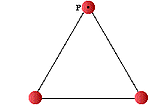
Audio Guided Solution
This is a very difficult problem and it's going to require that you use the habits of an effective problem solver. One of the most important ones of which is a good deal of plotting and strategizing. Thinking about concepts, principles, and formulas before you ever begin to use your calculator. You're going to need to use a good deal of geometry, trigonometry, and of course physics as you approach the solution to this problem. I'll talk you through modeling the habits of a good problem solver. One thing that you'll notice is that there's a diagram on this page in which the two forces acting upon the charge at point P on the triangle are diagrammed. And that's one of the first things I always do when I begin to approach a problem. Visualizing the situation, reading it carefully, catching the context of the situation, and then diagramming what's going on. We're focusing on the charge at point P at the very top of this equal angular, equal lateral triangle. And we want to determine the net electric force upon that charge at point P. And so there's two forces which I'm going to have to add up, F1 and F2. Or we could word that as F1 on 3 and F2 on 3. Now, I need to calculate these two forces and that's a matter of using Coulomb's Law. I need to go and calculate the force of charge 1 on charge 3. I need to go K times Q1 times Q3 divided by the distance between them squared. Now, all the charges are the same, so it's easy to find Q1. It's 7.8 times 10 to the negative 9th Coulombs. And charge 3 is the same thing, 7.8 times 10 to the negative 9th Coulombs. And then I have to multiply by the K value, 0.99 times 10 to the 9th and divide by the distance squared. That would have to be the 0.46 meters squared. When I do the math, I end up getting for the value of force 1 on charge 1 on charge 3, 2.5848 times 10 to the negative 6 Newtons. Now it ends up, since all the distances are the same and all the charges are the same, that the value of force 2, of charge 2 on charge 3, is going to be the same value. And I've shown that there on the diagram. Now, each of these forces are upwards at an angle of 60 degrees above the horizontal, along the length of the side of the triangle. And so they're going to have components going X-ward and Y-ward. And the X-ward components are going to be of the same magnitude in the opposite direction. So I can pretty much ignore the horizontal components of these forces and focus on the vertical components of these two forces when I try to find the net electric force. The vertical components of these forces are the side opposite the 60-30-90 triangle, the side opposite the 60 degree angle. So if I wish to find the magnitude of these vertical components, I just have to take the value of the force, multiply by the sine of 60 degrees. Doing so yields a value for the vertical component of the force, being 2.2385 times 10 to the negative 6 Newtons. Now there's two of these forces, one from charge 1, pushing upward and rightward on charge 3, and one from charge 2, pushing upward and leftward on charge 3. So I need to take these two vertical components and simply add them together. And when I do, I get my net electric force, and it comes out to be 4.4771 times 10 to the negative 6 Newtons. And I can round that to two significant digits, 4.5 times 10 to the negative 6 Newtons.
Solution
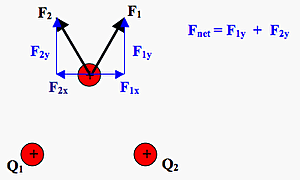
magnitude = 4.5x10⁻⁶ N
direction = upward
Habbits of an Effective Problem Solver
- Read the problem carefully and develop a mental picture of the physical situation. If necessary, sketch a simple diagram of the physical situation to help you visualize it.
- Identify the known and unknown quantities; record them in an organized manner. A diagram is a great place to record such information. Equate given values to the symbols used to represent the corresponding quantity - e.g., \(Q_1 = 2.4 \unit{\micro\coulomb}\); \(Q_2 = 3.8 \unit{\micro\coulomb}\); \(d = 1.8 \unit{m}\); \(F_\text{elect} = \colorbox{gray}{Unknown}\).
- Use physics formulas and conceptual reasoning to plot a strategy for solving for the unknown quantity.
- Identify the appropriate formula(s) to use.
- Perform substitutions and algebraic manipulations in order to solve for the unknown quantity.
Read About It!
Get more information on the topic of Static Electricity at The Physics Classroom Tutorial.