Vibrations and Waves Legacy Problem #14 Guided Solution
Problem*
A wave is traveling in a rope. The diagram below represents a snapshot of the rope at a particular instant in time.
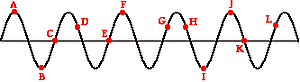
Determine the number of wavelengths which is equal to the horizontal distance between points …
- C and E on the rope.
- C and K on the rope.
- A and J on the rope.
- B and F on the rope.
- D and H on the rope.
- E and I on the rope.
Audio Guided Solution
There's no computing in this question. It's just counting. You have to count the number of waves between two points on a wave pattern. To do so, you need to be able to count, and you need to know what a wave looks like. A wave, as we read from left to right, could be thought of as starting in a rest position, going up to a crest, coming back down to a trough position, and then coming back up to the rest or equilibrium position, which is the center line going through horizontally through the middle of the diagram. So in part A of this problem, the number of wavelengths stretching from C to E is exactly one wavelength. That's how you can define a wavelength. In part B, going from C to K, I have to think of this distance from C to E and see how many times it replicates. Well, going from C to E is one wavelength. Then if I go up to a crest, back down to a trough, and back up to rest, I end up just before G on the rest position. That's two wavelengths. I'm going to repeat it again. Pass G up to the crest, pass H down to rest, down to the trough at I, and then back up to rest, and that's three full wavelengths. And then I have to go up to J and down to K. That's another half of a wavelength. So the distance from C to K is 3.5 wavelengths. The distance from A to J can be done in much the same manner, reading from left to right, but starting at a crest. So every time we get back up to a crest, we've done a complete wave. So down to B, up past C to the crest before D is one. Down to the next trough, and back up to the next crest, to F. That's two wavelengths. Down to the next trough, back up to the next crest, just past G before H. That's three wavelengths. And then finally down to the trough at I, and back up to the crest at J. And that's four wavelengths. In part D, we have to find the number of wavelengths between point B and point F. You'll notice point B starts at a trough, so every time I go up to a crest and back down to a trough, I've got a complete wavelength. Simply going from a trough up to a crest gives me a half of one. And so if I start at B and then go past C up to the crest just before D, that's a half of a wavelength. Then I come back down to the next trough just before point E, and that's a full wavelength. Then I go from that little trough back up to the next crest, and that's another half of a wavelength. And so the distance from B to F is one and a half wavelengths. In part E, I have to find the distance between point D and point H. And you'll notice that D's not at rest, and it's not at a crest, and it's not at a trough. It's just past a crest. But fortunately for us, H is also at the same location in the corresponding point on another wave pattern, just past a crest. And so we're going to have a whole number of wavelengths here. I'm going to have to find out how many whole numbers of wavelengths that is. So I can think of going down to the trough, back up to rest, back up to the crest, and a little past the crest. And I've got one full wavelength. That's the point, a point just past F and about the same height above rest. And then I can go down to the trough and then back up past G to the next crest and a little bit past that. And I've got another complete wavelength. And wouldn't you know, I'm right at H. So that distance from D to H is two complete wavelengths. Finally, in part F, I had to find the number of wavelengths between point E and point I. And if you look at point E, it's right on the rest position. If you look at point I, it's a trough. So now I have to do the counting as I've done to go up to F and back to rest, down to the trough, and then back up to rest position just before G. That's a complete wave. Now, if I go up to a crest and then back down to the rest position, past G and past H, I've got another half of a wave. That's one and a half waves total. Now, if I go down to the trough but don't come back to rest, that's less than an additional half of a wave. In fact, that's a quarter of a wave. So I have to add up that on to the one and a half I've already gone. So we end up with a distance from E to I as being 1.75, or one and three-quarters, of a wavelength.
Solution
- 1.0 wavelengths
- 3.5 wavelengths
- 4.0 wavelengths
- 1.5 wavelengths
- 2.0 wavelengths
- 1.75 wavelengths
Habbits of an Effective Problem Solver
- Read the problem carefully and develop a mental picture of the physical situation. If necessary, sketch a simple diagram of the physical situation to help you visualize it.
- Identify the known and unknown quantities and record in an organized manner, often times they can be recorded on the diagram itself. Equate given values to the symbols used to represent the corresponding quantity (e.g., \(\descriptive{v}{v,velocity} = 12.8 \unit{\meter\per\second}\), \(\descriptive{λ}{λ,wave length} = 4.52 \unit{m}\), \(\descriptive{f}{f,frequency} = \colorbox{gray}{Unknown}\)).
- Use physics formulas and conceptual reasoning to plot a strategy for solving for the unknown quantity.
- Identify the appropriate formula(s) to use.
- Perform substitutions and algebraic manipulations in order to solve for the unknown quantity.
Read About It!
Get more information on the topic of Vibrations and Waves at The Physics Classroom Tutorial.