Vibrations and Waves Legacy Problem #24 Guided Solution
Problem*
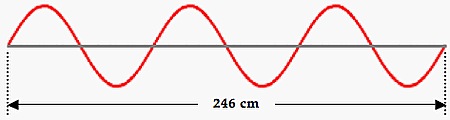
A standing wave pattern is established in a 246-cm long rope. A snapshot of the rope at a given moment in time is shown in the diagram below. Vibrations travel within the rope at speeds of 22.7 m/s. Determine the frequency of vibration of the rope.
Audio Guided Solution
In this problem, a 246 centimeter long rope is being vibrated such that a standing wave pattern exists within the rope. We know that the vibrations travel through the rope at speeds of 22.7 meters per second. The two known quantities are V equal 22.7 meters per second and L or length of rope equal 246 centimeters. The other known quantity is I have a diagram. That diagram tells me an awful lot about the number of waves which stretch from one end of the rope to the other. If I trace over the wave pattern that's shown, I'll notice that there are three complete waves within that length of rope. So I could say that the length, 246, is equal to 3 times lambda where lambda is the wavelength. If I divide each side of that equation by 3, I'll be finding the wavelength in units of centimeters. I get 82 centimeters which I'll convert to meters so that it's consistent with the units on speed, meters per second. So the wavelength is .82 meters. Now I know wavelength and I know speed and I'm asked to calculate the frequency of vibrations within this rope. And so if I use the wave equation, V equal F lambda, I can rearrange it to take the form of F equal V over lambda. Substituting in values of 22.7 meters per second for V and .82 meters for lambda, I can solve for F and it comes out to be 27.6829 hertz. And I can round that to three significant digits.
Solution
27.7 Hz
Habbits of an Effective Problem Solver
- Read the problem carefully and develop a mental picture of the physical situation. If necessary, sketch a simple diagram of the physical situation to help you visualize it.
- Identify the known and unknown quantities and record in an organized manner, often times they can be recorded on the diagram itself. Equate given values to the symbols used to represent the corresponding quantity (e.g., \(\descriptive{v}{v,velocity} = 12.8 \unit{\meter\per\second}\), \(\descriptive{λ}{λ,wave length} = 4.52 \unit{m}\), \(\descriptive{f}{f,frequency} = \colorbox{gray}{Unknown}\)).
- Use physics formulas and conceptual reasoning to plot a strategy for solving for the unknown quantity.
- Identify the appropriate formula(s) to use.
- Perform substitutions and algebraic manipulations in order to solve for the unknown quantity.
Read About It!
Get more information on the topic of Vibrations and Waves at The Physics Classroom Tutorial.