Vibrations and Waves Legacy Problem #18 Guided Solution
Problem*
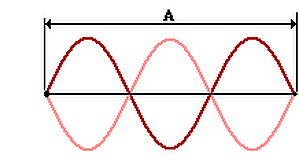
A rope is held tightly and shook until the standing wave pattern shown in the diagram at the right is established within the rope. The distance A in the diagram is 3.27 meters. The speed at which waves move along the rope is 2.62 m/s.
- Determine the frequency of the waves creating the standing wave pattern.
- Determine the number of vibrational cycles which would be measured in 20.0 seconds.
Audio Guided Solution
Here is a problem based upon a diagram of a standing wave pattern that has been established in a rope. We are told that the distance a on the diagram is equal to 3.27 meters and in the verbal statement we are given that the v, or the speed, equal 2.62 meters per second. In part a of the problem we are asked to find the frequency of these waves creating the standing wave pattern. So when I think of frequency I think of the equation v equal f times lambda and if I can find the v, which is easy because it is given, and I know if I can find the lambda I can calculate the speed. So somehow this distance of 3.27 meters must be related to the wavelength and indeed it is. If I think of a wavelength it is simply a distance along the pattern that we can visualize as starting at the rest position, going up to a crest, back to rest, down to a trough and back up to rest and that is a complete wavelength. Now the distance a is actually more than one wavelength. If you trace over the red line on the diagram, from rest to crest to rest, that is a half of a wave, from rest to trough to rest, that is another half of a wave, and then finally from rest to crest back down to the rest, that is another half of a wave. So there are three halves of a wave here. I could write 3.27 meters equal 3 over 2 times wavelength, or 1.5 wavelength. Dividing each side by wavelength by 1.5 gets me the wavelength of these waves and it comes out to be 2.18 meters. That is the wavelength. Now I can solve for f using the wave equation b equals f times lambda. So 2.62 meters per second is equal to f times the lambda or wavelength of 2.18 meters. Dividing each side by 2.18 gets me an f value of 1.20183 blah blah blah hertz. That is the frequency of these waves and I can round it to three significant digits such as 1.20 hertz. Now in part b I have to use this frequency value to determine the number of cycles, vibrational cycles in 20 seconds. So I have to understand frequency in hertz. Frequency is the number of cycles per second. When we say that the frequency is 1.20 hertz, we are saying that there is 1.20 cycles per one second. So I am going to set up a ratio here that goes 1.20 cycles divided by one second is equal to n divided by 20 seconds where n is the number of cycles in that 20 seconds. Now if I multiply each side of the equation by 20, I end up with 24.0 vibrations. That is the number of vibrations in 20 seconds.
Solution
- 1.20 Hz
- 24.0 vibrations
Habbits of an Effective Problem Solver
- Read the problem carefully and develop a mental picture of the physical situation. If necessary, sketch a simple diagram of the physical situation to help you visualize it.
- Identify the known and unknown quantities and record in an organized manner, often times they can be recorded on the diagram itself. Equate given values to the symbols used to represent the corresponding quantity (e.g., \(\descriptive{v}{v,velocity} = 12.8 \unit{\meter\per\second}\), \(\descriptive{λ}{λ,wave length} = 4.52 \unit{m}\), \(\descriptive{f}{f,frequency} = \colorbox{gray}{Unknown}\)).
- Use physics formulas and conceptual reasoning to plot a strategy for solving for the unknown quantity.
- Identify the appropriate formula(s) to use.
- Perform substitutions and algebraic manipulations in order to solve for the unknown quantity.
Read About It!
Get more information on the topic of Vibrations and Waves at The Physics Classroom Tutorial.