Vibrations and Waves Legacy Problem #25 Guided Solution
Problem*
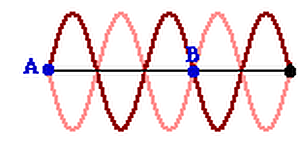
A standing wave is established in a snakey as shown in the diagram at the right. The distance from point A to point B is known to be 4.69 meters. When not being vibrated as a standing wave, a single pulse introduced into the medium at point A will travel to the opposite end and back in 2.70 seconds. Determine the vibrational frequency of the wave pattern.
Audio Guided Solution
This question is a very difficult question which demands that we practice the habits of an effective problem solver. We need to read the question carefully. Visualizing the situation, which is helped by the fact that we have a diagram, we need to identify the known and the unknown information and plot out a strategy as to how to get from the known to the unknown information. The problem pertains to this long, long snakey which is vibrated such that a standing wave pattern exists with the one shown in the diagram. We happen to know the distance from A to B. It's 4.69 meters. We happen to know that when you're not shaking it with a standing wave pattern, that a pulse introduced on one end will travel to the other end and back in 2.7 seconds. The unknown quantity is the frequency. Find the f. So, in my mind I'm thinking, to find the f, I need to know the speed of these waves and I need to know the wavelengths of these waves. So, how can I use the known information to get speed and wavelength so that I can calculate f? Well, first of all, the wavelength can be found knowing that the distance A to B is 4.69 meters. Looking on the diagram, I'll notice that that distance from A to B is equivalent to 1.5 wavelengths. I figure that out by taking my little finger and tracing it over the red wave. Start at point A. I go up to a crest and back down to rest. That's a half a wave. I repeat that going down to trough and back up to rest. That's another half of a wave. And finally up to crest and down to point B. At the rest position, that's another half of a wave. That's three halves of a wave equal 4.69 meters. I just wrote an equation that has wavelength in it as the only unknown. 4.69 meters equal 1.5 wavelengths. Divide each side by 1.5. We end up getting a wavelength value of 3.1267 meters. That takes care of half of what we need to know. The other half that we need to know is the speed. And I have to use the 2.70 seconds for that. Now if I think about what that 2.70 seconds represents, it represents the time for a pulse to travel a given distance. The distance being equivalent to traveling down to the end and back. Now if I look at the pattern that they give me, I notice that from point A to the opposite end is 2.5 wavelengths. Now what the wave does is it travels that 2.5 wavelength distance from A to the end and back in 2.7 seconds. So if I take my wavelength and just calculate it and multiply it by 2.5, I'll get the distance from point A to the opposite end. And if I double that distance, I'll get the distance traveled by a wave in 2.70 seconds. Whatever that distance comes out to be, once you divide it by 2.7 seconds, you end up getting a speed of 5.7901 meters per second. So now I know the two ingredients I need to have in order to calculate the frequency of these waves. I use the wave equation, V equals F lambda. I rearrange it to solve for F. F equals V divided by lambda, where lambda is the wavelength and V is the speed. So dividing 5.7901 meters per second by 3.1267 meters gets me a frequency of 1.8519 hertz. I can round that to three significant digits, so the answer is 1.85 hertz.
Solution
1.85 Hz
Habbits of an Effective Problem Solver
- Read the problem carefully and develop a mental picture of the physical situation. If necessary, sketch a simple diagram of the physical situation to help you visualize it.
- Identify the known and unknown quantities and record in an organized manner, often times they can be recorded on the diagram itself. Equate given values to the symbols used to represent the corresponding quantity (e.g., \(\descriptive{v}{v,velocity} = 12.8 \unit{\meter\per\second}\), \(\descriptive{λ}{λ,wave length} = 4.52 \unit{m}\), \(\descriptive{f}{f,frequency} = \colorbox{gray}{Unknown}\)).
- Use physics formulas and conceptual reasoning to plot a strategy for solving for the unknown quantity.
- Identify the appropriate formula(s) to use.
- Perform substitutions and algebraic manipulations in order to solve for the unknown quantity.
Read About It!
Get more information on the topic of Vibrations and Waves at The Physics Classroom Tutorial.