Vibrations and Waves Legacy Problem #22 Guided Solution
Problem*
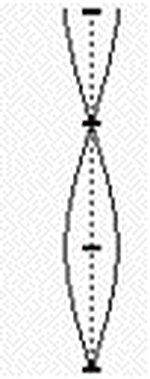
Gillian drives down Lake Avenue and observes an odd vibrational pattern of her car antenna. She observes it vibrating back and forth in the manner shown at the right. There is an antinode at its free end and a node at the location where the antenna mounts to the car. Vibrations travel through the 86 cm tall antenna at 5.0 x 10³ m/s. Determine the frequency of vibrations of the antenna.
Audio Guided Solution
This question pertains to a car antenna which is vibrating back and forth with a standing wave formation as a car moves down the world. What we know about the antenna is that it's 86 centimeters tall. That's the distance from one end to the opposite end. And we know that vibrations travel through the antenna at 5 times 10 to the 3rd meters per second. What we're asked to calculate is the frequency of those vibrations. Now, success at this problem demands that you concentrate on the diagram that's given. We notice in the diagram that there's a node at one end where the antenna mounts to the car. And there's a node two-thirds of the way up towards the opposite end. As a result, knowing that the distance between nodes is one-half of a wavelength, what we have is one-half of a wavelength from node to node, plus another quarter of a wavelength from the node to the end of the antenna where there's an antinode. So what I can state is that this 86 centimeters is equal to three-quarters of a wavelength, or 0.75 lambda. And then I can divide through both sides of the equation by 0.75. That would give me the wavelength, and it comes out to be 114.666 repeating centimeters. I need to change that to meters so that I can get the frequency in units of hertz, because the speed is given in units of meters per second. So now I can use the wave equation, V equals F lambda, and rearrange it to solve for F. F becomes V divided by lambda, substituting in numbers of 5 times 10 to the 3rd, 1.146666 repeating, I'll end up getting 4360.4651 hertz as my frequency of this car antenna. Now I can round that to two significant digits such that the answer becomes 4400 hertz, or 4.4 times 10 to the 3rd hertz.
Solution
4.4 x 10³ Hz
Habbits of an Effective Problem Solver
- Read the problem carefully and develop a mental picture of the physical situation. If necessary, sketch a simple diagram of the physical situation to help you visualize it.
- Identify the known and unknown quantities and record in an organized manner, often times they can be recorded on the diagram itself. Equate given values to the symbols used to represent the corresponding quantity (e.g., \(\descriptive{v}{v,velocity} = 12.8 \unit{\meter\per\second}\), \(\descriptive{λ}{λ,wave length} = 4.52 \unit{m}\), \(\descriptive{f}{f,frequency} = \colorbox{gray}{Unknown}\)).
- Use physics formulas and conceptual reasoning to plot a strategy for solving for the unknown quantity.
- Identify the appropriate formula(s) to use.
- Perform substitutions and algebraic manipulations in order to solve for the unknown quantity.
Read About It!
Get more information on the topic of Vibrations and Waves at The Physics Classroom Tutorial.