Vibrations and Waves Legacy Problem #17 Guided Solution
Problem*
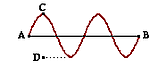
A wave with a frequency of 12.3 Hz is traveling from left to right across a rope as shown in the diagram at the right Positions A and B in the diagram are separated by a horizontal distance of 42.8 cm. Positions C and D in the diagram are separated by a vertical distance of 12.4 cm. Determine the amplitude, wavelength, period and speed of this wave.
Audio Guided Solution
Here is a problem that is centered around a collection of words in a given diagram. In the collection of words, we are given three quantities. The 12.3 Hz represents the frequency. As I read the problem, I write these things down. I write F equal 12.3 Hz. Then we are given the distance from A to B horizontally on the diagram. I label that as D subscripted AB and it is equal to 42.8 cm. I will deal with that a little bit later. Finally, related to the diagram, I am given another spatial distance. That is the distance vertically from C to D. That is 12.4 cm. What I wish to find is the amplitude, wavelength, period, and speed. I am going to begin with the amplitude because that might be one of the easier things to find. The distance vertically from C to D is the distance from a crest down to a trough. The amplitude is actually the distance from the crest at point C to the midway point at D, which is called the rest position. The horizontal line going across the middle of the diagram. The 12.4 cm is actually twice the amplitude. If I half that, I get 6.2 cm. That is the amplitude. I am going to deal with this frequency of 12.3 Hz. They ask me what is the period. Two things which are related mathematically are frequency and period. They are reciprocals of one another. If the frequency is 12.3, the period is 1 divided by 12.3 Hz. That will give me the period in seconds. It comes out to be 0.081301 seconds. I can round that to three significant digits such as 0.0813 seconds. Now I am going to deal with this horizontal distance of 42.8 cm from location A to location B on the diagram. That is actually what we would call two wavelengths. I can think of a wave starting at rest, going to crest, going down to a trough, and back up to rest. The wave pattern does that twice between point A and point B. Thus, I can say that 42.8 cm is equal or equivalent to the distance of 2 times wavelength. If I divide each side of that equation by 2, I end up getting wavelength equal to 42.8 divided by 2. It comes out to be 21.4 cm. I have now found the wavelength in three significant digits. I have been given the frequency. I can use the wave equation to find the speed of this wave. That equation goes like this. V for speed is equal to f for frequency times lambda for wavelength that I wish to solve for V. I simply take my 12.3 Hz and multiply it by my wavelength at 21.4 cm. You end up getting a speed in units of cm per second. It comes out to be 263.22 cm per second. I can round that to three significant digits.
Solution
amplitude = 6.2 cm
wavelength = 21.4 cm
period = 0.0813 s
speed = 263 cm/s or 2.63 m/s
Habbits of an Effective Problem Solver
- Read the problem carefully and develop a mental picture of the physical situation. If necessary, sketch a simple diagram of the physical situation to help you visualize it.
- Identify the known and unknown quantities and record in an organized manner, often times they can be recorded on the diagram itself. Equate given values to the symbols used to represent the corresponding quantity (e.g., \(\descriptive{v}{v,velocity} = 12.8 \unit{\meter\per\second}\), \(\descriptive{λ}{λ,wave length} = 4.52 \unit{m}\), \(\descriptive{f}{f,frequency} = \colorbox{gray}{Unknown}\)).
- Use physics formulas and conceptual reasoning to plot a strategy for solving for the unknown quantity.
- Identify the appropriate formula(s) to use.
- Perform substitutions and algebraic manipulations in order to solve for the unknown quantity.
Read About It!
Get more information on the topic of Vibrations and Waves at The Physics Classroom Tutorial.