Forces in 2D Legacy Problem #17 Guided Solution
Problem*
Xavier went rock climbing this past weekend. During one climb through a narrow vertical chimney, he supported his weight by leaning with his back against one wall of the chimney and pushing off the opposite wall with his legs. His left leg made a 26° angle with the horizontal. The coefficient of friction between his back and the chimney wall is 0.508. Determine the minimum amount of tension which would be required to support the weight of his 86-kg body.
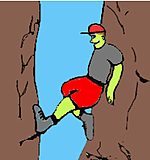
- Determine the tension in his left leg.
- Determine the normal force of the chimney wall pushing upon his back.
Audio Guided Solution
This is a very difficult problem that is going to require that you employ the habits of an effective problem solver, reading the problem carefully and identifying the known and the unknown information, and planning out a strategy as to how to get from the known to the unknown. Here we have a picture of Xavier, and literally, fortunately, we have a picture of Xavier, stuck between the two walls of a vertical chimney as he's climbing. You'll notice that against his back, one of the walls, the wall on the right, is pushing towards the left up on Xavier. And you'll notice that his left leg is pushing against the opposite wall, at an angle of about 26 degrees with respect to the horizontal. There's a normal force up to the left, a tension force, you could describe it, or an applied force from his leg going up and to the right at a 26 degree angle. There's a gravity force down, and finally, there's a little bit of friction from the wall that prevents him from sliding down. What we want to do is determine the tension in his leg, and the normal force of the chimney, while pushing up on his back. Two of these four forces we wish to determine. Now the difficulty of this problem lies in the first place, that you're going to end up with a two equation, two unknown situation. You're going to develop an equation from a horizontal analysis of the forces up on Xavier, and a second equation for an analysis of the vertical forces up on Xavier. Now if you've not yet drawn a free body diagram, you should do it now. Just represent Xavier by a dot or a box, and begin drawing the forces. You know that there's gravity down, let's draw the arrow down, label it F-graph. You know that there's friction up that prevents him from sliding down this wall, label it as F-friction up. You know that there's a normal force against his back, pointing to the left, label it F-norm. And then finally, the force of his left leg, pushing him upwards and to the right. And you can draw that arrow at 26 degrees with respect to the horizontal, approximately, and label it either F-applied or F-tension. It's one of our unknowns. Now, that F-applied or F-tension force is at a nasty angle, so what I typically tend to do is to break it up or resolve it into its two parts. An F-x part and an F-y part. The F-x part is simply the tension force multiplied by the cosine of 26, and you can just kind of write it in there. F-x equal T, for tension, multiplied by cosine 26. And the F-y part is simply T, for tension, multiplied by the sine of 26. And you ought to write this down. Now, the next thing I'm going to do is an analysis of the horizontal forces. And when I analyze the horizontal forces, there are two. There's the normal force pushing the left, and then there's this F-x component of tension. This T, cosine 26. These have to balance each other, so I'm going to write myself an equation. Do write it down. It goes T, cosine 26, equal F-normal. Now I'm going to analyze the vertical forces. And in analyzing the vertical forces, what I know is that the one down force, F-grab, has got to balance the two up forces. The two up forces are F-friction, and then the vertical component of this tension force. So I'm going to write the equation, F-grab equal F-friction plus F-y. Now the F-grab value is simply mg, which for this mass of 86 kilograms, would be 842.80 newtons. So I'm going to rewrite my vertical equation as 842.80 equal 0.508 times F-normal, that's the friction, plus T times the sine of 26 degrees. Now you'll notice we have two equations. You might want to box or star or somehow clearly indicate to yourself the two equations. One of them being for our x-analysis, the other being for our y-analysis. You'll notice these two equations have the same two unknowns in them. F-normal and tension. F-normal being the answer to question B, and tension being the answer to question A. So what I'm going to do is solve for these two unknowns. That's what makes the equation hard. Now one way I solve for two unknowns in a situation in which I have two equations and two unknowns, is I take an expression for one of them, written in terms of the other, and I substitute in my other equation. For instance, if you look at the x-equation, it says F-norm equal T cosine 26. And if you look at the y-equation, there's an F-norm there. So what I'm going to do is I'm going to substitute T cosine 26 for F-norm in my y-equation. So the y-equation now becomes 842.80 equal 0.508 times T cosine 26 plus T sine 26. That's just an algebra step. Now the next thing I'm going to do is I'm going to group my T-terms by themselves, which they're already on the right side by themselves, and I'm going to try to evaluate the right side of the equation. The 0.508, that's the mu, times the T cosine 26, that's the F-norm, is equal to 0.4566 T. And the T sine 26 is 0.4384 T. Grouping those two terms together, I get 0.8950 T. In other words, 842.80 newtons, the left side of that equation, is equal to 0.8950 T. Now I can solve for T by dividing through by 0.8950, and I end up getting a T of 941.7 newtons. I should round that to three significant figures, that's 942 newtons. Now in my next calculation, I'm going to calculate F-normal. I go back to the x-equation that I've written. F-normal is T times cosine 26. The T is 941.7, multiply that by the cosine of 26, and you get 846.41 newtons. Again, you should round that to three significant digits. F-norm equal 846 newtons.
Solution
- 942 N
- 846 N
Habbits of an Effective Problem Solver
- Read the problem carefully and develop a mental picture of the physical situation. If necessary, sketch a simple diagram of the physical situation to help you visualize it.
- Identify the known and unknown quantities in an organized manner. Equate given values to the symbols used to represent the corresponding quantity - e.g., \(m = \units{1.25}{kg}\), \(µ = 0.459\), \(v_o = \units{0.0}{\unitfrac{m}{s}}\), \(θ = 41.6°\), \(v_f = \colorbox{gray}{Unknown}\).
- Use physics formulas and conceptual reasoning to plot a strategy for solving for the unknown quantity.
- Identify the appropriate formula(s) to use.
- Perform substitutions and algebraic manipulations in order to solve for the unknown quantity.
Read About It!
Get more information on the topic of Forces in 2D at The Physics Classroom Tutorial.