Forces in 2D Legacy Problem #7 Guided Solution
Problem*
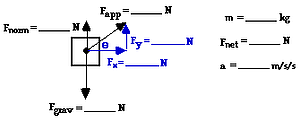
Lee Mealone is sledding with his friends. Disgruntled by a coarse comment, he decides to separate from the group. He momentarily exerts a 31 N force on the rope which is attached to his 2.5-kg sled. The rope makes an angle of 22° with the nearly frictionless surface. Use the structure provided below to determine the net force on and acceleration of the sled.
Audio Guided Solution
Levy alone is sledding with his friends and becoming disgruntled by a course common he decides to separate and so he applies a 31 Newton force at an angle of 22 degrees to the horizontal in order to accelerate his sled across its frictionless surface. It's a 2.5 kilogram sled and what you need to do is you need to determine the net force and acceleration of the sled. That is you need to take all the forces that are provided, and there's three here, and you need to add them up and sum them as vectors to determine the net force. Once done you can figure out the acceleration using the equation A equals F net over L. Now in the process of doing this you'll need to use some sort of organizational structure because you have a significant quantity of work to show. And as part of that organizational structure you'll need to take the applied force which is going not east, or I should say not right, and not up, but both right and up, and you need to find out how much of that 31 Newton's force is rightwards and how much of it is upwards. That is you'll need to calculate the horizontal and vertical component of the 31 Newton's at 22 degrees. Now if you weren't given this organizational structure you should create one of your own. A free body diagram such as this is an excellent organizational structure, and when you do you're always going to take these angled forces and break them up into components, ones which are going horizontal and vertical. The reason being is it's very easy to add forces when they're going up and down and right and left, and it's nearly impossible to add forces which are going at angles to one another without actually resolving them into their components. So I'm going to begin by writing for F applied 31 Newton's, that's a given, and for theta 22 degrees, that's a given, and for mass 2.5 kilograms, that's a given. What I'm looking for is F net acceleration. Your problem would always begin by finding the Fx, the horizontal component of the 31 Newton's, and doing so is a matter of finding the side adjacent on the little force triangle that you see drawn for you. So I need to go 31 Newton's times the cosine of 22 degrees to get Fx, and when I do I get about 28.74 Newton's. I need to do something similar for the side opposite that angle theta. I need to use the sine function, and I need to go 31 times the sine of 22 degrees, and when I do I get 11.61 Newton's. So now if I look at my diagram, I have two more individual force values to determine, and the one that's always easiest is F graph. It's always mg, 2.5 kilograms times the 9.8 Newton's per kilogram, and when I do that I get 24.50 Newton's. That's the down force, and leave me alone as pulling this, accelerating this sled across a horizontal surface, as it usually does, then what you know is that the vertical forces will balance one another. So the 24.50 Newton's down has got to balance the F norm and the 11.60 Newton's up, and if that's the case, you can simply take the 11.61 Newton's and subtract it from the 28.74 Newton's, and you end up determining the normal force up. And when you do that, I believe that you're going to get 17.17 Newton's, and that's the normal force. Now it's actual values have no consequence here, because the vertical forces balance each other, and they add up to zero, and what's left over as the net force is this little Fx vector. So F net becomes 28.74 Newton's, and if you take 28.74 Newton's and divide it by 2.5 Newton's, you end up getting the acceleration.
Solution
Fx: 28.74 N
Fy: 11.61 N
Fgrav: 24.5 N
Fnorm: 12.89 N
Fnet: 29 N, right
a: 11 m/s/s, right (rounded from 11.497 m/s/s)
Habbits of an Effective Problem Solver
- Read the problem carefully and develop a mental picture of the physical situation. If necessary, sketch a simple diagram of the physical situation to help you visualize it.
- Identify the known and unknown quantities in an organized manner. Equate given values to the symbols used to represent the corresponding quantity - e.g., \(m = \units{1.25}{kg}\), \(µ = 0.459\), \(v_o = \units{0.0}{\unitfrac{m}{s}}\), \(θ = 41.6°\), \(v_f = \colorbox{gray}{Unknown}\).
- Use physics formulas and conceptual reasoning to plot a strategy for solving for the unknown quantity.
- Identify the appropriate formula(s) to use.
- Perform substitutions and algebraic manipulations in order to solve for the unknown quantity.
Read About It!
Get more information on the topic of Forces in 2D at The Physics Classroom Tutorial.