Forces in 2D Legacy Problem #6 Guided Solution
Problem*
A pack of three Artic wolves are fighting over the carcass of a dead polar bear. A top view of the magnitude and direction of the three forces is shown in the diagram below.
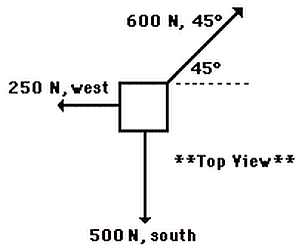
- Determine the resultant or net force acting upon the carcass.
- Determine the acceleration of the 750-kg polar bear carcass.
Audio Guided Solution
Here we have three forces acting upon the carcass of a polar bear, and what we need to determine is the net force, or resultant force. That is, what is the vector sum of these three forces? Now, whenever you have a situation where you have to add vectors of any kind, or forces such as these, force vectors such as these, you're very relieved if all the forces are going horizontal and vertical. Because you know if all forces go horizontal and vertical, it's simply a matter of using Pythagorean Theorem and adding all the forces together. The bad news here is we have one force that's not going horizontally or vertically. What we need to do is make it go horizontally or vertically. The 600 Newtons at 45 degrees can be resolved into two parts, two components. One component directed along the x-axis, and the other component directed along the vertical axis. We can find the Fx and the Fy of the 600 Newtons at 45 degrees. In the process of doing so, it demands that we use the sine and the cosine function in order to determine how much of the 600 Newtons is going horizontal and how much is going vertical. Now, unfortunately, since it is 45 degrees, the Fx and the Fy value for the 600 Newtons force will be the same value, determining as a matter of going 600 Newtons times the cosine of 45, or 600 Newtons times the sine of 45. Now, when you're done, you end up getting 424.26 Newtons for the horizontal, and that's directed to the east, and 424.26 Newtons for the vertical, and that's directed to the north. Now, you need to organize this information in one form or another, so you may want to use the provided table that is there, or simply the diagram that's provided, and begin organizing this information. Now, what you have is, instead of three forces to add up, is you have four forces to add up. But the good news is, they're all going in the direction that you like to see them going, horizontal and vertical. So for the 250 Newtons west, the horizontal component is 250 Newtons negative, and the vertical is zero. And for the 500 Newtons south, the horizontal component is zero, and the vertical component is 500 Newtons south, or negative 500 Newtons. And now we have to add up all the horizontals, and if you're using the table that's provided, we're determining the last row. We're trying to determine the horizontal component of the resultant, and doing so is a matter of taking 424.26 Newtons to the east, and adding to it negative 250 Newtons, or 250 Newtons to the west. When I do that, I get 174.2641 Newtons, and I can repeat the process for the vertical, adding together the 424.26 Newtons north to the 500 Newtons south, or negative 500 Newtons when I do that. I get negative 75.7359 Newtons negative, or south. Now I can use the Pythagorean Theorem to determine the resultant. I go 174.2641 Newtons squared, plus 75.7359 Newtons squared, and then take the square root of the sum, and I get about 190 Newtons. And now to determine the direction of this resultant force, I need to take my two components of it, and add them together. One of them is pretty lengthy, and it goes to the east, and the other one is a little bit shorter, and it goes to the south. I can draw that east first, then south, and then draw the resultant, and I'm trying to determine the direction of this resultant. And doing so demands that I find the angle between the resultant and the horizontal vector. So I say the tangent of theta is equal to the side opposite to the side adjacent, where the side opposite is that southerly side, and the side adjacent is the easterly side. So I say theta is equal to the inverse tangent of 75.7359 divided by 174.2641, and I come up with about 23.49 degrees, or approximately 23 degrees. That would be south of east, or if you're using counterclockwise notation, 337 degrees counterclockwise from east. That's how you do part A, and then part B is much more straightforward. You take your resultant force of about 190 point something newtons, and you divide it by the mass of the polar bear. The mass of the polar bear is 750 kilograms, and you get about 0.25 meters per second per second, and that's in the same direction as the net force.
Solution
- 190 N at 23° south of east (or 337°)
- 0.25 m/s/s
Habbits of an Effective Problem Solver
- Read the problem carefully and develop a mental picture of the physical situation. If necessary, sketch a simple diagram of the physical situation to help you visualize it.
- Identify the known and unknown quantities in an organized manner. Equate given values to the symbols used to represent the corresponding quantity - e.g., \(m = \units{1.25}{kg}\), \(µ = 0.459\), \(v_o = \units{0.0}{\unitfrac{m}{s}}\), \(θ = 41.6°\), \(v_f = \colorbox{gray}{Unknown}\).
- Use physics formulas and conceptual reasoning to plot a strategy for solving for the unknown quantity.
- Identify the appropriate formula(s) to use.
- Perform substitutions and algebraic manipulations in order to solve for the unknown quantity.
Read About It!
Get more information on the topic of Forces in 2D at The Physics Classroom Tutorial.