Forces in 2D Legacy Problem #20 Guided Solution
Problem*
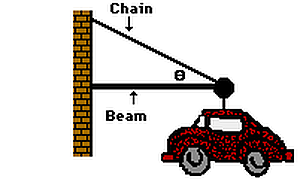
A local automobile dealership has chosen to hang a car outside the entry to their showroom. The car has been modified so that its mass is 645 kg. The car's weight will be supported by a heavy-duty chain which pulls upwards and leftwards. A beam will push outward to balance the wallward pull of the chain. The manufacturer of the chain claims it has a breaking strength of 17400 Newtons. Village code requires that there be a safety factor of 2.20. That is, the actual tension in the chain must be no more than 1/2.20 of the breaking strength. What is the minimum angle (between the chain and the horizontal) at which the dealership can hang the car?
Audio Guided Solution
A car is being hung down at the local dealership, and you see a picture of the physical situation given with this verbal statement. Now, if we think of the big dot as being the point of interest here, there are three forces acting upon this big dot. There's the weight of the car pulling down upon the dot, and there's the force of the chain that's going to be pulling upwards towards the wall, as well as leftwards. Now, if there were no other forces, that big dot would not stay there, because we need some other force to balance the leftward pull of the chain. And so a beam is inserted between the big dot and the wall, and that beam is going to push upon the dot to the right to balance the horizontal pull in the chain. Now, if this is to be held at equilibrium, then we know that all of the forces are going to have to balance each other. Analyzing the vertical pulls, there are two. There's a force of gravity, which is simply the weight of the car, the mg value, and then there's the vertical pull in the chain. The vertical component of the chain's tension force. What we're asked to do here is to determine the minimum angle at which this car can be hung and still support the weight, at which this chain can be hung and still support the weight of the car. Now, determining this minimum angle requires some careful reading and interpretation. What they tell us is that the manufacturer of this chain claims that it's going to break its 17,400 newtons. And they also tell us that village code requires that there be a safety factor of 2.20 newtons. That is to say that the actual tension allowed in the chain can be no more than 1 over 2.20 of the breaking strength. So what we want to do is determine what's the maximum tension we can have in this chain. And doing that means that we have to take 17,400 newtons and divide by 2.20 as a safety factor. Doing so gives us a maximum tension of 7,909.09 newtons. The tension in the chain can be no greater than that. Now if I focus on the chain, I know it's pulling horizontally and vertically. It's actually pulling diagonally. And it's pulling diagonally at a force of 7909.09 newtons. Now the maximum up force you can have in this chain is going to be equal to the mg value, the mass of the car, times this 9.8 newtons per kilogram. When you go 645 times 9.8, you get 6,321 newtons. So if you focus on the chain, the side opposite the theta, as indicated in the diagram, is going to be 6,321.00 newtons, and the side hypotenuse is going to be 7,909.09 newtons. So simply write this statement, sine of theta equals 6,321.00 divided by 7,909.09. That's sine equal opposite over hypotenuse. And solve for the angle theta. Comes out to be 53.05 degrees, or 53.1 degrees when rounded. And so that is the minimum angle that we can have. We can have angles bigger than that, but we can't have angles smaller than that.
Solution
53.1°
Habbits of an Effective Problem Solver
- Read the problem carefully and develop a mental picture of the physical situation. If necessary, sketch a simple diagram of the physical situation to help you visualize it.
- Identify the known and unknown quantities in an organized manner. Equate given values to the symbols used to represent the corresponding quantity - e.g., \(m = \units{1.25}{kg}\), \(µ = 0.459\), \(v_o = \units{0.0}{\unitfrac{m}{s}}\), \(θ = 41.6°\), \(v_f = \colorbox{gray}{Unknown}\).
- Use physics formulas and conceptual reasoning to plot a strategy for solving for the unknown quantity.
- Identify the appropriate formula(s) to use.
- Perform substitutions and algebraic manipulations in order to solve for the unknown quantity.
Read About It!
Get more information on the topic of Forces in 2D at The Physics Classroom Tutorial.