Forces in 2D Legacy Problem #21 Guided Solution
Problem*
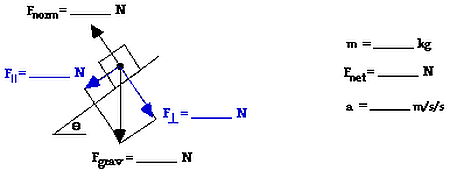
Lab partners Anna Litical and Noah Formula placed a 0.500-kg glider on their air track and inclined the track at 15.0° above the horizontal. Determine the net force and acceleration of the glider along the frictionless track. Use the structure provided with the free body diagram shown below.
Audio Guided Solution
An effective problem solver reads the problem carefully, getting a mental picture of what's going on, identifies the known values and the unknown values, and plots a strategy as to how to get from knowns to unknowns. In a problem like this, the best way to organize the known information, as well as to focus your strategy plotting phase, is to organize it in the form of a free body diagram, such as the one provided here. We have an object that's on an inclined plane, a surface that has been tilted. The mass of our object, m, equals 0.500 kilograms, and the angle at which this plane is inclined is 15.0 degrees. That's the theta in the diagram that you see. Now what we know about objects on inclines is that the gravity force goes straight down and it has two components, components which are directed parallel and perpendicular to the inclined plane. These components can be calculated using the equations that you'd find on the overview page of this set of problems. The f-parallel component can be calculated as mg times the sine of theta, and the f-perpendicular component can be calculated as mg times the cosine of theta. Using 15 degrees for theta, and 0.500 for m, and 9.8 newtons per kilograms for g, we can solve this problem, or we can determine the parallel and perpendicular components. For the parallel component, we can go 0.5 times 9.8 times the sine of 15 degrees, and we get 1.2682 newtons. Not all of those digits are significant. I'm going to write that value down. That ends up being the parallel component of force, of the force of gravity, and since there's no friction force opposing it, that also is our net force. Now to determine the perpendicular component, I would go 0.5 times 9.8 times the cosine of 15 degrees, and that becomes 4.733 newtons, and the normal force is the same value, since on an inclined plane, the normal force is going to balance the perpendicular component of gravity for situations in which there's no acceleration perpendicular to the incline. Now if you wish to determine the acceleration, you're going to take this parallel component, or the net force, and you're going to divide it by the mass. 1.2682 divided by the point, is equal to 0.50 times the acceleration. Divide each side by 0.500, and you get the acceleration of 2.5364. I can round this to 2.54 meters per second, per second.
Solution
Fnet: 1.27 N
a: 2.54 m/s/s
Habbits of an Effective Problem Solver
- Read the problem carefully and develop a mental picture of the physical situation. If necessary, sketch a simple diagram of the physical situation to help you visualize it.
- Identify the known and unknown quantities in an organized manner. Equate given values to the symbols used to represent the corresponding quantity - e.g., \(m = \units{1.25}{kg}\), \(µ = 0.459\), \(v_o = \units{0.0}{\unitfrac{m}{s}}\), \(θ = 41.6°\), \(v_f = \colorbox{gray}{Unknown}\).
- Use physics formulas and conceptual reasoning to plot a strategy for solving for the unknown quantity.
- Identify the appropriate formula(s) to use.
- Perform substitutions and algebraic manipulations in order to solve for the unknown quantity.
Read About It!
Get more information on the topic of Forces in 2D at The Physics Classroom Tutorial.