Forces in 2D Legacy Problem #19 Guided Solution
Problem*
Mom and Dad have tied a rope to Matthew’s sled and are momentarily pulling him through the snow. Dad is pulling with force A and Mom with force B.
- A: 54 N at 65° north of east
- B: 130 N at 22° south of east
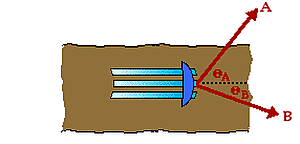
- Determine the resultant force of A and B.
- Determine the acceleration that these momentary forces would create for a 39-kg sled and child (assuming negligible friction).
Audio Guided Solution
Here we have a problem about a boy on a sled being pulled along by his mom and dad. At a given moment in time, there are two forces acting forward upon the boy. There is a 54 newton force at a 65 degrees north of east angle and a 130 newton force at a 22 degrees south of east angle. These forces we will call A and B. You want to draw force A or simply use the diagram that is provided and then resolve it into two components. Into a horizontal pole and a vertical pole. You can do the same thing for force B. Resolve it into a horizontal and a vertical pole. Now together, these two forces will add up to a resultant force and we want to determine it and then determine the acceleration upon the 39 kilogram sled and child. Now to determine the resultant force or the sum of these two forces, we need to divide it up into the AX, AY and BX, BY forces. Because as shown, these two forces do not add real nicely together. But if we can break it up into four forces going left, right and up, down, we can more easily add the forces and determine the net force. Now if I were to resolve force A into horizontal and vertical components, I would say AX equals 54 times the cosine of 65. Since the horizontal side is adjacent to the 65 degree angle on a force triangle. And if I were to find AY, I would say 54 newtons times the sine of 65 degrees. Now I can do the same thing for BX and BY. BX being 130 newtons times the cosine of 22 degrees. And BY being 130 newtons times the sine of 22 degrees. Now once I figure out the AX and the BX, I can add them together. They're both going to the right, so adding them is simple. And it becomes 143.3553 newtons. Now if you look at AY's value and BY's value, they're almost the same magnitude. And they're in opposite directions. So adding them pretty much adds up to 0 newtons. I know you'd disagree with me and say it really adds up to 0.25 newtons south. But for all practical purposes, it's actually 0.25 newtons north. But for all practical purposes, it's really adding up to 0. So now what I really have is a horizontal force of 143.3553 newtons. I can round that to 140 newtons, two significant digits. And that's the force acting upon Matthew's sled. Now to determine the acceleration, I'm going to take this 143.3553 newtons. And I'm going to divide it by the mass of 39 kilograms. And when I do, I determine the acceleration of the sled. And I round it to two digits. It becomes 3.7 meters per second per second.
Solution
- 140 N (rounded from 143 N)
- 3.7 m/s/s
Habbits of an Effective Problem Solver
- Read the problem carefully and develop a mental picture of the physical situation. If necessary, sketch a simple diagram of the physical situation to help you visualize it.
- Identify the known and unknown quantities in an organized manner. Equate given values to the symbols used to represent the corresponding quantity - e.g., \(m = \units{1.25}{kg}\), \(µ = 0.459\), \(v_o = \units{0.0}{\unitfrac{m}{s}}\), \(θ = 41.6°\), \(v_f = \colorbox{gray}{Unknown}\).
- Use physics formulas and conceptual reasoning to plot a strategy for solving for the unknown quantity.
- Identify the appropriate formula(s) to use.
- Perform substitutions and algebraic manipulations in order to solve for the unknown quantity.
Read About It!
Get more information on the topic of Forces in 2D at The Physics Classroom Tutorial.