Forces in 2D Legacy Problem #22 Guided Solution
Problem*
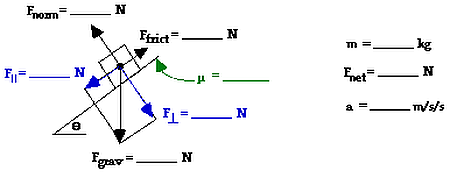
Anna Litical and Noah Formula now place a 1.38-kg brick on a wooden board and incline the board at 24.0° above the horizontal. The coefficient of friction between the brick and the board is 0. 328. Determine the net force and the acceleration of the brick. Use the structure provided with the free body diagram shown below.
Audio Guided Solution
In problems such as this, it becomes imperative that you're following the habits of an effective problem solver, that you're reading the problem carefully and getting a mental picture of what's going on, maybe even constructing a diagram such as the one you see here, that you're identifying the known quantities and the unknown quantities, and you're plotting a strategy to get from the known to the unknown quantities. Here we're given an object that's been placed up on an inclined plane, a board which is inclined at an angle of 24 degrees. The 24 degrees is the theta that you see in the diagram that's provided. The mass of this object is 1.38 kilograms. It happens to be a brick, and it's on an inclined plane, and what we're to do is to determine the net force and acceleration of the brick along the inclined plane once it's placed there. What you know is that there's a friction force that's opposing the motion of the brick, and it's based upon a coefficient of friction value, sometimes symbolized as mu, of 0.328. So for me to calculate the acceleration of this brick, I need to first determine the net force. The brick's going to accelerate parallel to the inclined plane. So to get the net force, I'm going to have to find the parallel component of gravity, that's F parallel in the diagram, and the friction force. Now to get the friction force, I'm going to need to know the normal force and apply the equation F frict equal mu F norm. The only way to get the normal force is to get the perpendicular component of the weight vector, and so I need to begin this whole problem by taking F grab and finding its parallel and perpendicular components. Now the equations for doing that are found on the overview page. For F parallel, it's mg sine of theta, and for F perpendicular, it's mg cosine theta. If I go 1.38 times 9.8, the acceleration of gravity, I'll be able to determine the F grab force. It becomes 13.524 newtons. Multiplying that mg, or F grab force, by the sine of 24 degrees gets me the F parallel. You should do that and write it down in the provided blank. It becomes 5.5007 newtons. Now the F perpendicular force can be found if you take that mg value of 13.524 and multiply it by the cosine of 24. You get an F perpendicular value of 12.3548 newtons. You should also write that one down. Now the importance of F perpendicular is that it allows us to find F normal and then F friction. So once you know F perpendicular, you can reason that the normal force has to balance it. Since objects placed on inclined planes are not accelerating perpendicular to the plane, therefore the perpendicular force is balanced. The normal force is equal to F perpendicular, which is equal to 12.3548 newtons. Now that you've found F normal, you can determine the F friction force using the equation F friction equals mu times F norm. The value for mu is 0.328, so you go 0.328 times 12.3548 newtons, and that gives you the F friction force. It's 4.0524 newtons, less than the parallel component of gravity. The parallel component of gravity, 5.5007, is going to accelerate the object down the inclined plane against the resistance force of friction. Now if we subtract the resistance force, and it's friction, from the parallel component of gravity, we get the net force, and it becomes 1.4483 newtons. You can round that to the third significant digit, as 1.45 newtons. Now once you get that value for the net force, take the 1.4483 newtons and divide it by the mass of the object, 1.38 kilograms, and you end up getting 1.0495 meters per second per second, rounded to the third digit, that's 1.05 meters per second per second.
Solution
Fnet: 1.45 N
a: 1.05 m/s/s
Habbits of an Effective Problem Solver
- Read the problem carefully and develop a mental picture of the physical situation. If necessary, sketch a simple diagram of the physical situation to help you visualize it.
- Identify the known and unknown quantities in an organized manner. Equate given values to the symbols used to represent the corresponding quantity - e.g., \(m = \units{1.25}{kg}\), \(µ = 0.459\), \(v_o = \units{0.0}{\unitfrac{m}{s}}\), \(θ = 41.6°\), \(v_f = \colorbox{gray}{Unknown}\).
- Use physics formulas and conceptual reasoning to plot a strategy for solving for the unknown quantity.
- Identify the appropriate formula(s) to use.
- Perform substitutions and algebraic manipulations in order to solve for the unknown quantity.
Read About It!
Get more information on the topic of Forces in 2D at The Physics Classroom Tutorial.