Electric Circuits Legacy Problem #22 Guided Solution
Problem*
The series circuit at the right depicts two resistors connected to a voltage source. The voltage source (ΔVtot) is a 48-V source and the resistor values are 6.4 Ω (R1) and 3.9 Ω (R2).
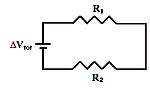
- Determine the equivalent resistance of the circuit.
- Determine the current in the circuit.
- Determine the voltage drop across each individual resistor.
Audio Guided Solution
One of the worst things you can do on electric circuit problems is to kind of stab it, take a stab at the answer in the dark. In other words, to not know a whole lot about the topic and try to go about using physics equations in order to solve for unknown quantities. If you feel like you're doing that, I recommend that you take some time to read the overview page of this set of problems. Read carefully about series circuits and if you're having difficulty with parallel circuits, read about that too. If that doesn't do it, there's more extensive information that can be found if you click the links at the bottom of this page. It goes back to the physics classroom tutorial where series and parallel circuits are discussed in a lot of detail. Now in this question we have a series, a sequence of questions that are going to ask us about a series connected resistors, two of them with resistances of 6.4 and 3.9 ohms. Now any charge leaving that battery, it's labeled delta V total, any charge that leaves that battery is going to have to go through both of those resistors such that the overall or equivalent resistance of the entire circuit is simply the sum of the individual resistors. So in part A of the problem where I'm trying to find the equivalent resistance, it's simply the sum of those two resistance values. This is always the case in series connected resistors. So the answer in A is what I get when I go 6.4 ohms plus 3.9 ohms comes out to be 10.3 ohms. In part B of the problem I'm asked to determine the current in the circuit. Now that 48 volt source of energy imposes an electric potential difference across the entire circuit of 48 volts and the entire circuit has a total resistance of 10.3 ohms. So to find the current in the circuit, I simply use those two values. I'm used to calling them delta V total and R equivalent or R total and I simply say the current is equal to delta V total divided by R total. That's the old equation I've had for some time, delta V equal I times R. Now when I substitute and solve, I end up getting 4.6602 ohms and that's the current through the battery, the current through the first resistor, and the current through the second resistor. In part C of this problem I'm asked to calculate the voltage drop across each of the individual resistors. Now this delta V equal IR is like the big equation in electric circuits. It's like the F net equal MA of mechanics. You can use it for so many things. So if you want to find a voltage drop, that's a delta V, then you can use that equation. It's equal to I times R, as long as you use it appropriately. Let's take the first resistor R1, the one that is 6.4 ohms. If I want to find the delta V across it, I simply say delta V1 is equal to I1 times R1. Well we've already determined what I1 is, it was 4.6602 and R1 is the given value, 6.4 ohms. If I want to find the delta V across that first resistor, what I have to do is go 4.6602 times 6.4 ohms, and of course it follows if I want to find the delta V2 that is across the socket resistor, I do the same thing, only I use the value of R2. The value of I2 is the same as the value of I1, as the value of I through the battery. After all, if you think about current, that's the flow of charge, and for the flow of charge to ever change, there has to be a place in the circuit where charge sort of divides into two paths. That's not the case in series circuits. So I2 is the same as I1, is the same as I total, is the same as 4.6602, and if I take that I2 and multiply it by R2, 3.9 ohms, I get delta V2. I end up getting answers of about 30 and 18. Together they should add up to the total voltage source. That was 48 volts. They do. So I know I've done it right.
Solution
- 10.3 Ω
- 4.7 A
- ΔV1 = 30. V and ΔV2 = 18 V
Habbits of an Effective Problem Solver
- Read the problem carefully and develop a mental picture of the physical situation. If necessary, sketch a simple diagram of the physical situation to help you visualize it.
- Identify the known and unknown quantities and record them in an organized manner. Equate given values to the symbols used to represent the corresponding quantity - e.g., \(\descriptive{\text{δV}}{δV,change in voltage} = 9.0\unit{\volt}\); \(\descriptive{R}{R,resistance} = 0.025\unit{\ohm}\); \(\descriptive{I}{I,current} = \colorbox{gray}{Unknown}\).
- Use physics formulas and conceptual reasoning to plot a strategy for solving for the unknown quantity.
- Identify the appropriate formula(s) to use.
- Perform substitutions and algebraic manipulations in order to solve for the unknown quantity.
Read About It!
Get more information on the topic of Electric Circuits at The Physics Classroom Tutorial.