Electric Circuits Legacy Problem #30 Guided Solution
Problem*
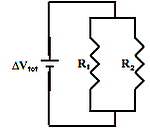
The parallel circuit at the right depicts two resistors connected to a voltage source. The voltage source (ΔVtot) is a 12-V source and the resistor values are 6.4 Ω (R1) and 3.9 Ω (R2).
- Determine the equivalent resistance of the circuit.
- Determine the current in each branch resistor.
- Determine the total current in the circuit.
Audio Guided Solution
You know, physics problems are so much more easier when you have a conceptual understanding of what's going on. When you understand the physics of the problem. There's a common syndrome, besides fear, that plagues many beginning students of physics. It's the, I got stuck before I got started syndrome, or I don't know where to begin on this problem syndrome. And typically, students suffering from that syndrome will do well if they learn some habits that effective problem solvers use. Those habits involve reading the problem carefully and writing down the things that you know. Even diagramming the situation, and in this case, a diagram is given. But if you weren't given a diagram, diagramming the situation. And then beginning to plot a strategy as to how to get from the known information to the unknown information. And that involves finding formulas, but it also involves understanding concepts. I'll walk you through this problem. It's a parallel circuit, and in a parallel circuit, there's a branching location where charge comes out of the battery and comes to a node, or a branching location, and breaks up into two paths, and then comes back together again. And on this diagram, you see that on the right side of the diagram. Those little squiggly lines represent resistors. They're labeled R1 and R2. And they're values given, and what I do right away is I write down R1 equals 6.4 ohms, R2 equals 3.9 ohms. I know it's written down in the problem, but you need to extract that information and equate it with symbols that are used in physics formulas. And then I write down delta V total equals 12 ohms. I have three unknowns here. I need to find R equivalent, that's part A of the equivalent resistance. I need to find the current in each branch of the circuit. That is, I need to find I1, the current going through the branch labeled R1, and I need to find I2, the current going through the branch labeled R2. Finally, I need to find I total. I don't need to find them in that order, but I'm going to come close to doing it in that order. OK, now I begin by first finding part A, the equivalent resistance. I need to have a formula for that. It needs to be a formula applicable to parallel circuits. If I click back to the overview page for this set of problems, I'll find that an equation for equivalent resistance is given for parallel circuits. It's 1 over R equivalent equal 1 over R1 plus 1 over R2. And if there's more resistors, you go plus 1 over R3, et cetera. So I'm going to write down, and then I'm going to solve it on my calculator later, but I'm going to write down this equation. 1 over R equivalent equal 1 divided by or over 6.4 plus 1 over 3.9. And I'm going to evaluate the right side of that equation. I hope you've written it down as well. So on my calculator, I'm going to evaluate the right side. I go 1 divided by 6.4 plus 1 divided by 3.9, and then I either press equal or enter. And what I find out when I do that is that the right side evaluates to 0.4127 blah, blah, blah. That's not the equivalent resistance. That's the right side of the equation. Now, if you look at the left side, what does that equal to? It's equal to 1 over R equivalent. So if you reciprocate both sides, legal and algebra, do the same thing on the left as the right, you will be able to find R equivalent. Taking the left side gives you R equivalent, and reciprocating, or taking the reciprocal of the right side, or simply going 1 divided by the answer on your calculator panel, 0.4127, gives you the total or equivalent resistance. Comes out to be 2.4233, and I can round that to two significant digits. Now, what have I found? I found the total resistance of the entire circuit. The two resistors combined, it's equivalent to having 2.4233 ohms. Now, I could, if I wanted to, answer part C, find the total current in the circuit, because I have this strategic equation in electricity that goes delta V equal IR. And the rule is that you can solve for any one of the variables in that equation, as long as you know two other variables for a corresponding part of the circuit. So I know delta V total, and I now know R total, or R equivalent, that is for the whole circuit, delta V, and for the whole circuit, R total. So I can simply go delta V equal IR, and plug in for delta V, the 12 ohms, and plug in for R total, the 2.4233 ohms, and chug out I total, 4.9519 amps. If I can round that to one decimal place, or two significant digits, it rounds up to 5.0. Okay, what have I just calculated? I've calculated the total current everywhere. Okay, now when that current, 5.0 amps, or 4.9519 amps, gets to the node, or the branching location, it's going to divide into two smaller parts, kind of like water approaching an island on a river. It's going to go through two paths around the island, and come back together again. And the sum of the current in those two branches is equal to the total current outside of the branches. It's true for water, it's true for charge. Now to find the current in the branches, I need to use the delta V equal IR equation. Now here's where a big concept comes in. If you think about charge going through the battery, it gains 12 volts in this problem. So as it goes through the entire circuit, every single charge is going to lose 12 volts. So whether it takes the path on the left or the path on the right, it's going to lose 12 volts. It doesn't matter which one it takes, but it's only going to take one of those paths. So as it goes through resistor 1, it drops in 12 volts of voltage. It goes through resistor 2, it drops 12 volts of voltage. So now what I can say is delta V equal IR, and I have to use, for delta V1, 12, and for R1 I have to use 6.4, and I can solve for I1. So solving for I1, I go 12 divided by 6.4, it comes out to be 1.8750. I can round that to the first decimal place, 1.9 amps. In doing the same thing for the other resistor, I can say I2 equal delta V2 over R2, 12 over 3.9, I get 3.0769 amperes. I can round that to one decimal place, it becomes 3.1 amps. Now look at the two numbers, I1 and I2. Notice what they do. They sum up to 5.0 amps, the current through the battery. That's conceptual physics and mathematical physics combined. That's what you need to be a good problem solver.
Solution
- 2.4 Ω
- I1 = 1.9 A and I2 = 3.1 A
- 5.0 A
Habbits of an Effective Problem Solver
- Read the problem carefully and develop a mental picture of the physical situation. If necessary, sketch a simple diagram of the physical situation to help you visualize it.
- Identify the known and unknown quantities and record them in an organized manner. Equate given values to the symbols used to represent the corresponding quantity - e.g., \(\descriptive{\text{δV}}{δV,change in voltage} = 9.0\unit{\volt}\); \(\descriptive{R}{R,resistance} = 0.025\unit{\ohm}\); \(\descriptive{I}{I,current} = \colorbox{gray}{Unknown}\).
- Use physics formulas and conceptual reasoning to plot a strategy for solving for the unknown quantity.
- Identify the appropriate formula(s) to use.
- Perform substitutions and algebraic manipulations in order to solve for the unknown quantity.
Read About It!
Get more information on the topic of Electric Circuits at The Physics Classroom Tutorial.