Electric Circuits Legacy Problem #23 Guided Solution
Problem*
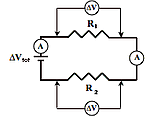
Voltmeters can be used to determine the voltage difference between two points on a circuit. An ammeter can be used to determine the current at any given location on a circuit. The circuit at the right is powered by a 12.0-volt battery and utilizes two voltmeters and two ammeters to measure voltage drops and currents. The resistor values are 1.28 Ω (R1) and 3.85 Ω (R2). Determine the ammeter readings and voltmeter readings.
Audio Guided Solution
If you've done any electric circuit labs in your physics class, you likely have used ampeters and voltmeters. Ampeters are just devices which are wired within the circuit itself, such that charge flowing through the circuit flows through the ampeter, and the ammeter measures the current at whatever location it's wired into. Here in this electric circuit, we have two such ammeters. Now a voltmeter, on the other hand, is simply a device which has two probes, and you typically touch here and touch there two metal parts within the circuit, so you can find the electric potential difference between those two points where you touch. It's possible you use multimeters instead of voltmeters and ammeters, and those simply serve as the same thing. Now in this question, what we're asked to do is determine what the ammeter readings are. In other words, what's the current at the two given locations on the circuit? And we also wish to determine the voltmeter readings. That is, if you took a little voltmeter and you touched and touched at the indicated locations, what would the readout be for the electric potential difference between those two locations? Now it's a series circuit, so we could actually use our math equations, our physics formulas, to actually predict what we would find for these two situations. Now the act of determining the current in a series circuit demands that we first determine the overall or equivalent resistance of the two resistors in that series circuit. The equation for finding the overall resistance is simply R equivalent, or R total, equal R1 plus R2. It's simply the sum of the individual resistance values. So if I add the two resistances, 1.28 ohms and 3.85 ohms, I end up getting 5.13 ohms. Now that's the overall resistance, and that resistance is the resistance offered to the 12-volt battery as it tries to pump charge around the circuit. So to find the overall current, I simply take the overall voltage drop across the entire circuit, and I divide into it the overall or equivalent resistance. So 12.0 volts divided by this 5.13 ohms gives me 2.3392 amps, or rounded 2.34 amps. That's the current through the battery. And in series circuits, the current never divides up into branches, and as such, that's the current in every one of the resistors in every location within the circuit. So wherever you put an ammeter, that's the current that's going to be read by that ammeter. So 2.34 ammeter is the reading on both of those ammeters. Now the next part of the problem. I wish to find the voltage drops across R1 and across R2, as indicated by the locations where that voltage probe or voltmeter is touched. So to find the voltage drop across R1, I simply need to use the equation delta V equals I times R. I now have three R values. Which one do I use? Well, I have to use the R1 value if I want to find the voltage drop across R1. The current through R1 is simply 2.3392 amps. So if I multiply that number by my 1.28 ohms, I'll get the voltage drop across those two locations where the voltmeter is being touched. It comes out to be 2.9942 volts. Now if I repeat the process for R2, I need to say delta V equals I times R. And now use R2 as the R value in that equation. So going 2.3392 amps multiplied by 3.85 ohms gives me 9.0058 volts. And that's the voltage drop across R2, across the two locations where those voltmeter probes are being touched. Now one thing you might notice here is that the 2.9942 volts for the voltage drop across R1, plus the 9.0058 volts for the voltage drop across R2, adds exactly to 12.00 volts. That's a good thing, because that's what we would expect for a series circuit.
Solution
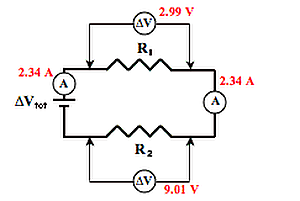
Ammeter readings: 2.34 A (for each)
Top voltmeter reading: 2.99 V
Bottom voltmeter reading: 9.01 V
Habbits of an Effective Problem Solver
- Read the problem carefully and develop a mental picture of the physical situation. If necessary, sketch a simple diagram of the physical situation to help you visualize it.
- Identify the known and unknown quantities and record them in an organized manner. Equate given values to the symbols used to represent the corresponding quantity - e.g., \(\descriptive{\text{δV}}{δV,change in voltage} = 9.0\unit{\volt}\); \(\descriptive{R}{R,resistance} = 0.025\unit{\ohm}\); \(\descriptive{I}{I,current} = \colorbox{gray}{Unknown}\).
- Use physics formulas and conceptual reasoning to plot a strategy for solving for the unknown quantity.
- Identify the appropriate formula(s) to use.
- Perform substitutions and algebraic manipulations in order to solve for the unknown quantity.
Read About It!
Get more information on the topic of Electric Circuits at The Physics Classroom Tutorial.