Electric Circuits Legacy Problem #24 Guided Solution
Problem*
The series circuit at the right depicts three resistors connected to a voltage source. The voltage source (ΔVtot) is a 110-V source and the resistor values are 7.2 Ω (R1), 6.2 Ω (R2) and 8.6 Ω (R3).
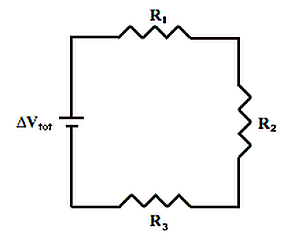
- Determine the equivalent resistance of the circuit.
- Determine the current in the circuit.
- Determine the voltage drops across each individual resistor.
Audio Guided Solution
About one of the worst things you can do in electric circuit problems like series and parallel circuit problems is to try to take a stab in the dark at the answers. That is to try to approach the mathematics of the problems without any conceptual understanding what's going on. If you feel like you're doing that, you may want to take a peek at the overview page for this set of problems. Click the little link at the bottom of the page that goes back to the overview page and get some background information. And if that doesn't suffice, then click the links to the physics classroom tutorial and read through the two pages on series and on parallel circuits. With a little conceptual understanding of what's going on, the mathematics is that much more meaningful. Here we have a series circuit problem. What we're asked to do is answer three questions. First of all, find the equivalent resistance in the circuit. Now in a series circuit problem, any charge that leaves the battery goes sequentially through the three resistors. It never bypasses one or goes through one and then gets back to the battery. It must go through each of the three resistors. And it's for that reason that the overall or equivalent resistance of the circuit is simply the sum of the individual resistance values. And so you need to take the 7.2 ohms and the 6.2 ohms and the 8.6 ohms and add them together to get the overall or equivalent resistance. It comes out to be exactly 22.0 ohms. Now for a series circuit, the voltage drop across the entire circuit is simply equal to the overall or equivalent resistance that we've just calculated multiplied by the current through the entire circuit. So if I want to find the current in the circuit, I take my known value for the voltage drop across all three resistors. That's 110 volts. It impresses an electric potential difference across the entirety of the three resistors of 110 volts. And I set that equal to I times R equivalent, which is the 22 ohms we just calculated. Solving for I, I get 5.0 amps. And what I've calculated is the current through the battery. But since current never divides up in a series circuit into a couple of paths, I've also calculated the flow rate, or the current, in each of the three individual resistors. So now in part C of this problem, I wish to calculate the voltage drops across each individual resistance. Now I have an equation that goes delta V equals I times R. As charge flows through a resistor, it encounters a voltage drop, a delta V, an electric potential difference between the positive side of that resistor and the so-called negative side of that resistor. So if I wish to calculate the difference in electric potential across that resistor, I use that equation, delta V equals I times R. But I have to ask now, which R should I use? The answer is, you should use the R for the resistor you're trying to find the delta V for. So if delta V equals IR, and I want to find the delta V for the first resistor, I'm going to go the I of 5.0 amps, which is the current in that resistor, times the R1 value of 7.2 ohms. When I do that, I get 36.0 volts exactly. I can repeat the process for the other two resistors, using their resistor value in the calculation, and I find for the second resistor, 6.2 ohms, the delta V2 is 31 volts. And for the third resistor of 8.6 ohms, the delta V is 43 volts. So picture a charge transversing this circuit. As it goes through each of the three resistors, it drops its voltage, or how energized it is, from a given value to a lower value. Starting at the positive terminal of the battery, it's got 110 volts. Going through the first resistor, it loses 36 volts of that 110. Going through the second, it loses 31 volts. And going through the third, it loses 43 volts. By the time it goes through all three, it's back to zero volts. Where is this charge now? It's at the negative terminal of the battery, where the electric potential is zero volts. There at that negative terminal of the battery, it's going to get pumped back up to 110 volts by the battery, and now it's going to repeat the loop again.
Solution
- 22.0 Ω
- 5.0 A
- ΔV1 = 36 V, ΔV2 = 31 V and ΔV3 = 43 V
Habbits of an Effective Problem Solver
- Read the problem carefully and develop a mental picture of the physical situation. If necessary, sketch a simple diagram of the physical situation to help you visualize it.
- Identify the known and unknown quantities and record them in an organized manner. Equate given values to the symbols used to represent the corresponding quantity - e.g., \(\descriptive{\text{δV}}{δV,change in voltage} = 9.0\unit{\volt}\); \(\descriptive{R}{R,resistance} = 0.025\unit{\ohm}\); \(\descriptive{I}{I,current} = \colorbox{gray}{Unknown}\).
- Use physics formulas and conceptual reasoning to plot a strategy for solving for the unknown quantity.
- Identify the appropriate formula(s) to use.
- Perform substitutions and algebraic manipulations in order to solve for the unknown quantity.
Read About It!
Get more information on the topic of Electric Circuits at The Physics Classroom Tutorial.