Electric Circuits Legacy Problem #31 Guided Solution
Problem*
The parallel circuit at the right depicts three resistors connected to a voltage source. The voltage source (ΔVtot) is a 110.-V source and the resistor values are 15.4 Ω (R1), 21.9 Ω (R2) and 11.7 Ω (R3).
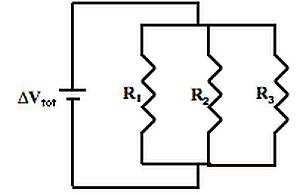
- Determine the equivalent resistance of the circuit.
- Determine the current in each branch resistor.
- Determine the total current in the circuit.
Audio Guided Solution
The successful solution to a physics problem often involves a blend of conceptual understanding and mathematical skill. That's no different for this parallel circuit problem. In order to understand a parallel circuit problem, you have to understand parallel circuits. Here's the big idea. If we could imagine a collection of charges leaving a battery and moving through the wires. In a parallel circuit, those charges eventually come to a node, a point along the circuit at which the wires branch off into different paths or branches. For instance, in this circuit, there are three branches exiting a point on the circuit. Charge reaching that point on the circuit will go through one of the three branches, but not all three. There will be a drop in electric potential, and eventually the charges will get back together again and then return to the battery. That's the idea of a parallel circuit. There's branching locations in branches. Now not every charge goes through the R1 resistor, or the R2 resistor, or the R3 resistor. But the sum of the currents in each individual resistor is going to equal the current outside those branches. In other words, the current, or rate of charge flow, in the wires before the branching location is equal to the sum of the individual currents within the branching location. Now irregardless of which branch a charge goes through, it's going to lose some voltage, some electric potential. And the electric potential difference, or drop, is going to be the same irregardless of what branch the charge goes through. For instance, in this problem, there's a 110 voltage source, which means charge going through the battery gains 110 volts. And going through the external circuit that involves the resistors, it will have to lose 110 volts. So since charge only goes through a single branch on its path around the circuit, the delta V across that branch is 110 volts. Now we have an equation that says delta V, electric potential difference, is equal to I times R. It's equal to the current between those two points multiplied by the resistance between those two points. So applied to resistor 1, we could say that I1 equals delta V1 over R1. Substituting in values of 110 volts and 15.4, we get 7.1429 amps as a current through R1. And the current in R2, that is I2, is equal to the 110 volts again, divided by R2, 21.9 ohms. That comes out to be 5.0228 amps. And applied again to resistor 3, we could say that I3 is equal to delta V3 divided by R3. That is I3 equals 110 volts divided by 11.7 ohms. That comes out to be 9.4017 amps. I've just answered all three questions in part B of this question. Now for part C, I could apply the idea that the current in the branches sum up to the current outside the branches. So I found I1, I2, I3. I can simply add up these currents, and that gives me I total, or the current, outside of the branches and passing through the battery. That adds up to just a little short of 21.57 amps. Now when I come to part A, I can answer that a couple of ways, as I could probably answer all of these questions a couple of different methods. Now I'm going to do it this way. I'm going to now take the 21.57 amps, or the unrounded number that I figured earlier, 21.5674 amps, as the total current, and I'm going to divide that into the total voltage drop, the 110 volts. I'm going to say I total equals delta V total over R total, where my total current is 21.5674, and my total voltage drop is 110 volts. When I do that 110 divided by 21.5674, I get just a little more than 5.1, about 5.1003. And that's my total resistance, or equivalent resistance, and the answer to part A. I could have gotten a part A answer a little differently. I could have used the equation 1 over R equivalent is equal to 1 over R1 plus 1 over R2 plus 1 over R3. I could have substituted in R values and figured out what 1 over R equivalent is. It comes out to be about 0.1961 when I do that. Now that's not R equivalent, that's 1 over R equivalent, so I take the reciprocal of each side of the equation, and I end up getting R equivalent equal 5.1003 ohms. That's the same answer, I've got to do it the other way. Now if I had done that first, part A that is, and found the equivalent resistance, I could have done part C second, and determined the total current by going delta V total 110 equal I total unknown times 5.1003 ohms. I would have gotten that same 21.5674 amps of current that I got earlier, done a different way. So as you can see, conceptual understanding of circuits is essential to working your way through a solution to problems like this one.
Solution
- 5.10 Ω
- I1 = 7.14 A, I2 = 5.02 A and I3 = 9.40 A
- 21.57 A
Habbits of an Effective Problem Solver
- Read the problem carefully and develop a mental picture of the physical situation. If necessary, sketch a simple diagram of the physical situation to help you visualize it.
- Identify the known and unknown quantities and record them in an organized manner. Equate given values to the symbols used to represent the corresponding quantity - e.g., \(\descriptive{\text{δV}}{δV,change in voltage} = 9.0\unit{\volt}\); \(\descriptive{R}{R,resistance} = 0.025\unit{\ohm}\); \(\descriptive{I}{I,current} = \colorbox{gray}{Unknown}\).
- Use physics formulas and conceptual reasoning to plot a strategy for solving for the unknown quantity.
- Identify the appropriate formula(s) to use.
- Perform substitutions and algebraic manipulations in order to solve for the unknown quantity.
Read About It!
Get more information on the topic of Electric Circuits at The Physics Classroom Tutorial.