Refraction and Lenses Legacy Problem #11 Guided Solution
Problem*
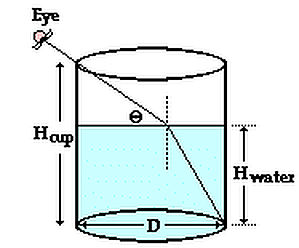
A tall cup is partially filled with water (n=1.33) to a height of 7.80 cm (Hwater). The diameter (D) of the cup is 14.64 cm. A student looks downward just over the left rim of the cup at an angle of 40.47 degrees with the water's surface (theta). At this angle, the refraction of light at the water's surface just barely allows her to see the bottom-right corner of the cup. A sketch (not drawn to scale) of the path of light is shown in the image below. Determine the height of the cup (Hcup) in centimeters.
Audio Guided Solution
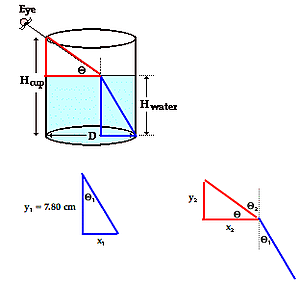
This is a very difficult problem which involves a blend of effective problem-solving habits, physics understanding, some good thinking, and an understanding of some trigonometry and geometry. You're going to have to get yourself very organized here, utilize the diagram that I've provided here on this page to help you out, and make an effort to work your way from the known quantities to the unknown quantities. The problem involves a student who's looking over the edge of a cup at the very opposite corner of the cup, and he looks at such an angle, 40.47 degree angle to the water surface, that he's just barely able to view the bottom right corner of the cup. Our problem involves finding the height of the cup. What we know is the height of the water in the cup and the diameter of the cup in this 40.47 degree angle. Now you'll notice that I've taken the provided diagram and I've sort of broken it up into a couple of right triangles, a red triangle, which I'll call triangle 2, and a blue triangle, which I'll call triangle 1. Now for the red triangle, I know the value of theta. That is given to me as 40.47 degrees. That's not the angle of incidence or of refraction, because that's the angle between the light ray and the boundary itself. But if I subtract that angle theta from 90 degrees, I'll get theta 2, which is the angle between the normal light and the ray of light that emerges from the water into the air. That's the angle of refraction. Its value is 49.53 degrees. Now if I take that angle and I substitute it into Snell's Law with the indices of refraction, I can find the angle theta 1 in the blue triangle. So doing so demands that I go 1.00 times the sine of 49.53 degrees equals 1.33 times the sine of theta 1. And when I do that, I solve for theta 1, and it comes out to be 34.8891 degrees. Now for my second step, I'm going to take this theta 1 value and I'm going to say the tangent of theta 1 is equal to x1 over y1. I'm focusing here on the blue triangle, and I'm applying the tangent function to that theta 1 angle within the blue triangle. When I do that, I can solve for x1, because I know that y1 is 7.80. So I say that x1 equals 7.80 times the tangent of 34.8891. When I do that, I get an x1 value of 5.4391 centimeters. Take a deep breath. Now you're ready for the third step of this problem. And in the third step of the problem, you're going to try to find x2 using the diameter of the cup. The diameter of the cup is given as 14.64 centimeters, and it's equal to the two horizontal dimensions that we have in our blue and our red triangle. It's equal to x1 plus x2. x1 I just calculated as 5.4391 centimeters. So I can subtract that from 14.64 centimeters. And I'll get x2. It comes out to be 9.2009 centimeters. That's x2, the horizontal length of the red triangle that you see drawn on this diagram. Now that I have x2, I can use it along with the angle theta in order to calculate y2. That's my fourth step. I say the tangent of theta equals y2 over x2. And then I rearrange the equation, y2 equals x2 times the tangent of theta. The tangent of theta was a given angle, or at least the theta was a given angle of 40.47 degrees. And the x2 we just calculated is 9.2009 centimeters. So y2 equals this 9.2009 times the tangent of 40.47 degrees. That gives me a y2 value of 7.8499 centimeters. You're just about done. Now to find the height of the cup. It's the sum of the y1 plus the y2. The y1 was given as 7.80. That's just the height of the water within the cup. And the y2 we've just calculated is 7.8499 centimeters. Summing the two up, we get 15.6499 centimeters. And I can round that to the second decimal place, 15.65 centimeters.
Solution
15.65 cm
Habbits of an Effective Problem Solver
- Read the problem carefully and develop a mental picture of the physical situation. If necessary, sketch a simple diagram of the physical situation to help you visualize it.
- Identify the known and unknown quantities and record them in an organized manner. Equate given values to the symbols used to represent the corresponding quantity - e.g., \(\descriptive{d_o}{d_o,distance object} = 24.8\unit{cm}\); \(\descriptive{d_i}{d_i,distance image} = 16.7\unit{cm}\); \(\descriptive{f}{f,focal length} = \colorbox{gray}{Unknown}\).
- Use physics formulas and conceptual reasoning to plot a strategy for solving for the unknown quantity.
- Identify the appropriate formula(s) to use.
- Perform substitutions and algebraic manipulations in order to solve for the unknown quantity.
Read About It!
Get more information on the topic of Refraction and Lenses at The Physics Classroom Tutorial.